• Skip to primary navigation
  • Skip to main content
  • Skip to primary sidebar

StoryToGo

Exploring storytelling in its many forms in this digital age

  • Our Story
    • Our Creatives
    • Join the StoryToGo Community
  • Community Resources
    • Web Monetization Guide
      • Web Monetization Resource Library
        • Web Monetization Tutorials
        • Web Monetization Research Papers
        • Interviews and Case Studies on Web Monetized Projects
      • Web Monetized Content Library
        • Web Monetized Courses
        • Web Monetized Podcasts
        • Web Monetized Social Networking Platforms
    • Podcasting with my Cat
      • Sustainable Funding Series Vlogcast
      • Encounters in EdTech Podcast
      • The Creative Farm Podcast
      • Boma Global Studios Podcast
    • Job Board
    • Storytelling Case Studies
  • Digital Magazine
    • Accessibility
    • Art Therapy
    • Blogging
    • Case Studies
      • Analyst Report
      • Extended Reality
      • Sustainable Funding
    • Community Building
    • EdTech
    • Gaming
    • Immersive and Interactive Media
      • XR
    • Performance Arts
      • Acting
    • Social Media
    • Storytellers
      • Alex Charters
      • Bjorn Yearwood
      • Erica Hargreave
      • Henry Hargreave
      • Jennifer Rose Garcia
      • Lori Yearwood
      • Mary McDonald
    • Tech Tips
    • Web Monetization
  • Professional Development
  • Calendar
  • Contact

Case Studies

Conceptualising an Extended Reality Open Education Guide

January 5, 2024 by Erica Hargreave 6 Comments

XR Open Education Guide for StoryToGo

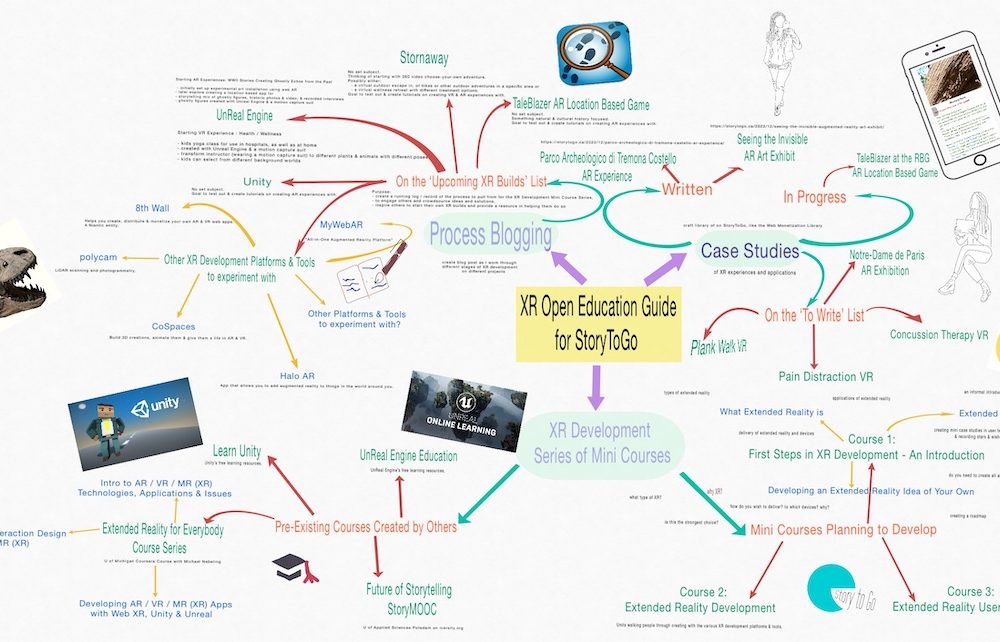
As we step into 2024 and I wrap up my ETEC 580 Directed Studies and Master of Educational Technology, I want to take a moment to conceptualise the Extended Reality Open Education Guide that I have begun to build; to give it shape, intention and create a road map for it, as well to seek feedback from you, our readers, as I continue to further my journey, experiments, and goals in extended reality (XR) beyond my Masters. As I previously wrote in Exploring XR Development with my Final Master of Educational Technology Directed Studies, the work I have done through the MET Program at UBC is a beginning to this work in XR development.

Here’s where I am at present in mapping out where I am going with this work:
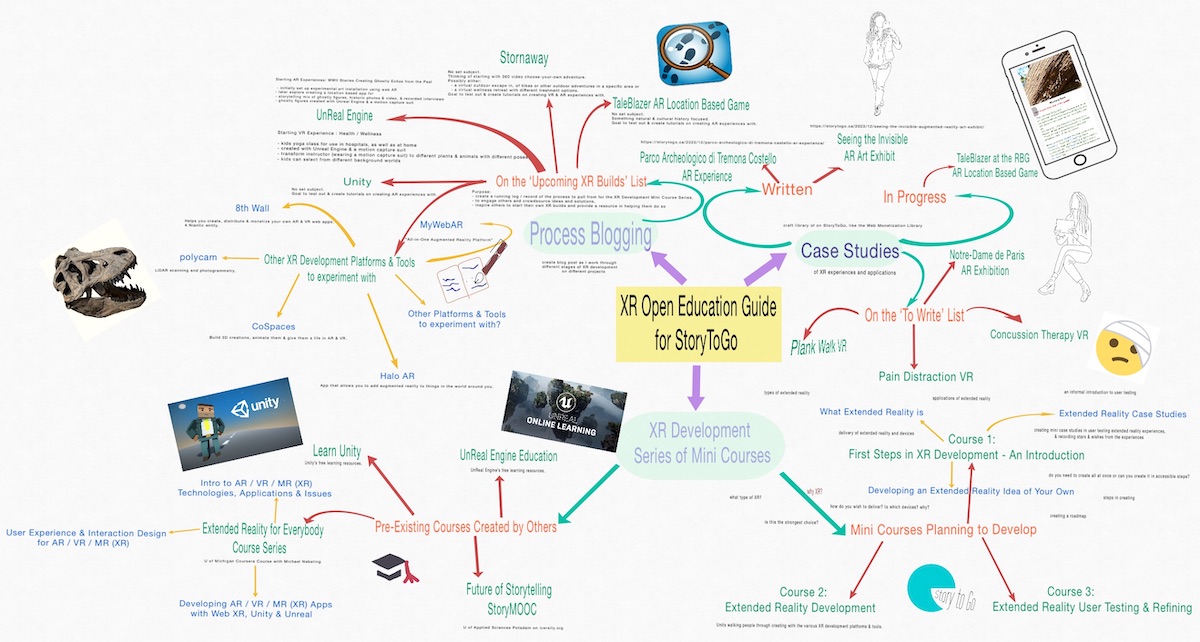
XR Open Education Guide for StoryToGo

As I continue to develop an XR Open Education Guide on StoryToGo, much as I did with the Web Monetization Guide, there are 4 main areas that I will be focusing on, developing, and building upon over time:

  • XR Case Studies
  • XR Development Experiments and Process Blogging
  • XR Development Series of Mini-Courses
  • Addressing Accessibility in Extended Reality

XR Case Studies

The goal of the Extended Reality Case Studies is to explore different extended reality experiences and applications to discover what resonates with myself and my team and to identify the challenges. By writing these up as case studies, the hope is to create a resource for our team in developing extended reality experiences, and to share that resource more broadly with other independent creatives, educators and students wanting to explore extended reality. Secondarily, these XR Case Studies will also be used as resources and examples within the XR Development Series of Mini-Courses.

At present, these XR Case Studies are focused around augmented reality (AR) natural and cultural history experiences and virtual reality (VR) health and wellness experiences, as these are the areas that my team and I are currently developing extended reality projects. Over times, we will broaden these case studies to other areas of interest.
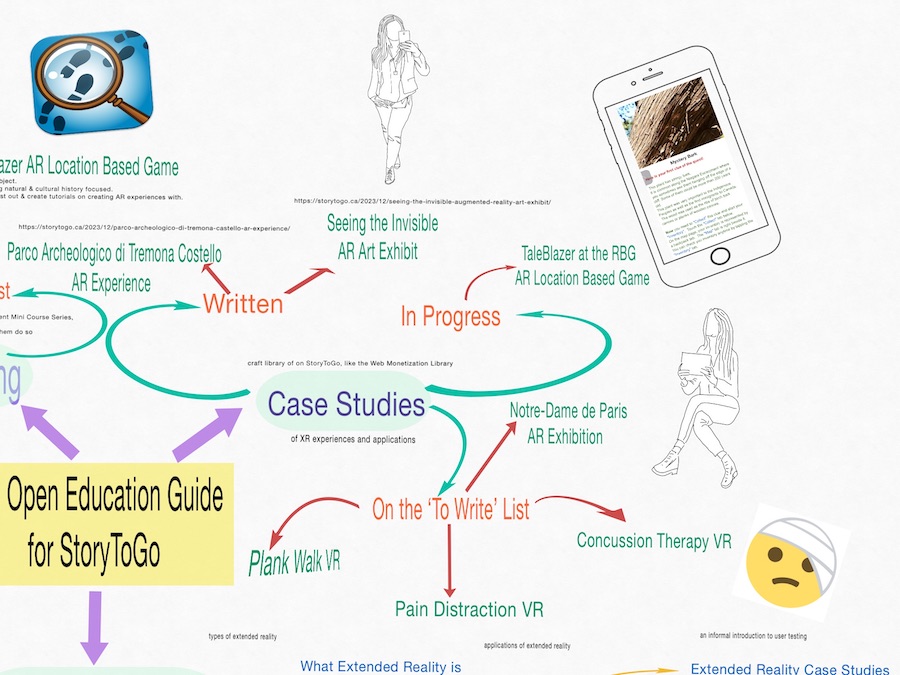
Extended Reality Case Studies

As my team’s and my current priority is on AR natural and cultural history experiences, the current case studies include:

  • Parco Archeologico di Tremona-Castello AR Experience
  • Seeing the Invisible Augmented Reality Art Exhibit

I am also writing up a case study on the TaleBlazer AR Game at the Royal Botanical Garden’s Rose Garden at present.

Other XR Case Studies on the current ‘to write’ list, include:

  • Notre-Dame de Paris, The Augmented Exhibition
  • Plank Walk VR
  • Pain Distraction VR
  • Concussion Therapy VR

As the XR Case Studies grow in number on StoryToGo, we will create an Experiential Reality Library, like the Web Monetized Content Library that we’ve begun to create.

XR Development Experiments and Process Blogging

As an indie creative who likes experimenting with emerging ways of crafting stories, I find it helpful to experiment with the technology for building those stories. That way even if we contract a larger team on our builds, I know what I am talking about and know what is possible. Often as I dive into such experiments, I also learn that building stories in these newer ways with emerging technologies is not so daunting, cost prohibitive, and inaccessible as people think. Thus, as I create and experiment with extended reality development, using different extended reality development tools and platforms, I intend to create process blogs walking people through the ‘how to’ of my experiments creating with different technologies.

The purpose?

  • to create a running log / record of the process to pull from for the XR Development Series of Mini Courses;
  • to engage others around this process, and crowdsource ideas and solutions; and
  • inspire others to experiment with their own XR builds, and provide them with a resource to helping them do so.
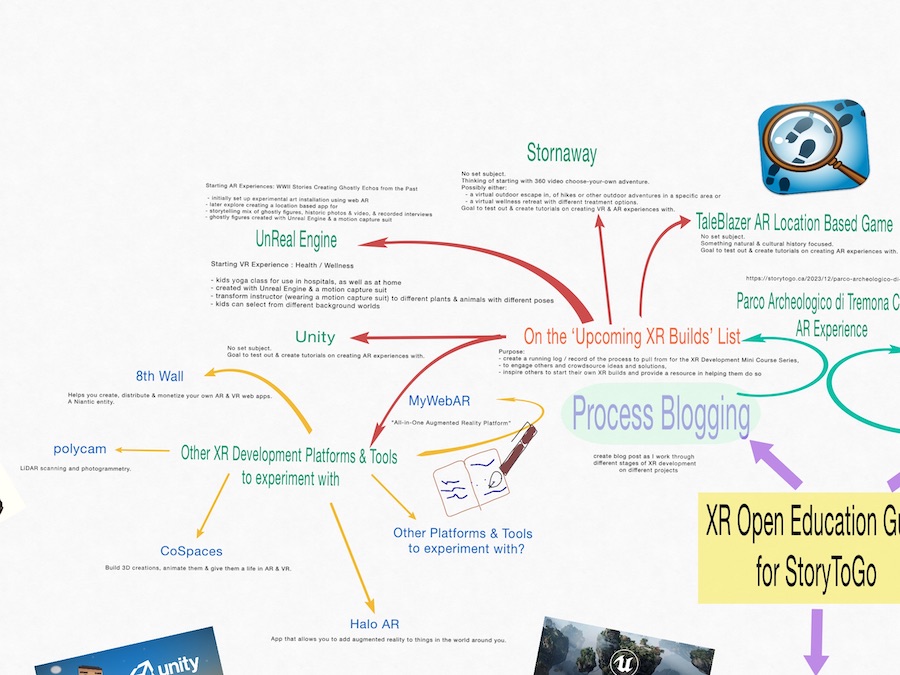
Extended Reality Development Experiments and Process Blogging

Currently my goals for my own projects involve Unreal Engine and motion capture technology. This, however, is not the most accessible entry point for educators and students wanting to begin their own experiments with XR, both in terms of the learning curve and in terms of the expense of the technology needed for. As such, I decided for the purposes of creating a more accessible entry to extended reality for teachers and students, that I want to begin with some more accessible extended reality builds / development ideas, and then build towards the more involved pieces using UnReal Engine and Unity, as part of my long term, on-going work.

What this means, is that my initial AR build will be with TaleBlazer to create some early development options within the open Extended Reality Course that are designed for teachers and students, and then later build Units on developing with UnReal Engine and Unity, as well as other more accessible extended reality development solutions, like Stornaway.io, CoSpaces, Halo AR, polycam, MyWebAR, and 8th Wall. If you have other suggestions of XR development tools and platforms that my team and I should be experimenting with, please let me know about them in the comments on this post.

In terms of the extended reality projects that my team and I have been developing, they include:

  • WWII stories from my friend Manami Calvo (Saito)’s family from their experience as Canadians of Japanese ancestry, living on the West Coast in WWII
    • our plan for this is to create some initial experimental ‘art installations’ using Web AR, that are accessible via smartphones and tablets
    • we plan on creating these utilizing animated ‘ghostly figures’ created with Unreal Engine and a motion capture suit, along with historic photos and video, as well as recorded interviews
    • we will then use those art installations to go after proper funding to further development

  • health / wellness VR Experiences
    • our plan is to start with a kids yoga class in VR that can be used in hospitals, as well as at home
    • create in Unreal Engine with a motion capture suit
    • the yoga will be lead by Lori Yearwood (wearing the motion capture suit) and will involve her transforming to different plants and animals with different poses
    • the children will also be able to select the background world (from a variety of calming choices) for their yoga experience

XR Development Series of Mini-Courses

To make things as easy as possible for other indie creatives, educators and students to begin to explore and develop their own extended reality projects, I intend to take what I have learned through my extended reality research, case studies, experiments and process blogging, and build a series of Extended Reality Mini-Courses for people to use as a guide in creating their own extended reality projects. The goal here being to remove the fear of extended reality being a far reaching, inaccessible goal by building their understanding of extended reality, getting them experimenting with it and envisioning the possibilities, and sharing with them a variety of pathways to creating extended reality, including step-by-step guides.
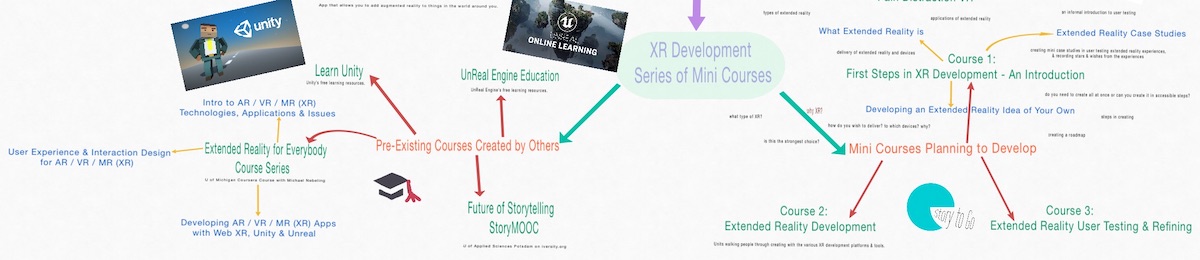
Extended Reality Development Courses

In developing a series of Extended Reality Mini-Courses, I am exploring other Extended Reality Learning Resources to see what is currently available to those wishing to explore extended reality further, so as best to identify a different, unique approach to the subject and include any beneficial resources that are currently missing.

The Extended Reality Learning Resources that I am currently delving into, include:

  • Extended Reality for Everybody Specialization by Michael Nebeling of the University of Michigan on Coursera
  • The Future of Storytelling StoryMOOC by the University of Applied Sciences Potsdam on iversity.org
  • Unity Learn
  • Learn UnReal Engine
Pre-Existing Extended Reality Courses

In approaching the extended reality course development for the StoryToGo Classroom site, I have come to the conclusion that XR development is more manageably approached as a series of mini-courses. Currently, I am thinking in terms of building the following three courses:

  • First Steps in Extended Reality Development – An Introduction
  • Extended Reality Development
  • Extended Reality User Testing and Refining

The talk I gave for the class at the American University in Cairo follows the layout for the first mini-course: 

My current breakdown for ‘First Steps in Extended Reality Development – An Introduction’ will include:

  • What Extended Reality Is
    • types of Extended Reality
    • applications of Extended Reality
    • delivery of Extended Reality and Devices

  • Extended Reality Case Studies
    • an informal introduction to user testing
    • creating mini case studies in user testing extended reality experiences, and recording stars and wishes from the experiences
  • Developing an Extended Reality Idea of Your Own
    • Why XR?
      • what type of XR?
      • is this the strongest choice?
      • how do you wish to deliver? to which devices? why?
    • Do you need to create all at once or can you create it in accessible steps?
    • Steps in creating
    • Creating a roadmap

Then the Extended Reality Development Course will be a continual work in progress, adding different Units, covering how to build XR with different extended reality development solutions, starting with TaleBlazer.
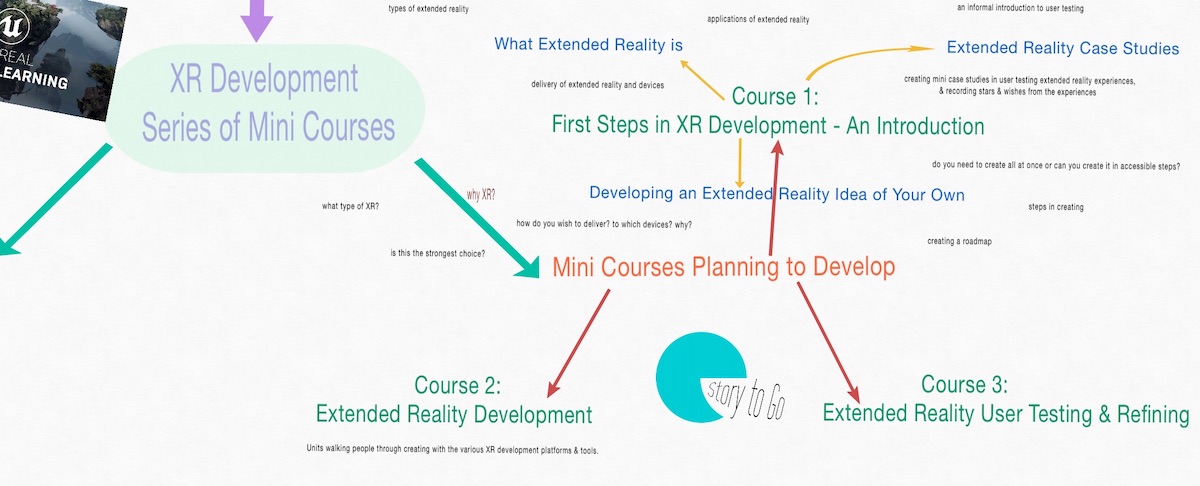
Extended Reality Mini Course to Develop for StoryToGo

If you have suggestions for the structure of or things I should be including in the XR Development Series of Mini-Courses, please share your thoughts in the comments.

Addressing Accessibility in Extended Reality

While not a standalone piece on my brainstorming document, for those of you who have begun to read our XR Case Studies, you may have recognized that accessibility in extended reality is central to my team’s and my explorations and development goals. This is very much driven by various disabilities and health and wellness issues that my team and I have experienced, but is also an aspect of extended reality design and user testing that has not been discussed and addressed as well as it should yet.

For now, my team and I intended to address Accessibility in Extended Reality throughout our case studies, process blogging, and course materials. I also had an invitation to come on as an advisor on accessibility to UBC’s Emerging Media Lab, after I brought accessibility and my perspective on with a few of the students at their Autumn Showcase. This is an invitation I intend to follow up on this year, with the hope that between that and my own team’s process thinking through accessibility in extended reality, as we share extended reality case studies, work on our own extended reality development and process blog on it, and create our Extended Reality Development Series of Mini-Courses, that we also begin to build a standalone piece or pieces that address accessibility in extended reality. Not sure what that will be yet, but if you have suggestions for this, I’d love to hear about them in the comments.


Your Thoughts?

I’d love to hear your thoughts in comments below on the direction I am taking with this Extended Reality Open Education Guide. If you have suggestions for future XR Case Studies, on XR Development Tools and Platforms to try, the structure of or things I should be including in the XR Development Series of Mini-Courses, or ways to further address Accessibility in Extended Reality, please share them in the comments. Thank you!

Also, if anyone wishes to become involved in any of the above endeavours with myself and my team, please reach out and we can chat further.


Thank Yous
Thank You!

The work that I have begun here has been inspired by and is evolving, thanks to:

  • Dr David Vogt for encouraging my dreaming, entrepreneurial thinking, and edtech product design and development;
  • Dr David Porter in exploring open education and searching for sustainable funding pathways for;
  • Saeed Dyanatkar for seeing my potential in dreaming up different pathways for storytelling and education, always making time for me when I had questions, and making me feel welcome and valued whenever I wandered into the Emerging Media Lab;
  • Dr Kyle Stooshnov and Juliana Loh for creating a framework for my first steps into thinking about XR development and experimenting with 360 video;
  • Dr Jennifer Jenson and Dr Suzanne de Castell for fostering my game design thinking;
  • Dr Heidi Janz, Dr Michelle Stack and Dr Paul Hamilton for helping me to process my newer disabilities, frame disabilities and myself as disabled in my storytelling, and begin to understand how to advocate for disability and accessibility in education (and feel empowered to do so, understanding it as a strength, as oppose to something to hide);
  • Yvonne Dawydiak for demonstrating the alternative pathways to navigating UBC, approaching teaching creatively in a hands-on way, and an empathy driven approach and practice;
  • Lori Yearwood for her vision in beginning to create case studies here on StoryToGo to act as resources for our students, workshop participants, clients and partners, and the broader independent creative and education community – for encouraging me to begin to share my disabilities in our storytelling and work, and sharing her own wellness challenges as we began to build our health, wellness and accessibility workshops, resources, and storytelling – and for always being a willing and enthusiastic supporter and co-creator on the ideas that wander through my mind; and
  • Manami Calvo for seeing the potential for sharing her family’s WWII stories in AR, joining me in crafting experiments around, and in trusting me with her family’s stories.

Also an enormous thank you to the Interledger Foundation for helping fund my research and work on Sustainable Funding Solutions for Creatives and Educators, and to CNIE – RCIÉ and BCIT who have helped fund my research and coursework throughout my Masters.

Thank you all, for all your help, support, direction and inspiration!
Filed Under: #StoryToGo, Accessibility, Case Studies, Courses, EdTech, Erica Hargreave, Extended Reality, Immersive and Interactive Media, Storytellers, XR Tagged With: Extended Reality, XR, XR Development

Seeing the Invisible Augmented Reality Art Exhibit – an Extended Reality Case Study

December 27, 2023 by Erica Hargreave 4 Comments

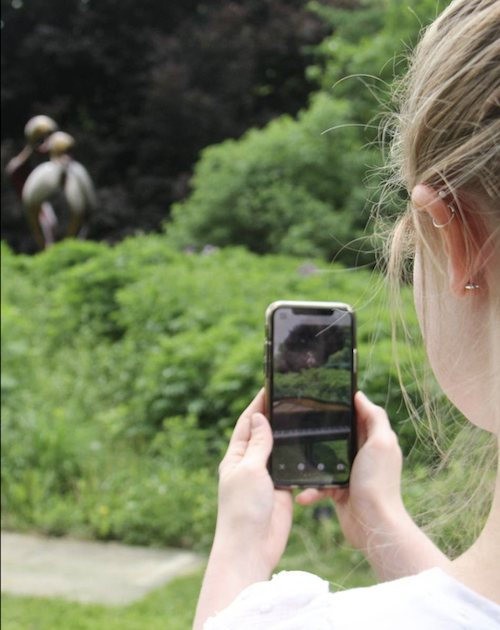
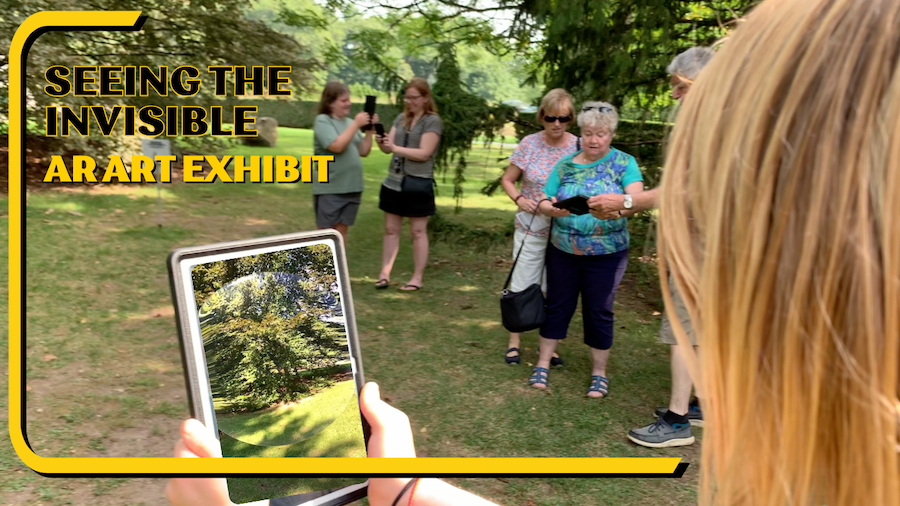
Garden visitors taking in the Seeing the Invisible AR Art Exhibit.

In this second case study in our series exploring extended reality (XR), we examine the Seeing the Invisible Augmented Reality (AR) Art Exhibit, as exhibited by the Royal Botanical Gardens. This AR art exhibition featuring the art of 13 artists from around the world was initiated by the Jerusalem Botanical Gardens and displayed concurrently at 12 Botanical Gardens worldwide.


Project:

Seeing the Invisible Augmented Reality Art Exhibit

Initiated By:

Jerusalem Botanical Gardens in partnership with Outset Contemporary Art Fund, with the support of the Jerusalem Foundation

Curated By:

Hadas Maor and Tal Michael Haring

Host At:

Royal Botanical Gardens (RBG)

Type of Experience:

Augmented Reality (AR) Outdoor Art Exhibition

Device for Experiencing:

Smartphone or Tablet, preferably with headphones

Link to Project:

https://seeingtheinvisible.art/

Date Partook in the Experience:

September 18, 2022

Country of Origin:

Israel

Country Where I Experienced:

Canada


Reflections On My Experience


Interview Between Tucson Botanical Gardens Executive Director Michelle Conklin & Seeing The Invisible Curators Hadas Maor & Tal Michael Haring


The Project:

In 2021, as the world continued to face the pandemic and many art galleries were closed to the public, an idea was fostered out of the Jerusalem Botanical Gardens to host an outdoor art exhibit, but not in the usual sort of way. Rather an invisible art exhibit, at least to the naked eye, and one that was concurrently displayed in 12 gardens worldwide with the same pieces of original art. “How?”, you ask. With augment reality (AR), creating the first such multi-location, simultaneous art exhibition of its kind with a number of artists, many of whom were new to AR, creating their first pieces in augmented reality.

Some of the goals of this exhibition were to:

  • give visitors something new to enjoy in gardens at times of year when plants may not be blooming
  • complement the natural setting with the AR art, encouraging visitors to experience it in a new way
  • give people a way to enjoy art in a shared, yet outdoor setting
  • encourage visitors to the gardens to engage with the gardens and with the art
  • collaborate with other gardens worldwide
  • create an exhibition without disturbing the gardens themselves, and keeping the carbon footprint to a minimum

The art exhibition was also designed to address shared themes of “nature, environment, and sustainability, exploring the boundaries and connections between art, technology, and nature. Both bleak and hopeful, each artwork offering a unique perspective on unresolved issues, creating thought-provoking, experiential, and contemplative spaces for viewers to immerse in.”

View this post on Instagram

A post shared by @seeing.the.invisible

The artwork and artists crafting this narrative included:

  • Gilded Cage AR (2021) by Ai Weiwei
  • Water Serpent (2021) by Jakob Kudsk Steensen
  • Dawn Chorus (2021) by Sarah Meyohas
  • Biome Gateway (2021) by Timur Si-Qin
  • Stones Against Diamonds (Ice Cave) AR (2015 / 2021) by Isaac Julien
  • Forget Me Not (2021) by Ori Gersht
  • Machine Hallucinations: Nature Dreams AR (2021) by Refik Anadol
  • AG + BA [AR] (2014 / 2021) by El Anatsui
  • Anamazon [Limb] (2021) by Pamela Rosenkranz
  • Morphecore Prototype AR (2021) by Daito Manabe
  • Directions Zero (2010 / 2021) by Mohammed Kazem
  • Pneuma (2021) by Mel O’Callaghan
  • Salt Stalagmite #1 [Three Bridges] (2021) by Sigalit Landau
  • Nea Zoi (2022) by Loukia Alavanou

Despite the art exhibition taking place concurrently in a number of different gardens, the experience is different in each garden, as the works are augmenting the unique surroundings and context of each garden.

Why Augmented Reality?

Building and purchasing sculptures and other art installations is a pretty major undertaking for a botanical gardens, and a travelling exhibition can generally only visit one garden at a time. While not without a cost, by making this art exhibition simultaneously available in a number of botanical gardens, this makes the cost of such an art exhibition less prohibitive. The fact that this art exhibition is accessible through augmented reality via digital devices, makes it possible to ‘install the pieces’ temporarily in multiple gardens at the same time.

View this post on Instagram

A post shared by @seeing.the.invisible

The initial launch of this AR art exhibition during the pandemic was well timed to offer an alternative outdoor way to enjoy art, outside the enclosed space of an art gallery, and further encouraged visitors to think about botanical gardens as arts spaces, as well as nature spaces.

The curators of Seeing the Invisible talk about the importance of this AR art exhibition being phygital, a blending of a digital experience with a physical one. Thought was put into where each artwork was placed in each garden to enhance both the artwork and the garden, as well as take visitor safety and the protection of the planted exhibitions into consideration. The AR artwork, through the Seeing the Invisible app, was geotagged to specific locations in the gardens they were exhibited in, and visitors could only experience the artwork in that location, and only in those gardens. Thanks to the phygital, the experience was unique in each garden.

The Augmented Reality Experience

The Seeing the Invisible artwork is experienced at the gardens hosting this AR art exhibition through visitors’ smartphones and tablets via a GPS triggered app.

Viewing AR art, Dawn Chorus, through a smartphone.

To see and experience these dynamic and engaging pieces of artwork, people visiting the gardens hosting this AR art exhibition need to:

  • Before visiting a Gardens hosting the AR art exhibition:
    • Download the Seeing the Invisible App to the smartphone or tablet with cellular capabilities that they will be using at the AR art exhibition.
    • Allow the app access to device’s camera and microphone.
    • Fully charge the device before visiting the gardens.
    • Take earbuds or headphones compatible with the device to the gardens with you.
  • At a Gardens hosting the AR art exhibition:
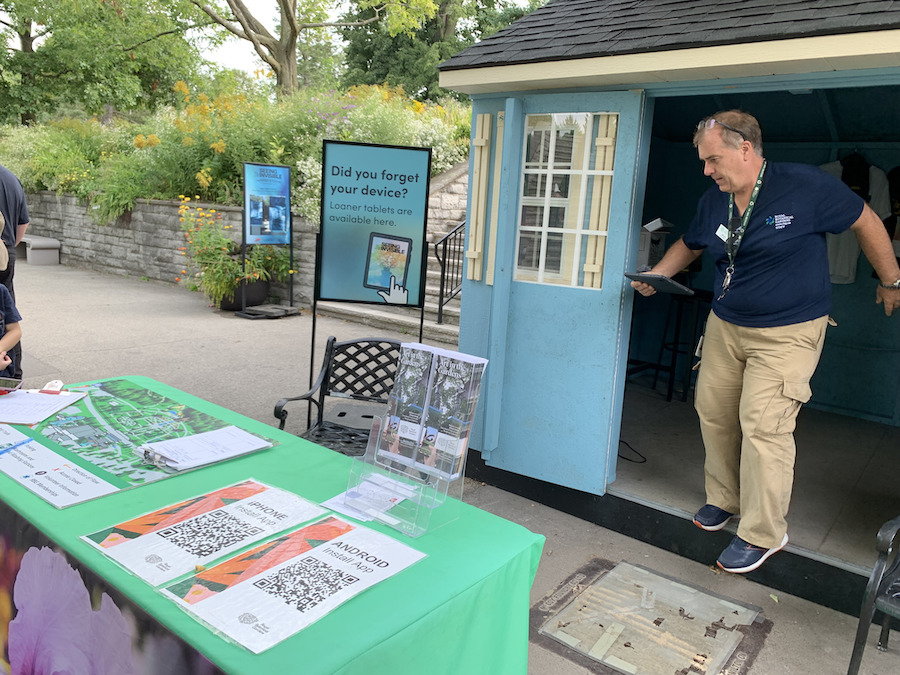
    • If you don’t have a smartphone or tablet, you can borrow one on site.
    • Follow the map in the app to the different pieces of AR art within the gardens.
    • Follow the Seeing the Invisible App’s instructions at each piece of AR art, scanning the ground where the piece of art has been virtually installed until the art virtually appears.

The Royal Botanical Gardens shares further tips on enjoying Seeing the Invisible Art Exhibition in their gardens, here.

Once the art virtually appears before you, visitors are encouraged to engage with it and fully immerse themselves in it, by listening through their headphones to the experience, and walking around the artwork and even into it. Visitors can also take pictures with the virtual art and read more about the art through the app.

Each piece of art, lends to different forms of engagement. For instance with:

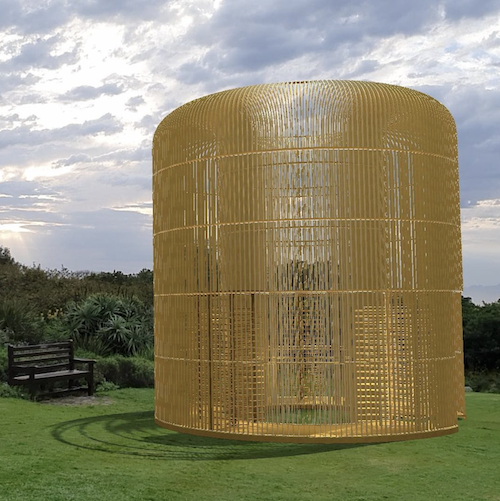
  • Gilded Cage: You can walk into the labyrinth of cells.
View this post on Instagram

A post shared by Royal Botanical Gardens (@rbgcanada)

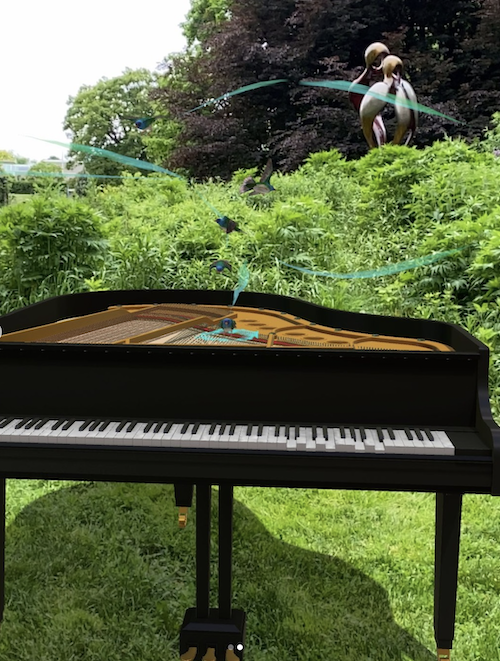
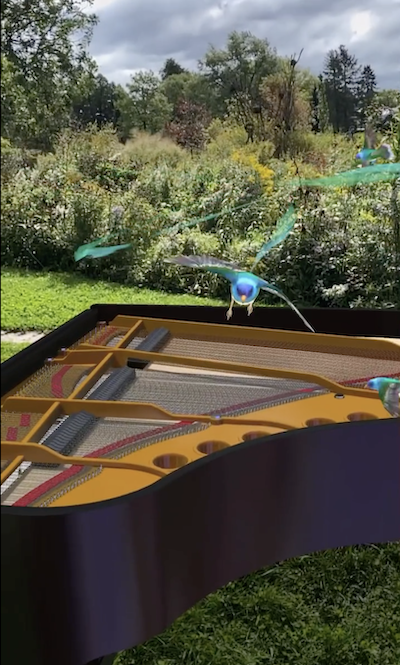
  • Dawn Chorus: Birds swoop around you as you are drawn in by the music from the piano.
View this post on Instagram

A post shared by @seeing.the.invisible

  • Biome Gateway: You can walk into the temple cave, and discover a portal to walk through and into a parallel landscape.
View this post on Instagram

A post shared by @seeing.the.invisible

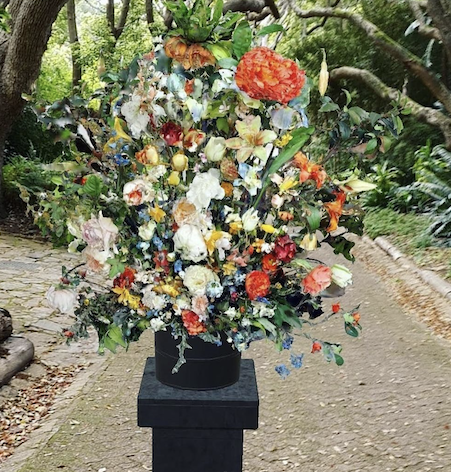
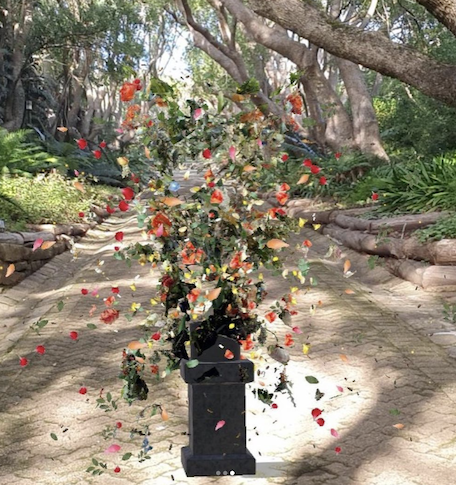
  • Forget Me Not: By moving toward the flower arrangement, you trigger a gun to propel a bullet through the flower arrangement causing it to explode outwards. Once the explosion has occurred, if you walk around the vase, you will hear three different scholars discussing the flower arrangement.
View this post on Instagram

A post shared by Royal Botanical Gardens (@rbgcanada)

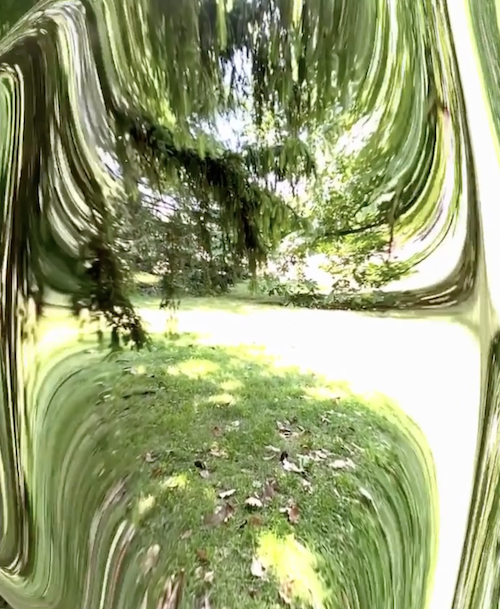
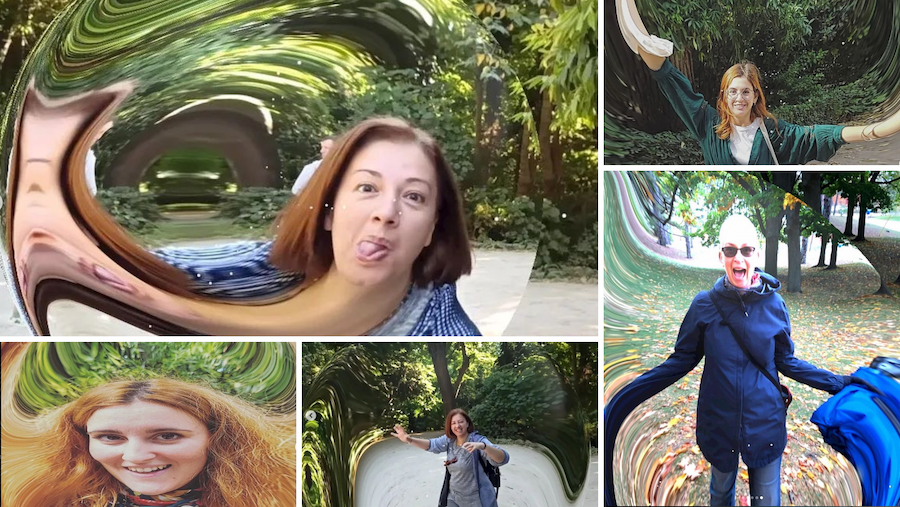
  • Pneuma: By walking into the sphere, you see the gardens around you through the distortion of being inside a bubble, while the sound of breathing acts to change your own breathing pattern while experiencing.
View this post on Instagram

A post shared by @seeing.the.invisible

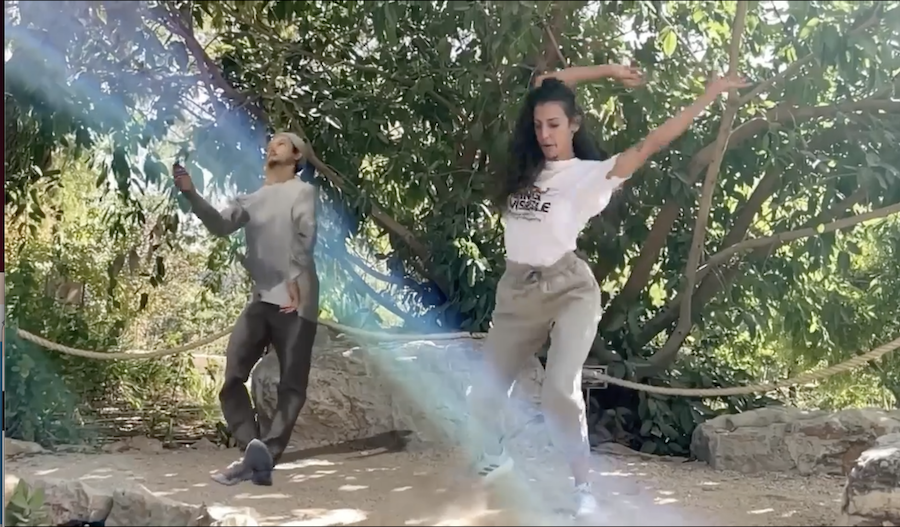
Morphecore Prototype AR even inspired a dancer to choreograph their own piece to dance along with. Other host Gardens similarly witnessed many of their visitors dancing along with the Morphecore Prototype.


My Reflections on this Augmented Reality Experience

One of my goals in exploring different extended reality experiences is to discover what excites me in these experiences and what I find challenging, in order to reflect on what could create even richer and more accessible extended reality experiences.

Here are my thoughts on the Seeing the Invisible AR Art Exhibition, from when I visited it in September of 2022 at the Royal Botanical Gardens.

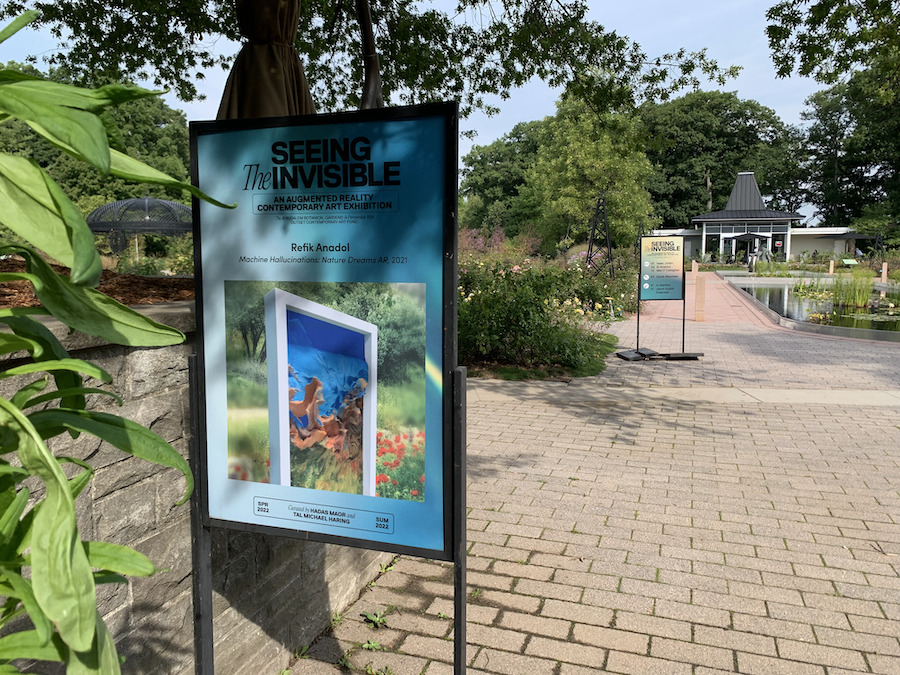
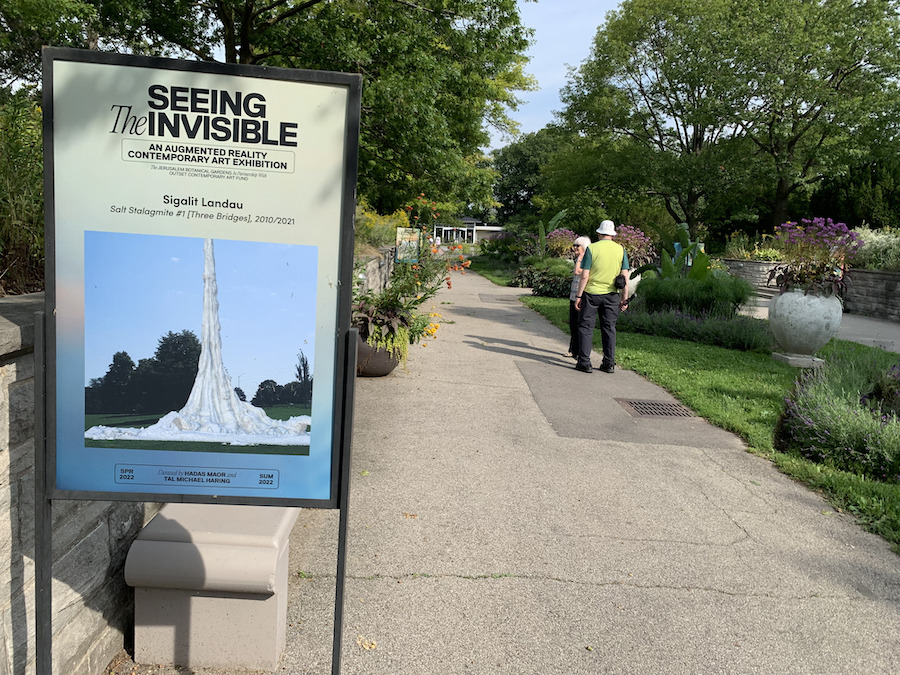
Signs welcoming visitors to the Seeing the Invisible AR Art Exhibition at the Royal Botanical Gardens.

The Extended Reality Magic

This is a clever idea to get visitors exploring the gardens through a new lens, allowing the augmented reality art to spark their imagination in a new way, to perceive the gardens differently, and to provoke thought pertaining to nature, technology and art.

Some art, like Dawn Chorus, brought pure joy of the fantastically, magical whimsy that augmented reality brings with it, further adding beauty to the surrounding gardens.

AR birds flying around an augmented reality piano in a real world garden.
AR birds flying around an augmented reality piano, care of Dawn Chorus, in a real world garden.

Other art, like Pneuma, made you feel as though you’d stepped out of reality and were peering back in at it.

AR Art looking back at the gardens through the distortion of the augmented reality bubble created by Mel O’Callaghan's Pneuma.
Looking back at the gardens through the distortion of the augmented reality bubble created by Mel O’Callaghan’s Pneuma.

While other art, like Gilded Cage, got you questioning our problematically omnipotent and controlling relationship with nature from the perspective on an artist who was imprisoned.

AR art, Ai Weiwei's golden Gilded Cage, casting augmented reality shadows, by a park bench in a real world garden.
AR art of Ai Weiwei’s golden Gilded Cage, casting augmented reality shadows by a park bench in a real world garden.

Best of all, the gardens discovered that people of all ages wanted to engage with the art, even dancing along to Daito Manabe’s Morphecore Prototype AR.

A real world dancer at Jerusalem Botanical Gardens dancing alongside Daito Manabe's Morphecore Prototype AR.
A real world dancer at Jerusalem Botanical Gardens dancing alongside Daito Manabe’s Morphecore Prototype AR.

Logistically the GPS triggered app is a good idea to create a curated experience within each garden, and to host this simultaneously between different gardens.

Adding in the ability for visitors to be able to photograph the AR art through the app, added in the ability for visitors to have fun engaging with the art. This also added to crowdsourced storytelling around the exhibit, which I can only imagine was beneficial to marketing the exhibition.

Visitors at a number of gardens playing with Pneuma selfies.

I’d love to experience future such AR art exhibitions at the Royal Botanical Garden, as well as to experience the Seeing the Invisible Art Exhibition in different gardens to see how the experience differs between the gardens with the same art.

Current Challenges (as of 2022 Experience)

Excited to experience the Seeing the Invisible Art Exhibition at the Royal Botanical Gardens in Burlington, Ontario, my niece and I followed the instructions and downloaded the Seeing the Invisible App to our smartphones before heading to Hendrie Park to enjoy the exhibit together.

Seeing the Invisible at the Royal Botanical Garden's Hendrie Park.

The only problem, when we got there, the Seeing the Invisible App didn’t work on either of our smartphones, despite both having compatible technology. Not sure if this is the reason why, but one woman told us the issue was due to the strength of the wifi signal from your data provider.

No problem, we queued to borrow one of tablets that the gardens had available for visitors that needed it.

Borrowing a loaner tablet at the Royal Botanical Gardens.

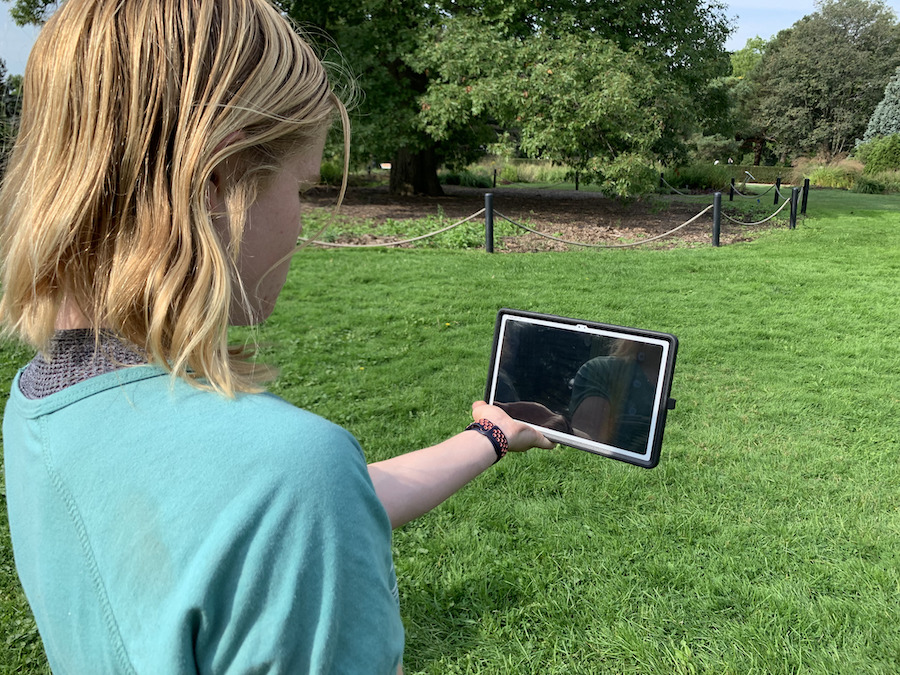
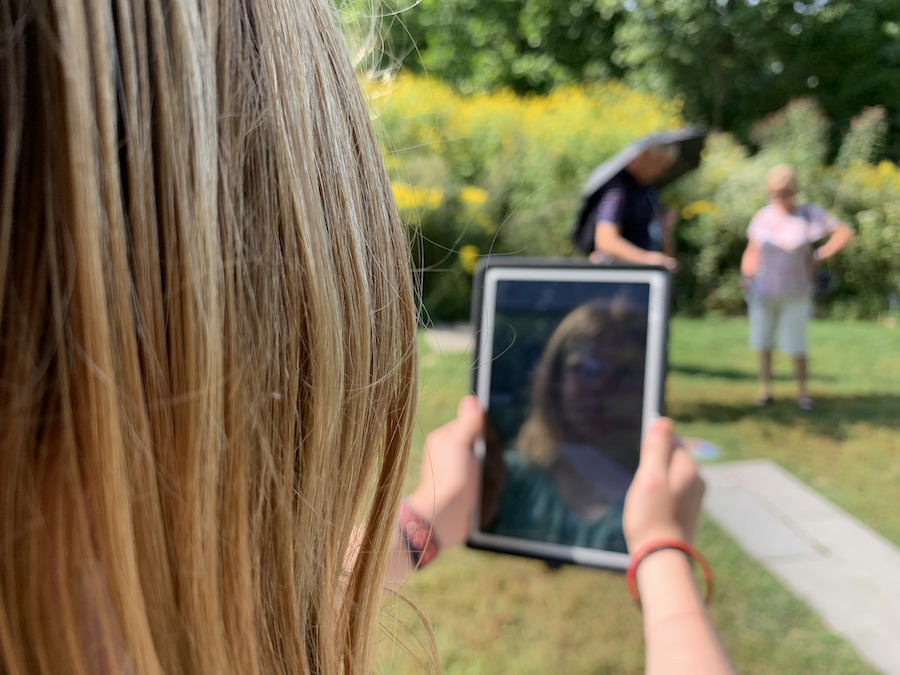
While the borrowed tablet worked, this now meant that we were now sharing a device, our headphones didn’t work in the borrowed device, and the borrowed tablet had a screen protector over it, that made the AR more difficult to see, especially in sunny areas. Added to this, almost every piece of AR art was placed in a sunny area, and it was hot, so not only were we battling with the light to see the AR art through the screen, but needed shade for respite for the sun.

I assumed that this user experience oversight was down to this being the Royal Botanical Garden’s first AR Exhibition and them not being familiar enough with the technology to understand how to create a positive user experience, but it turns out it was actually the curators that mapped out where each piece would be placed. Maybe the oversight of the sun was made, as due to the pandemic, the curators did not visit Hendrie Park before deciding where to place the AR art, but either which way, this emphasizes the importance of taking the user experience into consideration when designing AR exhibitions. Shade is important, both for the visitors’ physical comfort and for the practicality of visitors actually being able to properly see and experience the AR art work through their screens. With the size of the Royal Botanical Gardens there is more than enough options to place these 13 pieces of artwork in a way that keeps visitors out of the full sun and allows them to better see and experience the AR art on their screens.

Girl holding a tablet, demonstrating the difficulty seeing the AR art in the sun.

While certainly the audio experience would have been much better had we been able to use our headphones, as people do experience exhibits like this on a shared device, I think it would be beneficial for the audio portion of the experience to be added at a higher volume to better allow for visitors sharing a device to be able to hear the experience.

I appreciated that the artist shared a write up on their art within the app, but to spend time reading this, it takes you away from viewing and experiencing the AR art. It would be great, if visitors have the additional option to play an audio recording of the artist sharing their thoughts with visitors on the piece of art.

Finally, with the loaned tablets, it would be beneficial if the individual gardens made it possible for visitors to email themselves the copies of any photos they shot with the AR art.

Takeaways From This Extended Reality Experience

When easily visible and heard, the Seeing the Invisible Art Exhibition creates a glimpse into a hidden world that encourages thought and exploration through a new lens and perspective. Thats exciting, and demonstrated what excites me about sharing stories with augmented reality.

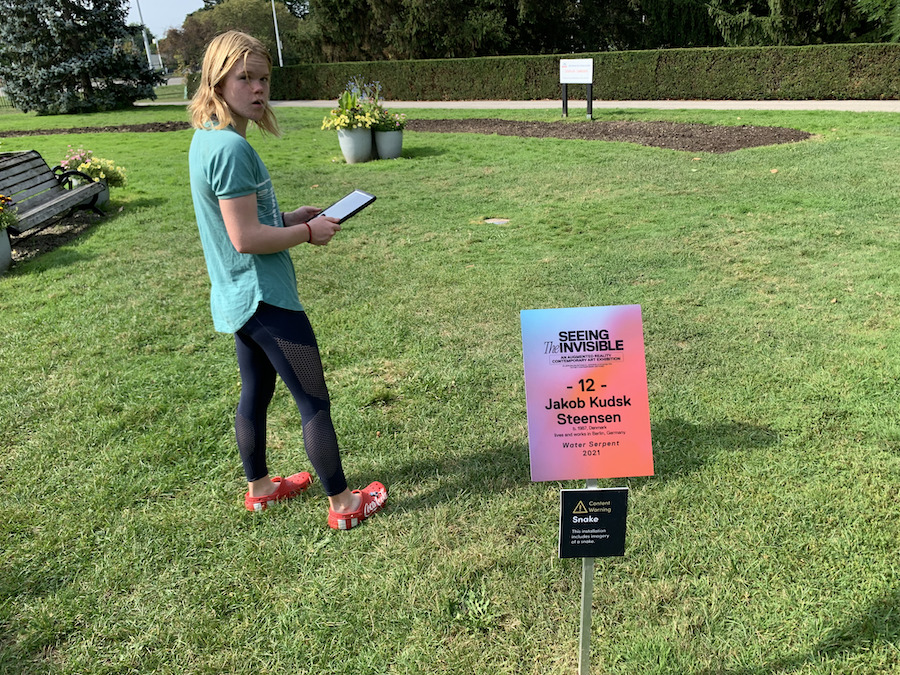
However, if the app isn’t working on people’s devices or the AR is difficult to see on people’s screens, then people become frustrated, rather than excited by the experience. This is why user design and testing is so very important. This should be thought of both in terms of the technology and visitors’ interactions with the physical environment in which they are experiencing the AR art. In the case of the RBG, the gardens and not trampling plants seems to have been taken into considerations, but not visitors’ physical comfort from the sun or thought of how that sun would impact user’s experience. This art exhibition was almost in its entirety in direct sun with no to very little shade.

A girl in another full sun AR art exhibit spot at the Royal Botanical Gardens.

User testing should be inclusive of the loaner tablets for visitor use, made available onsite. This means, if adding protective screen covers to the tablets, making sure those protective screen covers do not hinder visitors’ ability to enjoy the AR art.

It would also be advantageous to allow people using the borrowed tablets to be able to email themselves any pictures they took with the AR art, or if that is not possible, to be upfront with visitors about that from the start, so as not to leave them disappointed at the end of the experience.

Summary of Takeaways:

  • The technology exists to create a GPS triggered augmented reality app that works on people’s devices without overloading a device’s data.
  • The Seeing the Invisible AR App takes up 2.1 GB of space on my smartphone.
  • The Seeing the Invisible AR App was developed by Khora ApS, a virtual reality and augmented reality production studio in Copenhagen.
  • When the AR app is working, the augmented reality art exhibition creates wonder for visitors, gets visitors exploring and interacting in a new way, and has visitors engaging with the AR art.
  • By making the AR art exhibition viewable through smartphones and tablets (with loaner tablets available for use), it is accessible to all ages and most abilities.
  • User testing is important on the site of the experience, thinking about user comfort at different times of year.
  • Avoid creating GPS triggered AR screen experiences in direct sun.
  • Make sure protective screen covers on loaner tablet do not limit the ability to see the augmented reality.
  • Think about user safety and comfort when placing GPS triggered AR experiences.
  • Encourage visitors to bring headphones, while ensuring sound is available at a volume that those without headphones or sharing a device can hear.
  • People enjoy interacting with AR art.
  • Make sure people can email themselves any pictures they took with the AR art on loaned tablets.

Future Building

In reflecting upon the Seeing the Invisible AR Art Exhibition, in addition to placing the augmented reality art in spaces that people can enjoy the art in the shade and to be better able to hear the accompanying sounds when experiencing through a shared device, I’d also love to further encourage the engagement that people enjoyed with the art. Some possible ideas for that:

  • I’ve recently seen how the Relive App makes it easy to create videos from a walk by recording the map and editing in the photos and videos you take at different stops. Should this be possible within this AR app, it could create fun keepsakes from the AR experience, that also become valuable crowdsourced storytelling for the exhibit. An example from the travels of a fellow member of Vancouver’s tech community:
View this post on Instagram

A post shared by Shane Gibson (@shanegibson)

  • It would be great to be able to play the artist’s description of their work as an audio reading, complete with some prompts to encourage people to engage with their art in different ways.
  • I loved how Ori Gersht’s Forget Me Not was responsive to visitor’s movements, it would be exciting to have more pieces that respond to the location of the holder of a device.
Ori Gersht's Forget Me Not AR art flower arrangement.
Exploding vase of flowers, as a part of Ori Gersht's Forget Me Not responsive AR art.

The educator in me has also begun to design, in my head, a scavenger hunt that encourages visitors to collect experiences and different perspectives with each piece of art by encouraging visitors to take on some sort of challenge or unravel some sort of mystery with each piece of art. Being able to create a mapped storytelling account of such a scavenger hunt, in a format like the Relive App creates, would be a great way to further share the discoveries from such a scavenger hunt.

The storyteller in me would also love to learn more about the making of the art, like with this talk on Ori Gersht’s and Timur Si-Qin’s AR art pieces.


What’s Your Take on this Augmented Reality Experience?

I’d love to hear your thoughts in comments below on what you think would make this a richer and more accessible AR experience, and if you have technical solutions for making this a more immersive and user friendly experience.

One visitor using an umbrella to improve his AR art experience at the Seeing the Invisible Art Exhibition at the RBG, with all the sun.
One visitor using a black umbrella to improve his AR art experience in the sun.

References

Conklin, M., [Tucson Botanical Gardens], Maor, H., & Haring, T. (2022, December 1). A Talk with the Curators of Seeing The Invisible [Video]. YouTube. https://www.youtube.com/watch?v=1BXqc0g8D_c

Horwitz, L. (2023, June 12). phygital. Customer Experience. https://www.techtarget.com/searchcustomerexperience/definition/phygital

Jerusalem Botanical Garden. (2021, November 14). אחת העבודות בתערוכת האמנות, תפתיע אתכם במיוחד. . .. Jerusalem Botanical Garden’s Facebook Page. https://www.facebook.com/Jerusalem.Botanical.Gardens/videos/372403381331281

Rendell, H., Gertler, C., Katri, M., Maor, H., & Haring, T. (2021). SEEING THE INVISIBLE. SEEING THE INVISIBLE. https://seeingtheinvisible.art/

Royal Botanic Garden Edinburgh, Maor, H., Gersht, O., & Si-Qin, T. (2022, May 24). Seeing the Invisible  In Conversation with the Artists [Video]. YouTube. https://www.youtube.com/watch?v=3_XD4nmV-58

Royal Botanical Gardens. (2023, March 8). Seeing the Invisible – Royal Botanical Gardens. https://www.rbg.ca/things-to-do/art-in-the-gardens/seeing-the-invisible

Shamir, R., [America-Israel Friendship League], Gertler, C., Rendell, H., Maor, H., Haring, T., Rominiecki, J., & Firestone, W. (2021, November 8). Seeing the Invisible: Augmented Reality art [Video]. YouTube. https://www.youtube.com/watch?v=TIuxE1oZKtY

Filed Under: #StoryToGo, Art Therapy, Case Studies, EdTech, Erica Hargreave, Extended Reality, Immersive and Interactive Media, Storytellers, XR Tagged With: AR, art, augmented reality, Extended Reality, XR

Parco Archeologico di Tremona-Castello AR Experience – an Extended Reality Case Study

December 16, 2023 by Erica Hargreave 8 Comments

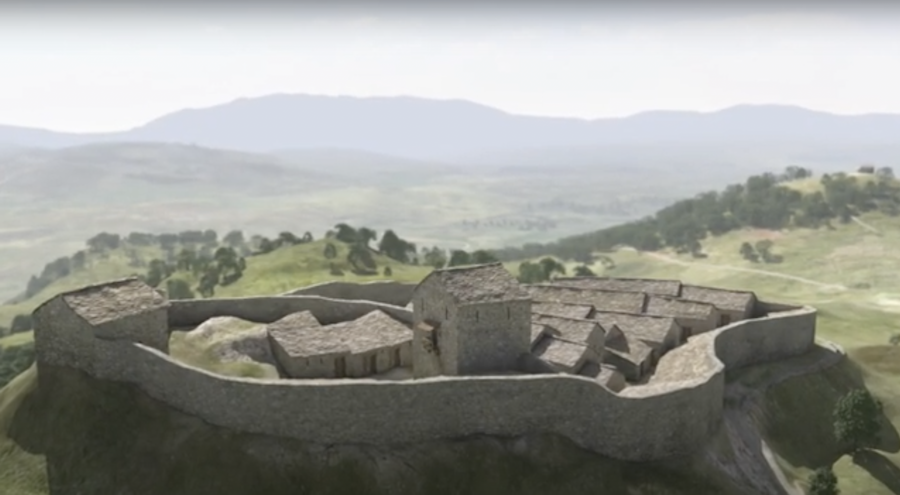
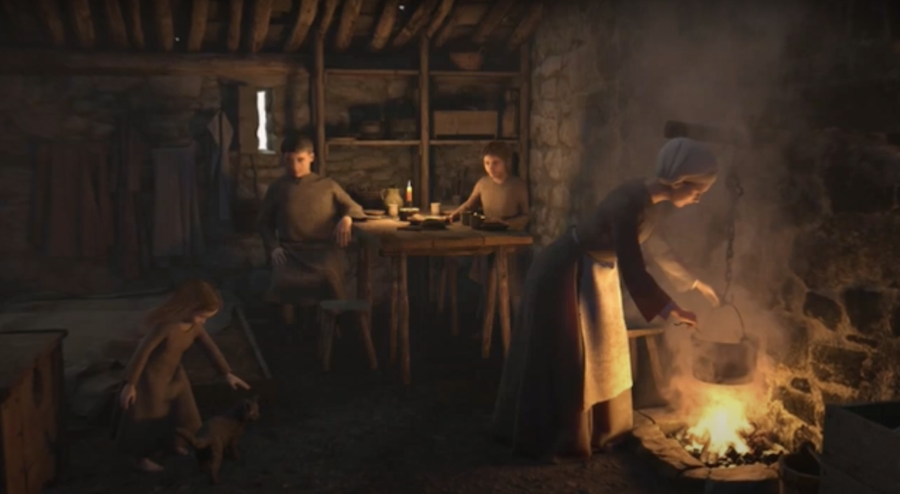
The Medieval Village that once stood at Parco Archeologico di Tremona-Castello, as depicted by Elia Marcacci.

Welcome to our new series exploring extended reality case studies, in a quest to develop richer and more accessible Extended Reality (XR) experiences. In this first case study, we delve into Parco Archeologico di Tremona-Castello’s (Tremona Castello Archaeological Park) Augmented Reality (AR) Experience and speak with Nadia Lupi, one of the visionaries behind the project.


Organization: 

Parco Archeologico di Tremona-Castello (Tremona Castello Archaeological Park)

Project:

Parco Archeologico di Tremona-Castello AR Experience

Type of Experience:

Augmented Reality Walking Tour

Device for Experiencing:

Augmented Reality Glasses paired with a guided audio tour

Link to Project:

https://www.parco-archeologico.ch/en/visita/la-realta-virtuale.html

Interview / Partook in the Experience Date:

April 30, 2019

Interview With:

Nadia Lupi, Director of Mendrisiotto Turismo

Country:

Switzerland


Delving Into the Tremona Castello Archaeological Park AR Experience & an Interview with Nadia Lupi


The Project : Parco Archeologico di Tremona-Castello AR Experience

Parco Archeologico di Tremona-Castello

Sitting on top of the hillside over looking the village of Tremona in the Mendrisiotto District of the Canton of Ticino, Switzerland, local archaeologist Alfio Martinelli, discovered the archaeological remains of an ancient medieval village sharing a history of the area for 6,000 years from prehistory to the 14th century. As Alfio and other archaeologists and volunteers began to uncover this village, many questions arose as they began the puzzle together the stories from the past. Among the curiosities of Parco Archeologico di Tremona-Castello are why they chose to build there, with no apparent water source on site.

Who lived here? How did they spend their daily lives? Why did they suddenly abandon this village in the 14th century? These are all questions that Alfio, fellow archaeologists, and volunteers excavating Parco Archeologico di Tremona-Castello have been asking, as they piece together pictures and stories of daily life in this ancient village when it was thriving.

It is believed that this rural village was inhabited by artisans and farmers from dark ages until the 14th century, who travelled widely and traded their goods. The people there made widespread use of money and owned beautifully handcrafted ornamental items. The site was likely established for the village due to its strategic position, which allowed its inhabitants to control the communication routes from Como and Varese to Riva San Vitale, Monte Ceneri and the central Alps. Excavations have brought to light a labyrinthine and well-fortified settlement that offered its inhabitants refuge from Barbarian invasions and the skirmishes between Como and Milan.

Why Augmented Reality?

These are stories that Alfio and others excavating the site wanted to share, along with Mendrisiotto Turismo. Initially Alfio and Nadia Lupi, the Director of Mendrisiotto Turismo, envisioned turning Parco Archeologico di Tremona-Castello into a open air, living history museum.

They did not get approval for an open air, living history museum, however, so had to think of alternative ways of helping others to envision life in Parco Archeologico di Tremona-Castello in medieval times. Thanks to 3D Artist and Animator Elia Marcacci volunteering on the excavation of Parco Archeologico di Tremona-Castello, Alfio and Nadia got the idea to have Elia create 3D animations of life in Parco Archeologico di Tremona-Castello in medieval times, which gave them the idea to create an augmented reality experience that would allow visitors to Parco Archeologico di Tremona-Castello to envision the site in medieval times, while still seeing the present day excavation.

The Augmented Reality Experience

In creating this augmented reality experience, Alfio, Nadia and Elia worked with the University of Applied Sciences and Arts of Southern Switzerland (SUPSI) to help shape and technically guide this experience.

They wanted to create an experience that would allow visitors to envision and experience life in the ancient village, while still seeing the excavated foundations of the ancient walls on the site today.

Initially Nadia had imagined this being experienced in AR through a smartphone or a tablet, with ghostly walls of the village and ghostly figures of villagers wandering about around you, going about their daily work and life.

While they do not have that experience yet, they do have an 10 detailed 3D scenes into the past, beautifully illustrated by Elia, including places where you can visualise the ancient village all around you.

The Medieval Village that once stood at Parco Archeologico di Tremona-Castello, as depicted by Elia Marcacci.

Bordering on Italy there was concern that if this experience were made accessible through smartphones and tablets, then visitors would run into issues with their devices accidentally switching to Italian telecommunication networks and resulting in additional charges. Thus the AR storytelling was created to be experienced through AR glasses instead.

To make this a richer experience, sharing audio storytelling about the ancient village and Parco Archeologico di Tremona-Castello, the AR glasses were paired with an audio guide that both shares stories on the 10-minute hike from the visitors centre to Parco Archeologico di Tremona-Castello and within Parco Archeologico di Tremona-Castello.

Due to the AR glasses and the audio guide, visitors can only partake in this experience when the visitor’s centre is open. You can get the address and hours of the visitor’s centre by clicking the button below, as well as details on renting the AR glasses and the audio guide.

Plan for an AR Walk through Parco Archeologico di Tremona-Castello

My Reflections on this Augmented Reality Experience

Part of my goal in exploring different extended reality experiences is to discover what excites me in these experiences and what I find challenging, in order to reflect on what could create even richer and more accessible extended reality experiences.

Here are my thoughts on Parco Archeologico di Tremona-Castello’s AR experience, from when I visited it in 2019.

The Extended Reality Magic

The concept video for Parco Archeologico di Tremona-Castello’s AR experience that Elia, Alfio and Nadia designed is beautiful and would make for an incredible experience for visitors, immersing them in two times / worlds simultaneously through ghostly echos from the past.

Elia’s 3D imagery is also well researched, well thought out, beautifully illustrated, and depicts incredible detail.

A household scene, as depicted by Elia Marcacci, in in the Medieval Village once at Parco Archeologico di Tremona-Castello.

Based on memory, the audio storytelling was also well done, to transport visitors through time and help them to better imagine life in the ancient village at Parco Archeologico di Tremona-Castello.

Current Challenges (as of 2019 Experience)

As Nadia mentioned, the Parco Archeologico di Tremona-Castello’s AR experience is not yet as she envisioned it in their concept video. In 2019, rather than seeing an active ghostly village around you, you can visit a number of 3D graphic illustrations of life in the village that are generally static, aside from minor movement, like a wisp of smoke. While these 3D illustrations are well done, when you are expecting to walk into an active ghostly village, this is disappointing.

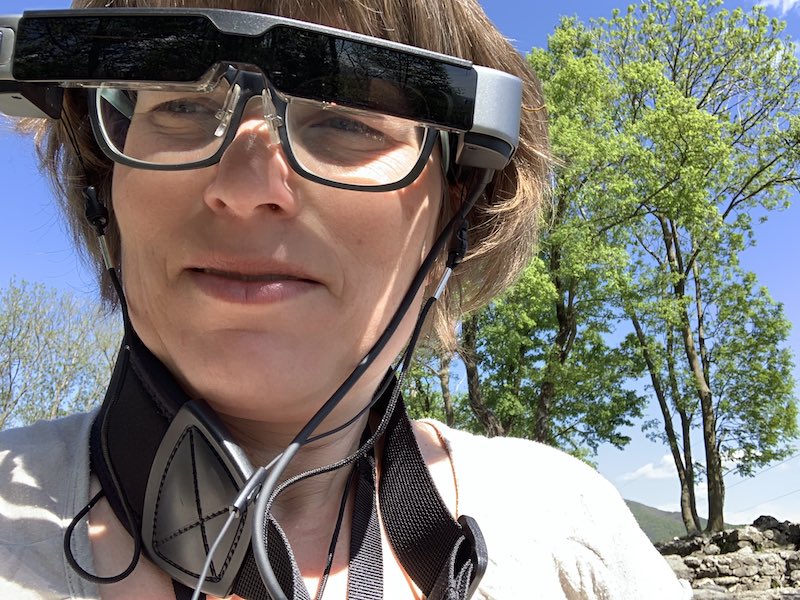
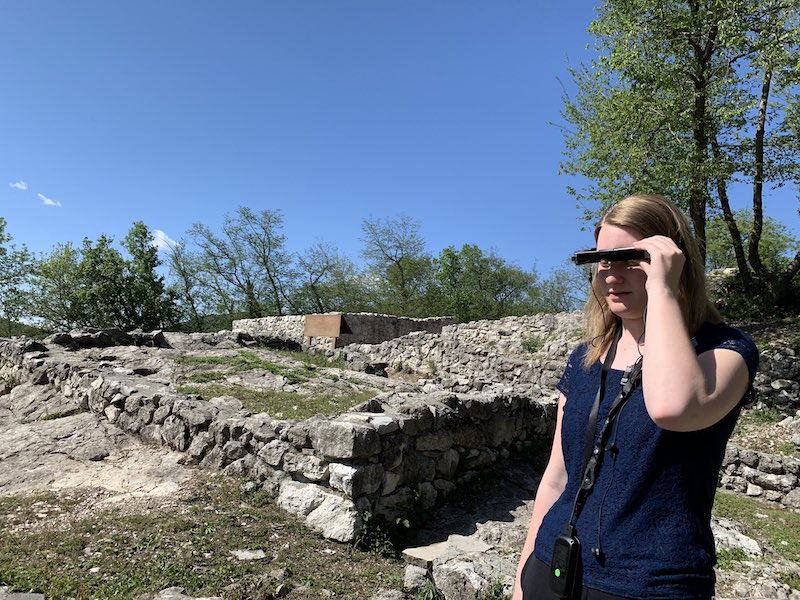
For me, however, the most problematic part of this AR experience is the AR glasses. They are uncomfortable, are difficult to see through, especially if you yourself wear glasses, and are difficult to see the 3D scenes through. As such, visitors don’t get to fully appreciate how well Elia’s illustrations have been crafted.

Erica wearing AR glasses at Tremona Castello Archaeological Park

While the audio storytelling is well designed, the audio storytelling device is problematic, as it has to be set in the visitor’s centre and once you start it, it cannot be paused or replayed without returning to the visitor’s centre to have it reset. This means you can’t take the time to enjoy and immerse yourself in the Parco Archeologico di Tremona-Castello’s AR experience at your own pace, but must stick to the pace of the device. This also means that on a hot, sunny day, you can’t take breaks from the tour under the shade of a tree, but must stay in the sun, until the tour reaches its completion.

The AR glasses and audio guide also limit when visitors can enjoy the experience to the hours of the Visitor’s Centre.

Takeaways From This Extended Reality Experience

Nadia’s initial description of what she envisioned for Parco Archeologico di Tremona-Castello’s AR experience is similar to what I’ve been envisioning for the natural and cultural history augmented reality experiences that I’ve been dreaming of. It is exactly the experience that I was hoping for, and I suspect that with advancements in motion capture suits and world building becoming more accessible through game design engines, like Unreal Engine and Unity, it is becoming easier to make visions like this a reality in the future, making me excited for a future visit to Parco Archeologico di Tremona-Castello to see how the AR experience has evolved. It would seem that Elia has already constructed and made it possible to explore the outdoor spaces of the ancient village that once stood at Parco Archeologico di Tremona-Castello through his 3D animations. Having said that, I think tackling this in pieces of starting with specific scenes, rather than a whole ghostly village all at once, makes this much more manageable logistically and financially, as well as allowing for the opportunity to test drive and learn from the initial scenes before designing more.

The AR glasses were very problematic for me, however, and create an accessibility challenge and I imagine a large expense in establishing this experience. I personally would design a version of this that visitors could enjoy through their smartphones and tablets. With advances in smartphone and tablet technology, the concerns for visitors’ devices switching to an Italian telecommunications network, resulting in unexpected cellular charges, could be resolved in the following ways:

  • Creating a GPS triggered app for the AR experience, that visitors download before leaving the visitor’s centre. Visitors can then turn on airplane mode on their devices, and start the app while using the visitor’s centre wifi. A number of travel audio guide apps work this way, including the popular GuideAlong audio tours.
  • Create a WebAR version of the AR experience, and install a mobile wifi router (like a starlink mobile) at Parco Archeologico di Tremona-Castello for visitors to use while their devices are in airplane mode.

Being able to enjoy this AR experience through a smartphone or tablet would make it accessible to more people, would make Elia’s 3D illustrations easier to view and enjoy, and would allow people to enjoy the experience at their own pace, pausing and replaying it, if they wish. In this way, the AR experience could even be made accessible outside of the visitor’s centre’s hours, if so desired.

It should be noted that one advantage to AR glasses over WebAR is that the augmented realities resolution is usually better with AR glasses, but if the augmented reality is difficult to see through the AR glasses, then it doesn’t really matter how good the resolution is.

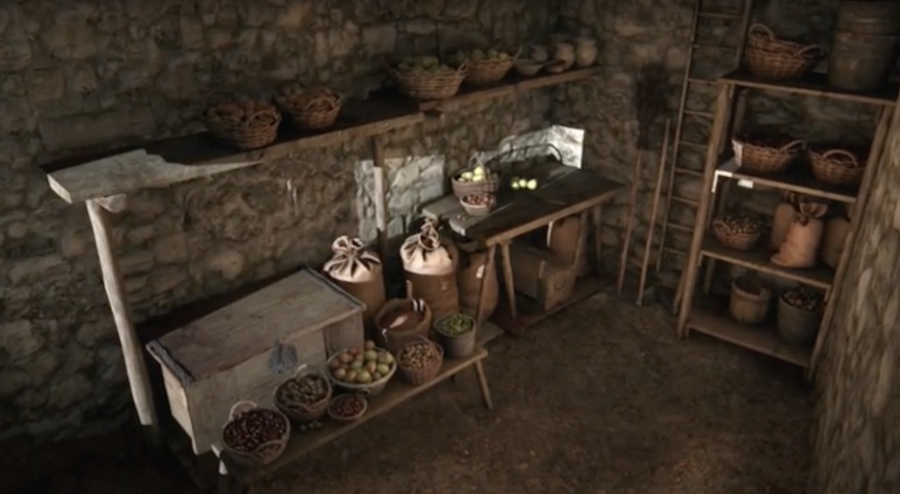
Food storage in the Medieval Village once at Parco Archeologico di Tremona-Castello, as depicted by Elia Marcacci.

Summary of Takeaways:

  • creating a ghostly ancient village that can be viewed with augmented reality with ghostly figures actively taking part in village life is where the magic in this experience is for me
  • creating a series of ghostly scenes from the village is a more manageable starting point, and allows for the opportunity to test drive and learn from the initial scenes before designing more
  • AR glasses are uncomfortable for some and difficult for some people to see the augmented reality scenes in
  • AR and audio storytelling is more accessible when experienced through a smartphone or a tablet
  • concerns of smartphones or tablets switching to an Italian telecommunications network, could be resolved by having the AR experience accessible through a GPS triggered app or available through WebAR if a mobile wifi router was available for use at Parco Archeologico di Tremona-Castello for visitors to use while their devices are in airplane mode
  • being able to enjoy this AR experience through a smartphones or tablet would allow people to immerse themselves in the experience at their own pace, pausing and replaying it, if they wish

Future Building

In reflecting upon Parco Archeologico di Tremona-Castello’s AR experience, in addition to the desire to have this experience accessible through a smartphone or table, allowing me to pause and replay the audio storytelling, and to see the ancient village in ghostly form with active ghostly villagers, I’d also love to be able to interact with those scenes in some way. Some possible ideas for that:

  • the ability to take pictures with the ghostly village and villagers, including selfies
  • being able to listen in on the conversations of ghostly villagers
  • being able to learn an activity from the ghostly villagers, perhaps as they teach a ghostly child or apprentice
  • being able to partake in a festive event, by dancing or signing along with the ghostly villagers

The educator in me is also envisioning creating the village in VR for use in school classrooms, or possibly VR (or AR) teaser experiences that would get school kids and other visitors prepared for a visit with a bit of a background of the time period that they will be transported to and some questions or things to look out for and think about on their visit to Parco Archeologico di Tremona-Castello.


Exploring Tremona-Castello Archaeological Park with AR glasses.

What’s Your Take on this Augmented Reality Experience?

I’d love to hear your thoughts in comments below on what you think would make this a richer and more accessible AR experience, and if you have technical solutions for making this a more immersive and user friendly experience.


References

Hargreave, E., [StoryToGo]. (2023b, December 15). Tremona Castello Archaeological Park AR Experience [Video]. YouTube. https://www.youtube.com/watch?v=6f8NZaeC_do

La storia. (n.d.). https://aram-ti.ch/il-villaggio/la-storia/

Marcacci Elia. (2014, January 6). Ein Tag in Tremona-Castello. Medienarchiv. https://medienarchiv.zhdk.ch/entries/63853132-1225-498b-ba50-c0b38d3a9eb9

Martinelli, A. (2008). Tremona Castello. Dal V millennio a.C. al XIII secolo d.C. All’Insegna del Giglio.

MendrisiottoTurismo. (2016a, May 25). Il villaggio di Tremona-Castello in 3D [Video]. YouTube. https://www.youtube.com/watch?v=4gzp_A9ADrQ

Mendrisiotto Turismo. (2016b, August 10). Parco archeologico di Tremona-Castello, oggi [Video]. YouTube. https://www.youtube.com/watch?v=ri7HMuhSrVQ

MendrisiottoTurismo. (2016c, August 29). Anno Domini – Rievocazione storica al Parco archeologio di Tremona-Castello [Video]. YouTube. https://www.youtube.com/watch?v=hkCdTiknS-4

MendrisiottoTurismo. (2019a, May 15). Parco Archeologico di Tremona Castello [Video]. YouTube. https://www.youtube.com/watch?v=qHGKHO4bZBI

MendrisiottoTurismo. (2019b, July 12). Hunting for mysteries in time [Video]. YouTube. https://www.youtube.com/watch?v=Ty9LxvWVsOw

Mendrisiotto Turismo. (2023, May 19). La Regione da scoprire – Il Parco archeologico di Tremona 2023 [Video]. YouTube. https://www.youtube.com/watch?v=6BbQJVkru30

Parco Archeologico di Tremona-Castello (n.d.). Ticino Tourism. https://www.parco-archeologico.ch/en/

Società editrice del Corriere del Ticino SA. (n.d.). Tremona – TicinoTopTen. Ticino Top Ten. https://www.ticinotopten.ch/en/experiences/tremona

Filed Under: #StoryToGo, Case Studies, EdTech, Erica Hargreave, Extended Reality, Immersive and Interactive Media, Storytellers, XR Tagged With: AR, augmented reality

Funding Documentary Storytelling & Open Educational Resources Through NFT Collectibles – An Experiment

November 28, 2021 by Erica Hargreave 1 Comment

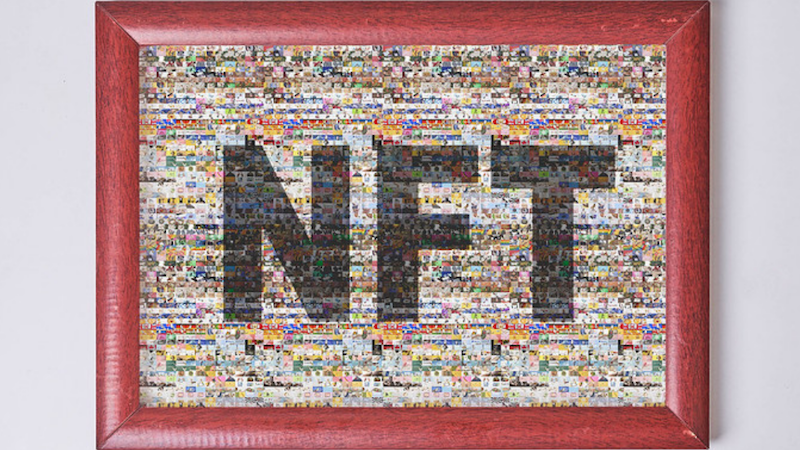
With the growing hype, and success and Cinderella stories around NFTs for creativesin 2021, I decided it was time this Autumn to investigate NFTs for myself. Why? As funding for creatives is broken, especially around educational projects and projects for social good.

Cinderella Glass Slipper care of Pixy.org

You can read more about my initial research into NFTs by clicking on the article I wrote earlier this Autumn, below.

NFT (Non-Fungible Tokens) – A Sustainable Funding Solution for Open Education and Open Culture?

In it I cover:

  • What NFTs are?
  • The history of NFTs.
  • NFT success stories.
  • My NFT concerns.
  • The evolving possibilities for NFTs.
  • Opportunities for creating NFTs for open education and open culture projects.
  • NFT ideas for my own projects.

The Problem

Image care of Markus Spiske via UnSplash

As we’ve learned over the years, it doesn’t matter how good or innovative your idea is, or if you and it have won awards, you will likely be turned down for funding many, many, many times, if you are a creator. Along with that, you will also be told numerous ridiculous and at times insulting reasons why you and / or your project are not good enough.  Things like:

  • The mention of ‘educational’ is a deal breaker, as what kids going to want to learn.
  • Kids in North America won’t be interested in stories with kids with different accents in different parts of the world. (Yes, a broadcaster actually told me this in a pitch meeting. She was a mom, therefore I was told she knew.)
  • You are too old as a woman to be the host.
  • You are too ‘vanilla’ to be the host. (Belief it or not, this was actually in a jury members notes from a CMF pitch.)
  • That our ideas only had value if we had someone famous attached.

We talked about these problems and more this week on The Creative Farm with Ralph Talmont:

Tune in to our Discussion on Art & Commerce

This means that you as a creative need to be resilient, determined, and to learn to differentiate between the beneficial feedback, and that that represents one person’s opinion or shines a spotlight on a problem within the system.  But at some point you must also question your path. Are you approaching this in a manner that works for you?  With a bit of nudging from our friend Steve Dotto, who has had his own experiences with applying to traditional broadcast funding, and as a result successfully found an alternate path to educational media creation, we began to question our path.

The Solution

Rather than continuing to smack into the same wall of rejection over and over again, my creative partner Lori Yearwood had the brilliant idea of learning from creatives that were funding their projects in alternative ways, ways that gave them more freedom to craft projects that have heart, do social good, and in which the creators could speak loudly and proudly of the educational value.

This lead us to create the Sustainable Funding Series, in which we’ve been interviewing creators on how they are piecing the funding together for their storytelling, social good, educational, and technology projects. From this we have learned many different alternative approaches to funding projects, that others can learn about in our open access Sustainable Funding Series Course.

Sustainable Funding Course for Creatives, Educators and Technologists

Included in this work, we’ve spent the past year experimenting with the Web Monetization Standard, which while still early days, does earn enough to pay for our site costs. We share what we’ve learned from those experiments and our Web Monetization community research in our open access Web Monetization Course.

Web Monetization Course

A New Funding Opportunity with NFT Collectibles

Given our investigations into alternate forms of funding, the hype around NFTs had us curious.  Is this a fad?  Is this just for artists or the internet famous?  Or is this an opportunity for other creatives and educators to set up new funding models around their projects?

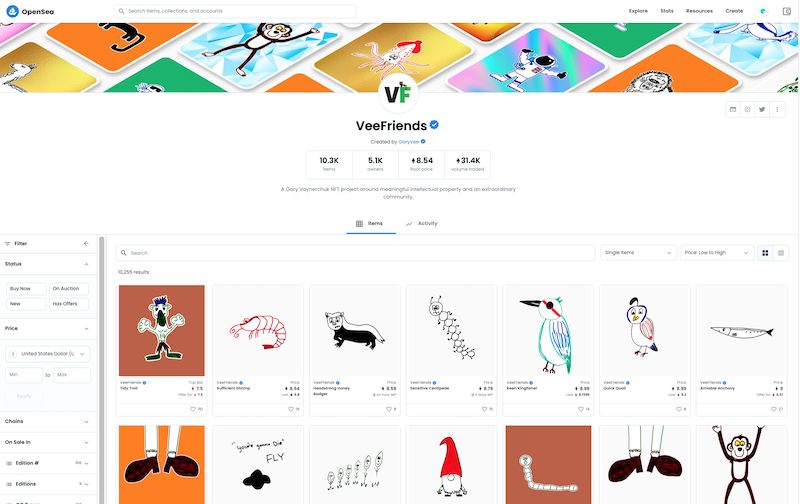
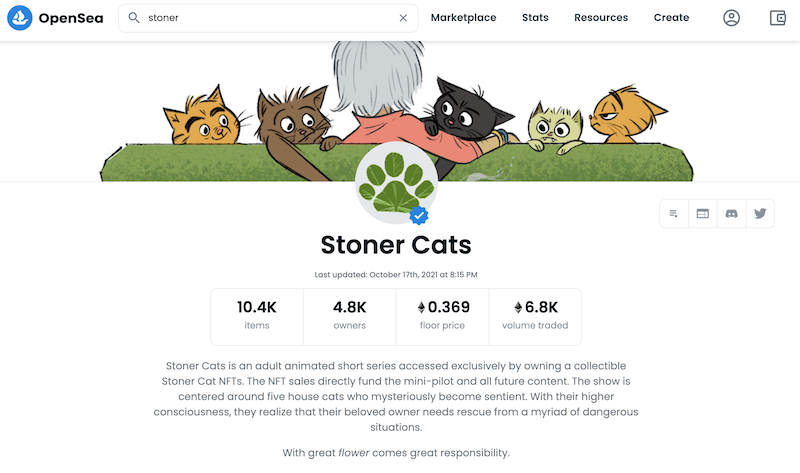
From my early research, I discovered that the idea of NFT Collectibles are being used to unlock other opportunities. In the case of Gary Vee, purchasing a VeeFriend unlocks exclusive access to future events, that would be classified as informal education.  Stoner Cats meanwhile gives purchasers exclusive access to their web series, once they’ve raised enough funds through NFT sales to film it. And with names like Jane Fonda, Seth MacFarlane, Chris Rock, Ashton Kutcher, Mila Kunia and Vitalik Buterin involved, they’ve done that and more.  The trading of collectibles around these projects has been in obscenely large amounts of money (VeeFriends: *31,400 Ethereum = *$135,997,796 USD / Stoner Cats: *7,100Ethereum = *$30,751,094 USD), which demonstrates an opportunity, especially when you see that VeeFriends are not professional pieces of art.  Having said that, these two projects also deal with the internet famous, begging the question if this is not just their fan base following them?

*It should be noted here that the publicly shared volume traded on someones OpenSea account does not equate to what the creator of that collection is pulling in, but rather the total amount earned by everyone who has owned and traded any of the NFTs within the collection. One creator explains this further below.

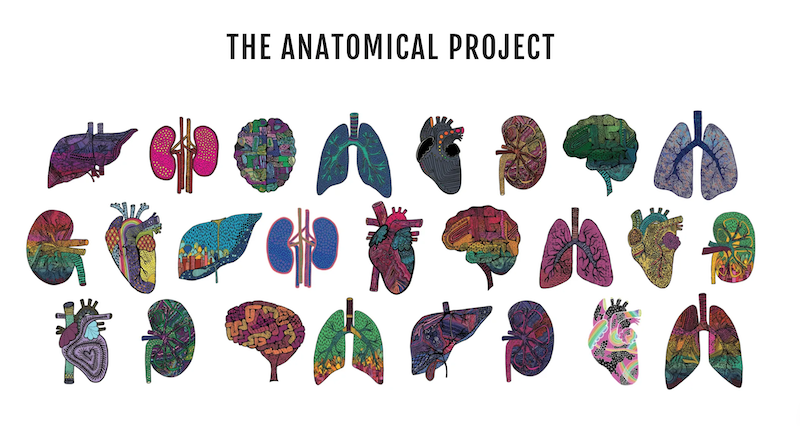
To answer that, I went in search of some NFT Collectible projects for social good and found the Anatomical Hearts Project and Emotion Monsters. TheAnatomical Hearts Project is a collection of anatomically drawn hearts created by Melissa Freund, as a way of dealing with her daughter’s congenital heart disease and the three open heart surgeries that she’s already had in her young life. She first released these hearts in the Spring of 2021 as a colouring book and then as NFTs in September 2021. At the time of writing this, 3 months later, *30.6 Ethereum from the Anatomical Heart NFT Collectibles has been traded, which is currently valued at *$132,533 USD. Melissa is not someone who is famous, nor did she have anyone famous attached to the project.

Melissa also graciously explained to me what the volume traded means, in terms of her collection, and what the translated earning are to her.

I want to mention that the 30 ETH you reference for me is traded. So I actually made 100 x .05 ETH = 5 ETH (minus 2.5% for OS fees and minus 2.5% of my own fees… don’t worry I add those back in a moment) on my heart project. So I made 4.75 ETH on the initial sale. Then the 30 ETH is what has actually traded hands. So I receive a percentage of that not the whole thing. So that is about 0.75 (at 2.5%). So total I’ve made about 5.5 ETH on my hearts.

Melissa Freund

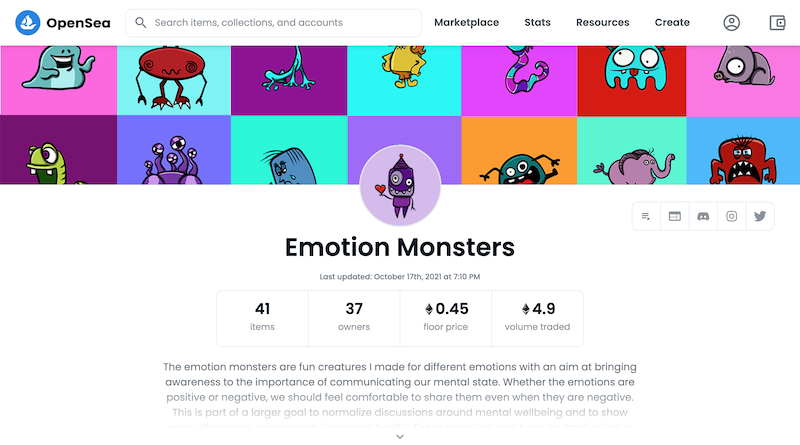
Similarly medical student Carmen Aguirre (also known as VJ Neurite), who started the Emotion Monsters NFT, is not famous. Rather, after being disturbed by her colleagues reactions to kids dealing with mental health issues in the hospital, she started creating the Emotion Monsters NFT Collectibles to break stigmas around mental health and raise money for a children’s book on mental health. So far her Emotion Monsters have traded *4.9 Etherium to date, which is approximately *$21,223 USD.

This made me think that perhaps NFT Collectibles are a viable funding solution for one of our educational projects? While there are a lot of NFTs out there, and we don’t have fame behind us, we do have heart and are about creating projects for social good, and as Anatomical Hearts and Emotion Monsters have taught us, there are people looking to purchase NFTs that are intended for good.


Our Experiment – Naturally Ours NFT Collectibles

Loving a good experiment, I decided to see if I could apply what I’ve been learning about NFTs to create some NFT Collectibles of our own, and raise enough money to shoot subsequent seasons of Naturally Ours.

The Project

For a bit of backstory, Naturally Ours is our internationally award winning nature series all about parks and natural spaces and the people they inspire.

Our team loves shooting this series, as the stories people share with us are rich in hope, cultural understanding, and awareness and connection to our natural world. While we might think we have an idea of what the people we interview are going to share with us, we are constantly blown away by the greater depth and layers of understanding that they end up sharing with us. For me, this also allows me to return to my nerdy, tree hugging biologist days.

We shot Season 1 of the Series on Salt Spring Island. In addition our film festival screenings, and featured launch on Vidme (which alas exists no longer), the series can also be found freely accessible on:

  • Seeka.TV
  • YouTube

And then the documentary, can be found behind paywalls on:

  • Fearless
  • EVRGRN (Tom Skerritt’s new network)

The Art

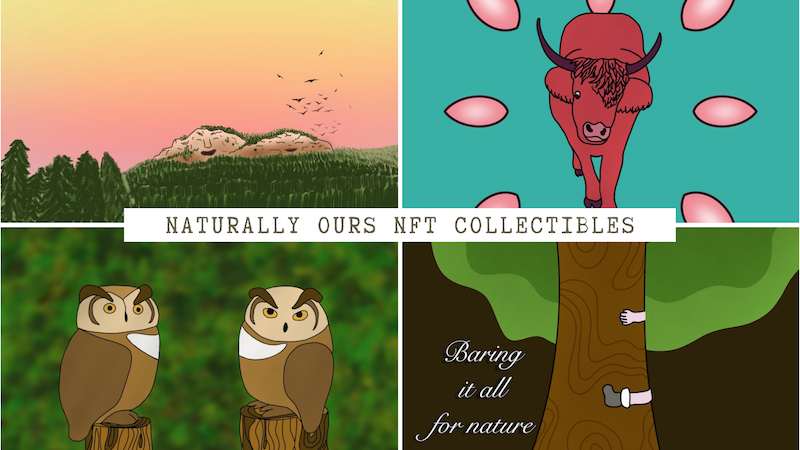
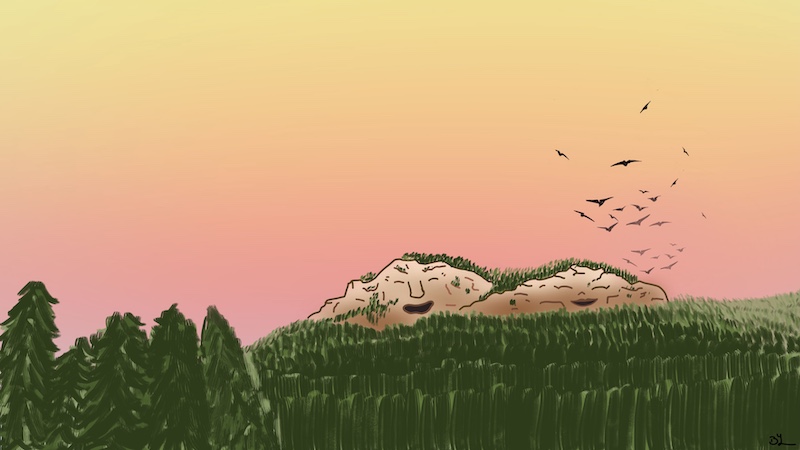
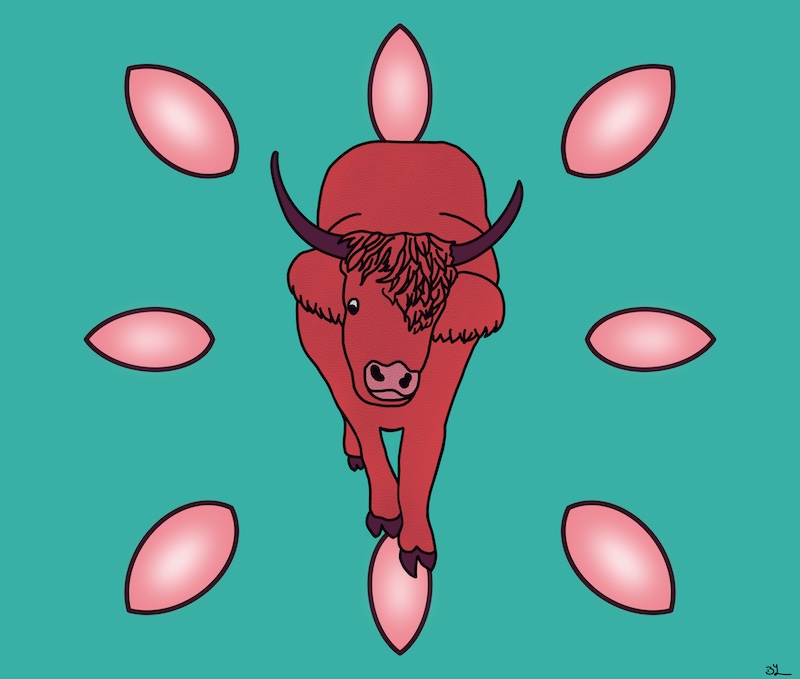
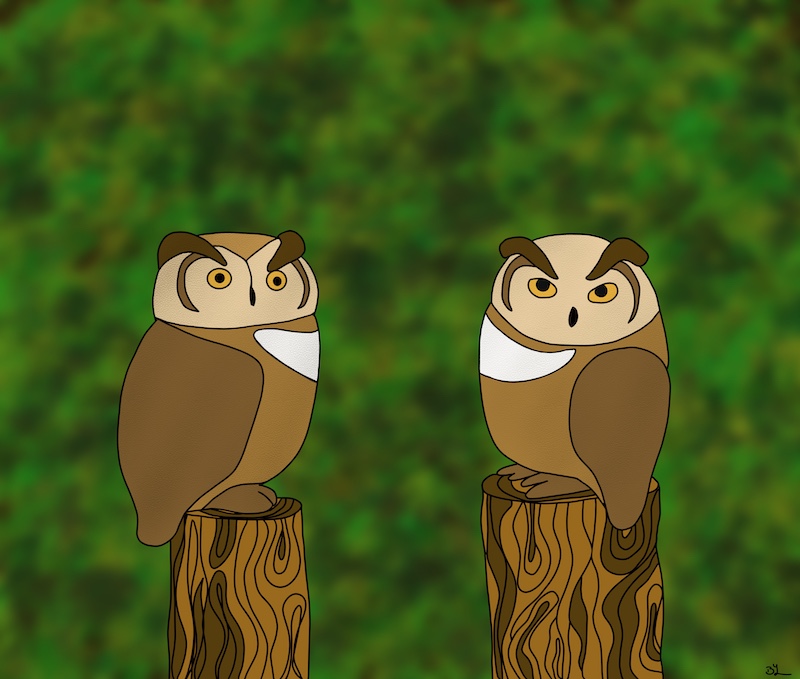
While I recognise that people with limited art skills are selling NFTs, I wanted ours to represent the mix of quirkiness, quality, thought, hope and empathy that the series has done, and I expected my stick figures would not convey all of that, so after reaching out and considering the artwork of a few people that we suspected might be a good fit for the project, I commissioned Bjorn Yearwood, a recent university graduate turned art therapy student, to create some NFT collectibles for us.

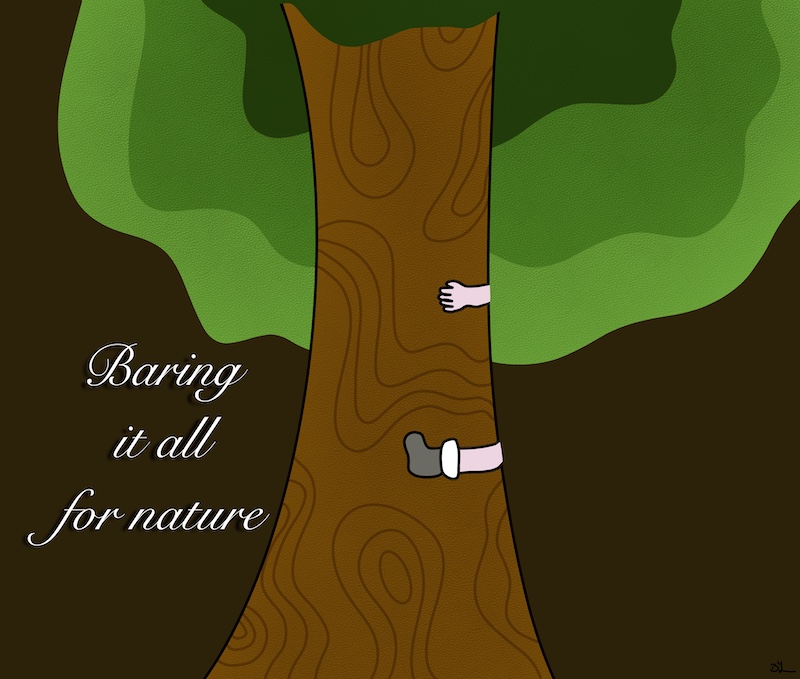
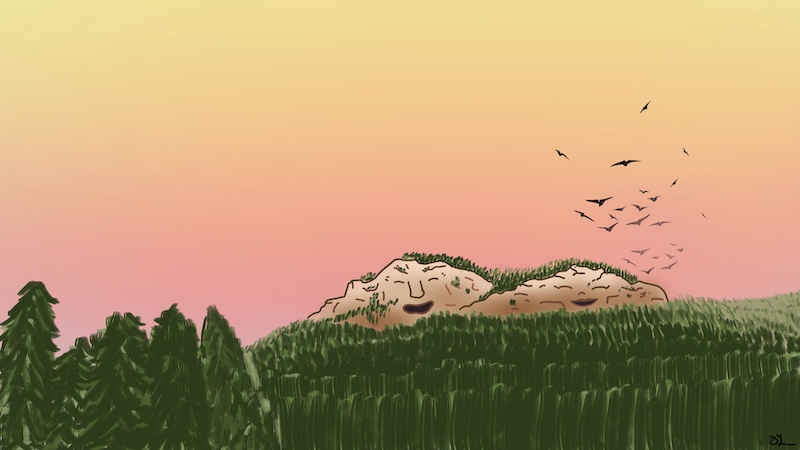
Why Bjorn? As he gets us and our storytelling, is using art to do good in the world and help others, and as he is an incredibly empathetic young fellow, which fits with how we operate within this series. You can see a few of the Naturally Ours NFT Collectibles he created for us below.

The team and I are pleased with what Bjorn has created, as they are fun, intelligent, connect with the essence of Season 1 of Naturally Ours, and include images from each of the episodes.

NFT Marketplace

There are a number of NFT Marketplaces out there, including OpenSea, Rarible, Mintable, and others.

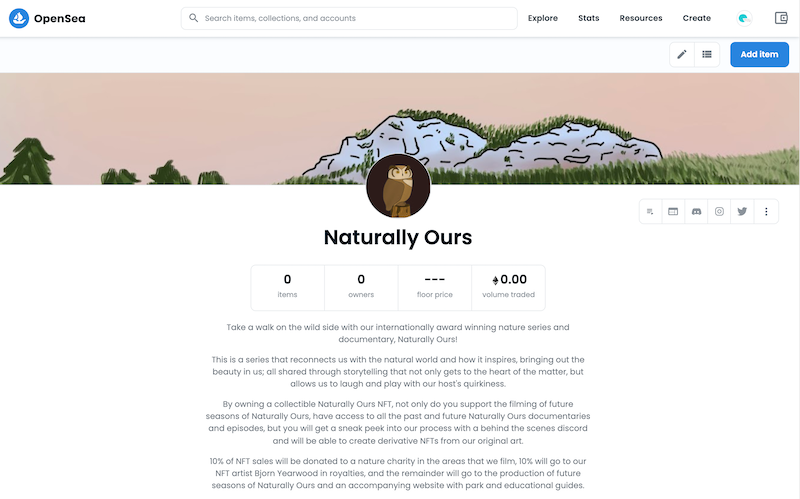
To decide where to place our Naturally Ours NFT Collectibles, I researched through the platforms, looking for similar projects to ours, with the hope being that that platform would be more likely to have collectors that would be interested in our collectibles. I was tempted to go with Mintable, as Mark Cuban is on there, and was hoping he might then be supportive of a fellow Fireside Chat Podcaster. However, OpenSea had the closest examples to what we are trying to do, with Stoner Cats, Anatomical Hearts, and Emotion Monsters all on OpenSea, so that is where we’ve opened a Naturally Ours NFT Collection and entered the marketplace.

Since OpenSea is on the Ethereum Blockchain, OpenSea requires that you have an Ethereum wallet with Ethereum in it before you set up an account. OpenSea has a list of compatible wallets, here: What crypto wallets can I use with OpenSea? Already owning a digital wallet, this was quick for me (and only momentarily terrifying) in transferring Ethereum into my new wallet. Be aware though, that if you do not have a digital wallet, such a transfer from a bank can take a few days.

In setting up our first collection on OpenSea, we also set out our sales intent, that:

  • 10% of NFT sales will be donated to a nature charity in the areas that we film,
  • 10% to go to our NFT artist Bjorn Yearwood in royalties (with the hopes that if we are successful that this will help further support him through his art therapy program), and
  • the remainder to go to the production of future seasons of Naturally Ours and an accompanying website with park and educational guides

Giving the artist a percent royalties on top of a paid contract is not the norm, but I believe a wise move, as it invests our artist in the success of the project, and ultimately if we end up seeing decent success with this, I want our artist to as well.

Discord

Community and access to a behind the scenes creative space for chatting throughout the day is a key characteristic of the NFT Community, especially in the collectible space. The two platforms they use for this is Discord and Telegram. You don’t need both, but you do need one, and I have in fact been told that some buyers won’t purchase an NFT from you, if they don’t like your community space.

I chose to set up our community on Discord, and have been designing it to appeal to the characteristics and interests of our varied community members, whether part of the NFT Community or not. This has included channels to:

  • get behind the scenes glimpses into the series development and production
  • be able to participate in development discussions
  • share their nature rambles
  • share their nature pictures
  • chat about other nature series they enjoy
  • indulge in mindful moments
  • talk about their favourite parks

In addition, we have created a space in the discord for NFT enthusiasts to chat about that world, and for teachers to discuss and share nature education resources.

The advantage to what I have designed of this space so far, is that while it is at present a bit of an echo chamber, it is a space I like and thus like posting to, which is important while the community is still building there.

If anyone has any suggestions or tips for me in helping me to both grow and add to this space, and foster the community there, please let me know.

Minting

Minting our Naturally Ours NFTs has turned out to be a surprisingly easy process. The most time consuming part of which has been crafting a write up behind each of our NFTs. We also shared what the NFT includes here, and looked to Emotion Monsters to help craft the wording behind the creation of derivatives attached to our NFTs. Currently we have phrased that as:

By owning this collectible Naturally Ours NFT, not only do you support the filming of future seasons of Naturally Ours, have access to all the past and future Naturally Ours documentaries and episodes, but you will get a sneak peek into our process with a behind the scenes discord and will be able to create derivative NFTs from this original artwork.

Only the holder of this NFT may make derivative artwork from it, and if sold those rights are transferred to the buyer. We highly encourage that 10% of any derivative art sales be donated to a nature or indigenous charity of your choosing. These derivative rights are for use in the NFT community and do not include commercial rights to make and sell any type of merchandise, as only Ahimsa Media and Bjorn Yearwood retain these rights. Permission from Ahimsa Media is required for the sale of derivative prints.

This leads to one of the questions we have: are we offering enough unlockable value as a part of our NFT, or should we be adding more?

You’ll note here, that we do not reference exclusive viewing rights of our web series and documentaries to our NFT holders, as the whole point of our web series is to share it widely and freely to provoke thought and positive change in this world. Making this exclusive to just those that can afford an NFT negates that. The same goes for the open educational resources too, which as the name implies would be openly accessible and remixable.

Having said that, our NFT Collectible Holders will have access to a private NFT holders only website with the full length documentaries that are normally behind paywalls, and we also plan on sharing other extras here, like additional extras for teachers to make their lesson planning around the open educational resources we’ve shared even easier and parks guide extras, like write ups of our favourite hikes and tips where to see wildlife. And we’ve allowed for NFT holders to create derivatives of our NFTs.

Have I articulated the value well enough? I know I haven’t really mentioned the teaching and parks guide perks. How would you phrase this to better articulate the value?

Does this need more? I know some filmmakers have talked about adding accessible libraries of images and video for NFT holders. While this would require some extra work, I can add libraries of images and videos from shoots for our NFT holders to access and use. I’d just want to keep these to my images and videos, to keep this separate from those that Kelly, our cinematographer, is shooting for the series. Is this something I should be adding as a part of our NFT unlockables or is this too much?

The other big question that came up in minting is how many copies of each NFT Collectible should we be minting. To keep costs of the NFT Collectibles reasonable and still raise enough money for filming, we need to be minting multiple copies, and the more copies we can make, the lower the price that we can sell the NFT Collectible for. But is there a point that the number of copies of the NFT Collectible is devaluing it? Would love peoples thoughts and opinions here. So far I’ve been experimenting with minting 50, 75, and 100 different copies of our NFT Collectibles. Too early though to see if this is impacting buyer behaviour with our NFT Collectibles.

A tip here, for new minters on OpenSea: to mint multiple copies of an NFT, scroll down to copies, and select the Polygon Network, as the Ethereum Network will only allow you to mint one copy at a time at the time of my writing this. Also, this allowed me to mint all of our NFT Collectibles without being charged any of the feared gas prices to date.

Preparation for Minting

You will see from our minting sample above that one of the questions asked in the process is about both an external link and unlockable content. While minting does allow you to edit and add that content later, I would not want to add anything to the marketplace that did not demonstrate the value that we promise, as first impressions are everything when it comes to people making an investment. Whether they decide to buy now or return later, we want to leave them with a good impression so that they do return for a second or third look, and so they tell their friends about it.

What this meant, is that in order to mint, we need to create both a public website for Naturally Ours, and a private website that is unlockable to our Naturally Ours NFT Collectible holders. While the various pages on these two websites still need completing, our audience is welcomed to a clear and inviting homepage to both sites, which gives visitors a vision of what’s to come.

While here, only the main website is accessible to visitors, if there are things that you would add to it, please let me know.

The Drop

‘The Drop’ in NFT terms is when one releases NFTs for sale on the marketplace. The typical way of doing this with NFT Collectibles is to ‘drop’ a number of new collectibles at once, and build anticipation towards that drop on your social media feeds and in your Telegram or Discord Community.

Drops require thought and strategy, in deciding how best to garner attention to them. Often you might give your Telegram or Discord Community advanced access to a drop or an early bird discount.

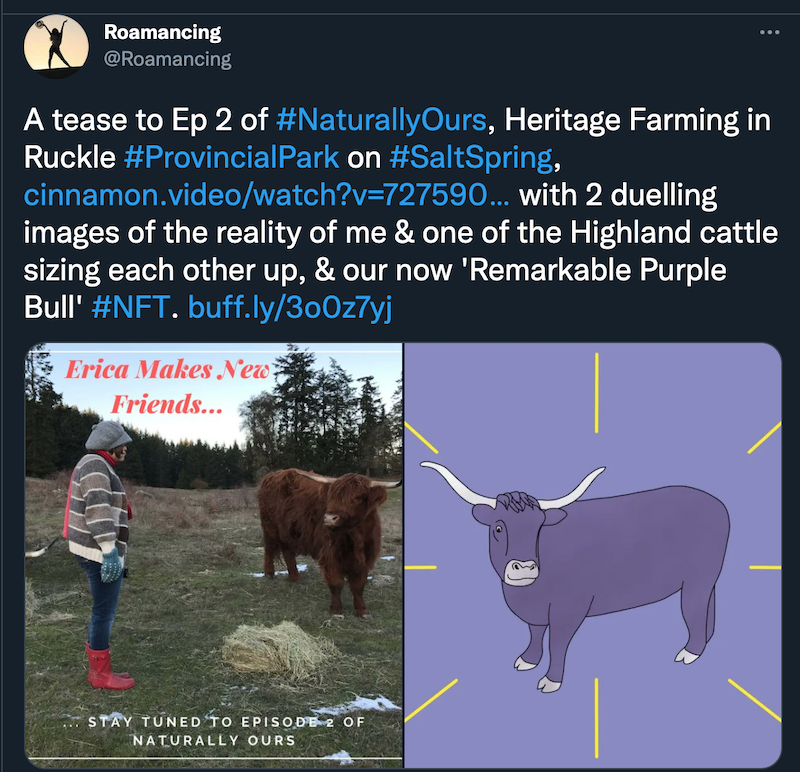
With not really having an NFT driven Discord Community yet, I am doing our drops a little differently, in a way that makes sense for us, in already having one season of Naturally Ours shot. The way I am doing this is to release a new video (teaser or full episode) on Cinnamon Video each day and then release one new Naturally Ours NFT Collectible that day, corresponding to that episode. This is allowing me to:

  • begin to build a slow buzz around the series and our NFTs
  • lead with story first, so that I don’t feel like I am becoming an NFT advertisement
  • show off the value of the series that people would be supporting in purchasing our NFTs

Once I have dropped the first 7 images, tied to the sharing of videos on Cinnamon, I will take a couple of Bjorn’s early less refined images, and do a free NFT giveaway to people who join the Discord community and either share what we are up to on Twitter or Instagram.

Next, I will do another slow tease out of images, tied to either the release of a new Parks Guide or Open Educational Resource, on the Naturally Ours website. These drops are intended to create deadlines for me in building more content to the Naturally Ours website, in addition to continuing the slow and steady build to our NFTs and Naturally Ours.

If you have any feedback on this Drop Strategy or other ideas that we might try, I’d love to hear them, as this is an experiment in progress.

With the drop, also comes the pricing of the NFT Collectible, which I am still debating on. After looking at what Stoner Cats, Anatomical Hearts, Emotion Monsters, and other nature based projects are priced at, crunching the numbers on how much we’d need to earn to shoot a second Season of Naturally Ours, I decided to price our NFTs at 0.03 Etherium until the New Year. This is less thanAnatomical Hearts and Emotion Monsters, while still acknowledging the value of what we are creating. I may, after the release of the first seven NFTs, experiment with some lower priced NFTs between 0.02 – 0.0275 Ethereum, with some of Bjorn’s early less refined images to see if that makes a difference in sales. Depending on how sales go, I may increase the price on the NFT Collectibles in the New Year, closer to whatAnatomical Hearts and Emotion Monsters are going for at between 0.035 – 0.05 Etherium.

If you have any thoughts or advice related to the pricing of our NFT Collectibles, we’d greatly appreciate it.


Feedback from Melissa Freund on My Early Creator Questions

Feeling the need for some guidance on the questions swirling in my head at these initial stages of the experiment, I reached out to Anatomical Hearts NFT Collectibles creator Melissa Freund for a bit of guidance from her story and experience. Here is what she generously shared with me:

  • How did you first garner attention to Anatomical Hearts?

I first garnered attention from a @Garyvee Twitter post. He asked for artists that hadn’t had their first sale yet to share their story/collection on his Twitter post and then he was going to buy one. He didn’t pick my collection as one to buy but it had a lot of ‘likes’. From that post I had probably sold around 10 of my nfts. Then on September 16 @bullgirlfriends tweeted (like a 5 part tweet) about my story and project and I sold out the rest of my 100 piece project in about an hour. It was pretty crazy.

  • How did you first garner attention to your Discord?

My discord was dead for forever. That took a long time to get even a little traction. In mid/late September I had someone ask if my project was dead. It was insulting because I was doing so much on the back-end but just didn’t have a lot of traction on twitter/discord yet. I will say I had my husband, Shane (@dadcipher) and another gamer friend signed up as mods right away. They were already on discord so they were happy to chat away and say hi to people as they came in.

  • How long was it before you sold your first NFT, and then until you began building momentum behind that?

I listed August 31 and sold my first NFT on September 4. Those two interactions I mentioned above introduced me to a lot of people that began to start to believe in me and really liked my work. Also, Twitter spaces and chatting with people in other discords is a good way to meet new people.

  • What was your initial price / NFT?

All my art has sold for 0.05 ETH each. That is about $200 USD, which sound like a lot but is a really good entry point in NFTs. I would even say, I price my art a little low. I’m new and priced it lower for two reasons: 1) I wanted tHE people who bought my art to be able to make gains on it. 2) It felt accessible, and I wanted people who really felt meaning in my art to be able to collect it.

  • How many copies of each NFT do you make available?

Each piece I only sell a quantity of 1. I repeat some of the styles but each of the coloring I change manually so I still consider all my artwork 1/1. I hope that makes sense. In the future I’m going to play around with different price point and quantities.


Lessons / Discoveries to Date

So far in this experiment, I have been met with the following discoveries:

  • Hope and Empowerment – Unlike writing a grant proposal, creating these NFT Collectibles feels like it is something I have some control in catalysing our success. As a result, rather than this process exhausting me, it has been exhilarating and is somewhat addictive.
  • Patience – While I’d love to see instant success, I need to keep reminding myself that I am playing the long game, and do not want to come across as spam, as so many in this space are doing.
  • It’s About Community – As is often the case in early adopter tech ecosystems, it’s about community. You need to foster, grow and engage community – both around your project and with the broader NFT community.
  • It’s Easier than It Seems – The process of setting up your digital wallet, minting, and adding your NFTs to the marketplace is much easier than it seems from the outside, and quite a straightforward and streamlined process.
  • To Do Things Properly is Time Consuming – This is not a get rich quick, field of dreams. To do this properly, you need to be invested with your time, creativity, and attention.
  • Beware of the Snake Oil Salespeople – With every success and Cinderella story, come those looking to make a quick buck and sell people on dreams of fame and fortune. As my instagram NFT shares will show in the comments, the NFT community is currently rife with them.

Future Potential / Possibilities

At this point in my experiment, with only two NFTs dropped and no sales as of yet, it is still too early for me to predict the future potential and possibilities for our project, but I am excited at the prospects. My current goals with this:

  • Make my first NFT Sale, so that I can then pitch my ideas to the NFT Marketplaces that Ripple is investing in building.
  • Raise enough to shoot another season of Naturally Ours, or at least offset the cost for another partner on the project.
  • Raise enough for freedom of where and when we shoot future seasons of Naturally Ours.
  • Raise enough to pay myself and team members to support me in the marketing of Naturally Ours and in the development of open educational resources around the series.

With the above, it would also be outstanding to be able to give some decent sized donations to charities on behalf of the series and to see royalties coming in for Bjorn.

Having said that, even without any of that, this process has already been a great success for me, as we now have some wonderful images that are a part of Naturally Ours as I further build the website, the parks guides, and the open educational resources. And it has created deadlines for me in finally building the Naturally Ours website and finally releasing Naturally Ours on Cinnamon Video. All of this breathes new life into the project and gives me new talking points when I follow up with potential partners for the project.

This has also got me excited to attempt this funding model for raising money for both our Chronic Pain Chronicles Series and accompanying open educational resources, and for our Augmented Reality Natural and Cultural History Storytelling App. Who knows, maybe we even come up with an NFT campaign for building more open educational courses around contemporary media on the StoryToGo Classroom site and for supporting our podcasts? So many possibilities, and as this is something that Bjorn and I are both having fun experimenting with, it is just time and a bit of catalysing funds that is limiting us. Which again reminds me to pace myself and focus on this experiment first, before diving into the next one.


Your Thoughts / Experience

I’d love to hear about your experience.

Have you created or contemplated creating any NFTs? If so, what around? Have you yourself bought an NFT? What inspired you to make the purchase? How do you see creating and utilising NFTs in your industry?

Share your thoughts in the comments below.


A Few of the Rabbit Holes I Wandered Down in my NFT Research

Aguirre, C. (2021, September 5). Emotion Monsters. VJ Neurite. Retrieved October 16, 2021, from https://www.vjneurite.com/crypto-art/emotion-monsters

Ahimsa Media Inc., & Hargreave, E. (2021, November 24). Naturally Ours. Naturally Ours. Retrieved November 28, 2021, from https://roamancing.com/naturallyours/

Burke, K. (2021). The Metaverse Podcast. PodBean. Retrieved October 14, 2021, from https://outlierventures.podbean.com/

Freund, M. (2021). The Anatomical Project. The Anatomical Project. Retrieved October 13, 2021, from https://theanatomicalproject.com/

Hargreave, E. (2021, October 13). Would Love Your Advice on Navigating the World of NFTs [Forem Post]. Web Monetization Community. https://community.webmonetization.org/ericahargreave/where-on-navigating-the-world-of-nfts-4b9c

Hargreave, E. (2021b, October 14). Exploring NFTs on the Sustainable Funding Series | by Erica Hargreave. Fireside Chat.  https://firesidechat.com/ericahargreave/01FJ00CYXG1E86WEY707NSYRFJ

Hargreave, E. (2021c, October 18). NFTs – A Sustainable Funding Solution for OpenEd? | by Erica Hargreave. Fireside Chat. https://firesidechat.com/ericahargreave/01FJAC39R96M8XQ91Z52TF4EEB

Hargreave, E. (2021, October 22). NFT (Non-Fungible Tokens) – A Sustainable Funding Solution for Open Education and Open Culture? StoryToGo. https://storytogo.ca/2021/10/nft-non-fungible-tokens-a-sustainable-funding-solution-for-open-education-and-open-culture/

Hargreave, E. (2021c, November 24). Naturally Ours NFT Experiment : Part 1 – the Concept & Discord. Web Monetization Community. https://community.webmonetization.org/ericahargreave/naturally-ours-nft-experiment-part-1-the-concept-discord-1fh5

Hargreave, E. (2021d, November 24). Naturally Ours NFT Open Education Experiment : Part 1 – the Concept & Discord. OE Global Connect. https://connect.oeglobal.org/t/naturally-ours-nft-open-education-experiment-part-1-the-concept-discord/3320/2

Henbu. (2021, March 24). NFTs for a Photographer/Filmmaker? How to ACTUALLY make NFTs that SELL! [Video]. YouTube. https://www.youtube.com/watch?v=akzPKeh3j9c
Jackson, R. (2021, August 25). NFTs Are Here To Stay, Dominate And. . . Crunchbase News. Retrieved October 13, 2021, from https://news.crunchbase.com/news/nft-outlook-2021/

NIFTY WORLD. (2021, August 28). How to build a strong NFT Community | NFT Tips and Tricks [Video]. YouTube. https://www.youtube.com/watch?v=9lhNxhtxFDw

NFTCON October 12–14th – NFT Conference. (2021). NFTcon. Retrieved October 14, 2021, from https://www.nftcon.co/agenda

NFTs – What You Need to Know. (2021, July 28). Real Vision. Retrieved October 13, 2021, from https://www.realvision.com/nfts-what-you-need-to-know

Open Sea. (n.d.). Open Sea. Retrieved October 13, 2021, from https://opensea.io/

Prism Productive. (2021, September 11). How To Mint NFT On Opensea For Free – No Gas Fees [Video]. YouTube. https://www.youtube.com/watch?v=dzr1BKrmm4o

Radhy. (2021, October 16). Web Monetization + NFT = . . . ? [Forem Post]. Web Monetization Community. https://community.webmonetization.org/radhyr/web-monetization-nft-5hbg

Roamancing. (2021, November 24). Roamancing on Cinnamon. Cinnamon Video. Retrieved November 28, 2021, from https://cinnamon.video/Roamancing

Stoner Cats. (2021). Stoner Cats. Retrieved October 16, 2021, from https://www.stonercats.com/

Thomas, P. (2021, August 20). NFTs in education — fashion, fad or truly non-fungible? Medium. Retrieved October 16, 2021, from https://medium.com/haileyburyx/nfts-in-education-fashion-fad-or-truly-non-fungible-252a662d4bce

Vaynerchuk, G. (2021, May 13). What is NFT? Non-fungible Token Guide. GaryVaynerchuk.Com. Retrieved October 14, 2021, from https://www.garyvaynerchuk.com/what-is-nft-non-fungible-token-guide/

Young, J. R. (2021a, August 18). Could NFTs Play a Role in Education? EdSurge. Retrieved October 16, 2021, from https://www.edsurge.com/news/2021-08-10-could-nfts-play-a-role-in-education

Young, J. R. (2021a, September 15). Glitches, ‘Gas Fees’ and Lessons We Learned Selling an NFT. EdSurge. Retrieved October 16, 2021, from https://www.edsurge.com/news/2021-09-14-glitches-gas-fees-and-lessons-we-learned-selling-an-nft

Young, J. R. (2021, October 12). We Wondered If NFTs Could Change Education, So We Decided to Sell This Article on the Blockchain. EdSurge. Retrieved October 16, 2021, from https://www.edsurge.com/news/2021-08-09-we-wondered-if-nfts-could-change-education-so-we-decided-to-sell-this-article-on-the-blockchain

Filed Under: #StoryToGo, Case Studies, Erica Hargreave, Storytellers, Sustainable Funding Tagged With: NFT, sustainable funding

NFT (Non-Fungible Tokens) – A Sustainable Funding Solution for Open Education and Open Culture?

October 17, 2021 by Erica Hargreave 2 Comments

Could NFTs (non-fungible tokens) poise a potential sustainable funding solution for open education and open culture?

An ode to Beeple’s NFT image collage, entitled ‘Everyday’, that sold for $69,346,250 US in a Christie’s auction in March 2021. Image care of Marco Verch via Flickr.
Click here to listen to a live audience Podcast Recording of this Article, followed by a Discussion.

This article was updated on October 22, 2021, thanks to some insights and explanations of Janos Farkas of CLink Media on the Web Monetization Community Forem.

Immersion in the Blockchain and Web 3.0

Over the past year as I’ve immersed myself in the Web Monetization Standard, I have become more and more excited about the potential that decentralization protocols, the blockchains, and cryptocurrencies hold in transforming the creator’s economy and building more equity for underserved groups across the digital verse. I am so very thankful to Grant for the Web and Interledger for starting me on this journey (along with a little nudge from David Porter).

With this and with the rise in popularity of NFTs within the artistic community, I have naturally become curious about exploring NFTs in greater depth to discover if they present a potential solution for the educational and storytelling projects that my team and I have been developing. While Web Monetization presents a solution for the royalties and sustainable management of our projects, could NFTs hold a solution for sustainably funding our projects, along with other open education and freely distributed cultural storytelling projects?

The Web Monetization Standard for those unfamiliar with it, is a JavaScript browser API that allows for the creation of a payment stream from a website visitor to a website. The way this currently works is that when someone with a Web Monetization subscription(currently Coil) visits a digital asset that is Web Monetized (like this digital magazine), then micropayments flow from the subscription to the digital asset in real time, based on the amount of time spent on the site.

To learn more about Web Monetization, visit our:

  • Web Monetization Course
  • Web Monetization Guide
    • Web Monetization Resource Library
    • Web Monetized Content Library

Understanding NFT

In gaining understanding of NFT and the potential that non-fungible tokens present, let’s first breakdown the word Non-Fungible Tokens.

Image care of Mario Taddei via the Wikimedia Commons.

Fungible

Fungible is a term used in finance to reference something that can be exchanged for something else that is the same, like a Canadian dollar or loony for another Canadian dollar or loony.

Non-Fungible

Non-Fungible refers to something that is unique, that can’t be replaced with something else. As an example of something that is non-fungible, since it’s a rainy day which brings cozy, comfy thoughts, my childhood yellow blanket that my mom made me is unique, as no other yellow blanket is the same as it. For me, it hold greater value to all those other yellow blankets.

Non-Fungible Tokens

This definition has been updated, thanks to insights and explanations shared by Janos Farkas of CLink Media.

Non-Fungible Tokens refers to non-fungible items that are tokenized. While with the current craze in NFTs, we think about tokenized items placed on the blockchain, tokens that are non-fungible have been used in commerce for centuries. As an example there include negotiable instruments, securities, deeds of real estate, certificate of title for automobiles.

“The term NFT was popularized in our current culture by the Ethereum ERC-721 Standard and is now used by other ledgers and marketplaces. The NFT itself is unique, but NOT the asset it is linked to. This has been the crux of major confusions around NFT.”

Blockchain

The Blockchain is a system of recording information in a way that makes it difficult, if not impossible to change, hack, or cheat. In essence it is a digital ledger of transactions that are duplicated and distributed across the entire network of computer systems on the blockchain.


NFT Success Stories

NFTs first gained more mainstream attraction and attention in 2017 as CryptoKitties (created by Vancouver’s Dapper Labs), took off. For those of you unfamiliar with CryptoKitties, it isa blockchain game on the Ethereum network that allows players to purchase, collect, breed and sell virtual cats.

CryptoKitties’ 2017 popularity congested the Ethereum network so badly that it caused the network to reach an all-time high in the number of transactions, slowing the network down significantly. In the years since then, while NFTs had a dedicated niche following, it wasn’t until 2020 that NFTs began to grow in popularity, perhaps as artists looked for different avenues and ways to sell their art during the pandemic. While popularity began to grow in 2020, 2021 has presented an enormous boom in NFTs and is changing the financial prospects for many artists.

I mention artists, as much of the NFT boom has been around art, along with collectibles. Creatives in multiple other disciplines have also begun to experiment with creating NFTs around their creative endeavours. The money that some artists are making is enough to not only maintain their projects, but fund new projects, pay for their education, donate some of their earnings to charities and causes of interest, and change their lifestyles. Below, I share a few projects that have caught my attention in my explorations.

Anatomical Hearts Project

The image above is a screenshot from The Anatomical Project website.

Melissa Freund began to draw anatomically correct hearts as a way of coping with and processing the rare heart defect that her daughter was born with and needed open heart surgery on at 11 days old. In May 2021, Melissa took these drawings and turned them into a published colouring book. Then in September 2021, she created a 100 piece NFT collection called Anatomical Hearts on the Open Sea NFT marketplace. Within a month, she sold 65 of those hearts, began to build a community around her art on discord, and earned 25 Ethereum, which is currently valued at approximately $96,900 US.

The hearts Melissa sells are essentially ‘digital prints’. The copyright for the drawings remain with her, so that she is able to use them in her other work. She also gets royalties on any future sales of her purchased hearts within the blockchain.

Melissa has now started a second project, The Anatomical Project.

Emotion Monsters

The image above is a screenshot from the Emotion Monsters Collection on Open Sea.

Emotion Monsters is an NFT project started by medical student Carmen Aguirre (also known asVJ Neurite), after being disturbed by her colleagues reactions to kids dealing with mental health issues in the hospital. With this series, she aims to break stigmas around mental health.

In the initial round of this project, she sold out on her first 30 monsters (in July 2021), and has since added additional monsters and emotional support pets for the monsters. As of writing this, she has earned 4.85 Ethereum, which at present is approximately $18,750 US. 10% of these earnings are donated to a mental health charity and the remainder is being used to fund a kids book on mental health

Each monster comes with access to a private discord group and will allow for derivative NFTs to be made from the original art.

Carmen has subsequently launched Emotional Support Plants on Open Sea.

Ethereum Towers

The above image is a screenshot of the Ethereum Tower‘s apartment sales on Open Sea.

Ethereum Towers is a decentralized, community-first, social real-estate experiment in which space is being sold in a virtual world that will eventually exist in the metaverse. Think luxury virtual living, in the fashion of Second Life or Minecraft, as a way of bringing people from around the world virtually together in a shared virtual living space.

Launched in September 2021, at the time of writing this article, 425 Units of this virtual real estate have been sold, pulling in 88.5 Ethereum (which is currently approximately $340,000 US). This money will go into building the virtual towers in the metaverse, as well as managing the community.

Stoner Cats

The image above is a screenshot of Stoner Cats on Open Sea.

To raise money for a new animated series named Stoner Cats, Mila Kunis and Orchard Farm Productions ran an NFT Stoner Cat Collectibles sale, much in the fashion of a crowdfunding campaign with added perks for the first people to unlock particular milestones in the NFT sales. Everyone with a Stoner Cat collectible has exclusive access to all the Stoner Cat content produced.

The first round of sales was sold out to 4800 owners, raising 6800 Ethereum, which is currently approximately $26,180,00 US. To date, a 5-minute pilot for the series has been released.


My NFT Concerns

As I did a deep dive into the NFT ecosystem, there were a couple of points that raised my concerns with NFTs as well as with their practicality of use in creating free and open education and free and open culture. These concerns revolved around the notions of Ownership, Status, Copyright, and Equity. Many conversations around NFTs are focused on this notion of proof of ownership of something unique, and even go further to talk about this ownership over something acting as a point of status. All of this set my alarm bells off, as one of the strengths of the web for me is opening culture and education up to people worldwide. With a rise in popularity of NFTs would this transform the web into a series of gated communities in which only those that could afford to could enter, learn and experience? Part of what I love about Web Monetization and the people involved in creating that ecosystem is the movement towards making the web more equitable, and opening things up for underserved communities to earn. Yet when we talk Ownership and Status, this signals classism to me, which is counter to equity. This fearwas further compiled by learning of an individual who gave away their choice of what to eat each day as an NFT and on a particular deep dive discovering HaremTokens. Also as a digital creator, did I want to be giving away my right to utilise my creations, when so often they build upon one another and come from a collective of ideas beyond just my own, especially in education?

To address some of these concerns, I hosted a panel of individuals experimenting with NFTs to discuss further, including Melissa Freund of the Anatomical Hearts Project, Dadcipher of Etherium Towers, and Adam Waring of gFam. You can listen to that podcast below on YouTube or the original version on Fireside Chat:

Smart Contracts

To summarise my discoveries from the discussion:

  • While NFTs do show proof of ownership over something (in this case as Janos Farkas shared with me – the ownership is of the token not the asset itself), when an NFT is created a Smart Contract is established that dictates what the ownership of that item entitles the owner to. Usually that ownership does not involve the copyright of the asset, does not limit the artist’s other uses of the asset, and is often not even the original of the asset, rather a copy – just like owning the print of an original piece of art, allowing the artist to sell multiple prints of the same piece.
  • The Smart Contract also stipulates how the buyer is permitted to utilise the item that they’ve purchased, and any other permissions that their purchase might give them.
  • In addition, Smart Contracts can also stipulate percent royalties to be shared with the artist on all future sales of the item.

Our discussion covered other topics too, including how to get started on creating and selling NFTs, which I will go into further in another article, along with walking you through creating an NFT of our own. In the meantime, EdSurge has shared their journey in doing just that, that you can listen to below.

EdSurge Podcast · Glitches, ‘Gas Fees’ and Lessons We Learned Selling an NFT

Janos Farkas went on to share with me, “When someone is purchasing an NFT, they are purchasing the metadata file, and as a non-fungible token this is transferable as well. Some people have therefore compared NFTs with a signed copy of a work, which is somewhat inaccurate as the NFT is not a copy itself, it’s more like a signed receipt of a work, where the ownership is not of the work itself, but it’s ownership of the receipt.” “The key takeaway from that paragraph ‘the ownership is not of the work itself’, so it is NOT a song, a book, a message, or a Tweet.” He further recommends reading ‘What do NFTs represent?’ section of the article, ‘The Rise of Non-Fungible Tokens (NFTs) and the Role of Copyright Law – Part I‘.

He further shares…

“This leads to the question: can an NFT represent the content/asset? For example, can it replace a certificate title of an automobile?

A certificate of title imprints the VIN (Vehicle Identification Number) of the automobile. VIN is unique to the vehicle and can be verified from third party sources. In other words, VIN provides a verifiable reference. This is not the case for the majority NFTs using Ethereum ERC721 tokens. Those link the content/asset by a “breakable” URL. There are multiple reasons why that URL is breakable. The most obvious one is that the ERC721 spec allows changing the URL after the token is minted by the function (_setTokenURI(tokenId, newTokenURI). See github.com/0xcert/ethereum-erc721/… at line 110 in the ERC 721 reference implementation.

In summary NFT cannot be considered as a verifiable ‘certificate of ownership’ for a content/asset.”

The Possibilities for NFTs are Evolving Quickly

Another thing I learned this past week from tuning into NFTcon (Day 1 – Music, Art, Fashion & Culture / Day 2 – Collectibles, Gaming, Sports & Metaverse / Day 3 – Protocols & Demos) and having the discussion above, as well as conversations with other NFT creators, is that the NFT ecosystem is changing rapidly, and with that there are many misconceptions (like those I had around what ownership means and what unique means in the context of NFTs) and opportunities to shape how NFTs evolve. In terms of NFT evolution, there are already conversations around NFT rentals or examples of NFTs as tickets to an event. In some cases, owning an NFT is like owning a key that unlocks different experiences. There are huge opportunities in contributing to this evolution by experimenting with the creation of your own NFTs, especially in spaces beyond art and collectibles.


Opportunities for Creating NFTs for Open Education & Open Culture Projects

I struggled initially in pondering whether with the notion of ownership, if it would be possible to create NFTs around Open Education and Open Culture Projects, and then as I continued popping down various NFT rabbit holes and exploring what others were up to, the ideas rapidly began to hit me.

Here are my initial thoughts on how NFTs could be utilised around open education and open or free culture projects to begin to create sustainable funding models for those project:

  • Completion Certificates for Open Courses, that are available at a fee, provided the learner also completes the required assignments. This NFT Completion Certificate could also include feedback from the Instructor on the assignments and a one-on-one coaching session.
  • Fundraising Collectibles that unlock special privileges, like access to the behind-the-scenes community or voting rights in future resource development.
  • Creation of NFTs around Secondary Resources built as a part of the open education project.
  • Creation of NFTs around Learnings that you have had as a result open education project.

While the above is just a start, my hope is that you, dear reader, will add to these ideas, growing the possibilities.

In terms of how I am envisioning utilising NFTs to help our team to continue to grow our open educational and freely accessible storytelling projects, here are a few of my current ideas:

StoryToGo Classroom

What? Online Course Site

NFTs?

  • Completion Certificates for Open Courses, provided the learner also completes the required assignments. This NFT Completion Certificate will also include feedback from the Instructor on the assignments and a one-on-one coaching session.

Chronic Pain Chronicles

What? Web Series, Documentary, and Open Educational Resources on Chronic Pain and Chronic Pain Management

NFTs?

  • Chronic Pain Chronicles Character Collectibles with the purchasers of the characters having full and advanced access to the web series, documentary, and educational resources, in addition to access to the behind-the-scenes discord community where they can have direct access to our team and contribute to development discussions. Proceeds from the characters will go to the development and production of the series, documentary, and educational resources, with a percent going to chronic pain research and programs, and in royalties to the artist.
  • Chronic Pain Chronicles Digital Art Gallery of art created by individuals with chronic pain, with the majority of the sales going to the artist, and a smaller percent of sales going to the series and to chronic pain research and programs.

Naturally Ours

What? Web Series, Documentaries, and Online Parks and Education Guides

NFTs?

  • Flora and Fauna Character Collectibles with the purchasers of the characters having full and advanced access to the web series, documentary, and parks and education guides, in addition to access to the behind-the-scenes discord community where they can have direct access to our team and contribute to development discussions. Proceeds from the characters will go to the development and production of the series, documentary, and parks and education guides, with a percent going to a conservation charity, and in royalties to the artist. Character dumps will be tailored to the flora and fauna native to upcoming Seasons of the Series.
  • Digital Prints of Stock Photos and Videos from filming.
  • Travel and Hiking eBook Guides
  • Teaching eBook Guides

Story Steppers AR Natural and Cultural Storytelling App

What? AR Natural and Culture History Experiences and Online Educational Resources

NFTs?

  • Ghostly Figures Character Collectibles tied to upcoming experiences with the purchasers of the characters having access to hidden AR experiences that are unlocked by their character, in addition to access to the behind-the-scenes discord community where they can have direct access to our team and contribute to development discussions. Proceeds from the characters will go to the development and production of the AR experiences and online educational resources, with a percent going to a charity tied to the experience being built, and in royalties to the artist.
  • Digital Prints of Stock Photos and Videos from filming.
  • Travel and Hiking eBook Guides
  • Teaching eBook Guides

Roamancing Travel Magazine

What? Digital Travel and Culture Magazine and Storyworld

NFTs?

  • Digital Prints of Stock Photos and Videos from our travels.
  • Travel eBook Guides

Your Thoughts?

Now it is your turn. Have you been experimenting with NFTs? If so, what has your experience been? Do you have ideas for utilising NFTs on a project of your own? Do you have other insights on how NFTs can be utilised in sustainably funding open education and freely accessible cultural projects?

Share your thoughts in the comments below.


A Few of the Rabbit Holes I Wandered Down in my NFT Research

Aguirre, C. (2021, September 5). Emotion Monsters. VJ Neurite. Retrieved October 16, 2021, from https://www.vjneurite.com/crypto-art/emotion-monsters

Burke, K. (2021). The Metaverse Podcast. PodBean. Retrieved October 14, 2021, from https://outlierventures.podbean.com/

CryptoKitties. (2019, November 19). In Wikipedia. https://en.wikipedia.org/wiki/CryptoKitties

Easy Peasy Finance. (2021, June 8). Finance 101: What are NFTs or Non-Fungible Tokens? Easy Peasy Finance for Kids and Beginners [Video]. YouTube. https://www.youtube.com/watch?v=szxilXB1POI

Freund, M. (2021). The Anatomical Project. The Anatomical Project. Retrieved October 13, 2021, from https://theanatomicalproject.com/

Hargreave, E. (2021, October 13). Would Love Your Advice on Navigating the World of NFTs [Forem Post]. Web Monetization Community. https://community.webmonetization.org/ericahargreave/where-on-navigating-the-world-of-nfts-4b9c

Hargreave, E. (2021b, October 14). Exploring NFTs on the Sustainable Funding Series | by Erica Hargreave. Fireside Chat. Retrieved October 14, 2021, from https://firesidechat.com/ericahargreave/01FJ00CYXG1E86WEY707NSYRFJ

Hargreave, E. (2021c, October 18). NFTs – A Sustainable Funding Solution for OpenEd? | by Erica Hargreave. Fireside Chat. Retrieved October 18, 2021, from https://firesidechat.com/ericahargreave/01FJAC39R96M8XQ91Z52TF4EEB

Jackson, R. (2021, August 25). NFTs Are Here To Stay, Dominate And. . . Crunchbase News. Retrieved October 13, 2021, from https://news.crunchbase.com/news/nft-outlook-2021/

Kastrenakes, J. (2021, March 11). Beeple sold an NFT for $69 million. The Verge. Retrieved October 16, 2021, from https://www.theverge.com/2021/3/11/22325054/beeple-christies-nft-sale-cost-everydays-69-million

NFTCON October 12–14th – NFT Conference. (2021). NFTcon. Retrieved October 14, 2021, from https://www.nftcon.co/agenda

NFTs – What You Need to Know. (2021, July 28). Real Vision. Retrieved October 13, 2021, from https://www.realvision.com/nfts-what-you-need-to-know

Open Sea. (n.d.). Open Sea. Retrieved October 13, 2021, from https://opensea.io/

Radhy. (2021, October 16). Web Monetization + NFT = . . . ? [Forem Post]. Web Monetization Community. https://community.webmonetization.org/radhyr/web-monetization-nft-5hbg

Stoner Cats. (2021). Stoner Cats. Retrieved October 16, 2021, from https://www.stonercats.com/

Studyum Foundation [STUDYUM]. (2021, July 2). Applying Non-fungible tokens (NFTs) in education [Video]. YouTube. https://www.youtube.com/watch?v=SkQKgOyKfI0

Tan, E. (2021, October 8). NFT Rentals: Why VCs Are Backing a Puzzling New Project. CoinDesk. Retrieved October 13, 2021, from https://www.coindesk.com/tech/2021/10/08/nft-rentals-why-vcs-are-backing-a-puzzling-new-project/

Thomas, P. (2021, August 20). NFTs in education — fashion, fad or truly non-fungible? Medium. Retrieved October 16, 2021, from https://medium.com/haileyburyx/nfts-in-education-fashion-fad-or-truly-non-fungible-252a662d4bce

Vaynerchuk, G. (2021, May 13). What is NFT? Non-fungible Token Guide. GaryVaynerchuk.Com. Retrieved October 14, 2021, from https://www.garyvaynerchuk.com/what-is-nft-non-fungible-token-guide/

Young, J. R. (2021a, August 18). Could NFTs Play a Role in Education? EdSurge. Retrieved October 16, 2021, from https://www.edsurge.com/news/2021-08-10-could-nfts-play-a-role-in-education

Young, J. R. (2021a, September 15). Glitches, ‘Gas Fees’ and Lessons We Learned Selling an NFT. EdSurge. Retrieved October 16, 2021, from https://www.edsurge.com/news/2021-09-14-glitches-gas-fees-and-lessons-we-learned-selling-an-nft

Young, J. R. (2021, October 12). We Wondered If NFTs Could Change Education, So We Decided to Sell This Article on the Blockchain. EdSurge. Retrieved October 16, 2021, from https://www.edsurge.com/news/2021-08-09-we-wondered-if-nfts-could-change-education-so-we-decided-to-sell-this-article-on-the-blockchain

Filed Under: #StoryToGo, Analyst Report, Case Studies, Erica Hargreave, Podcasts, Storytellers, Sustainable Funding Tagged With: NFT, non-fungible tokens, open education, sustainable funding

gFam Web Monetized Photo Networking Platform – a Sustainable Funding Case Study

June 10, 2021 by Erica Hargreave 1 Comment

With the growing ecosystem of creatives, educators and technologists building sustainability into their projects in part with the Web Monetization Standard, we have begun a series within our Sustainable Funding Series for Creatives, Educators, and Technologists exploring projects that are utilizing the Web Monetization Standard as a part of their plan. In this first interview in the series, we speak with Adam, the founder of gFam – a Web Monetized Photo Networking Platform.


Founder: Adam

Country: Australia

Interview Date: March 5, 2021

Link to the Project: https://gfam.live

Funding Method: Ingenuity, Blood-Sweat-and-Tears, Grant, Web Monetization Standard 


Interview with gFam Founder, Adam


The Project : gFam Photo Networking Platform

Recognizing that there is a problem with equity in revenue models on the web, in that tech giants are receiving the majority of revenues from the time spent on content creators’ work, through advertising dollars, while the content creators themselves see little to none of these revenues, Adam set out to change this. His Goal? To help his friends that he saw had large networks of fans, but were struggling financially. From this desire to help content creators, Adam founded gFam – the global family app, which is a Web Monetized Photo Networking Platform.

Like with Instagram, gFam is a social media platform designed for the sharing of images with the ability to add text descriptions to accompany the images. The BIG difference for creators on gFam is that creators can begin earning revenue from their images starting with the first image that they share on the first day that they join the platform. Creators can earn in two different ways. Firstly gFam is Web Monetized, meaning that creators can earn using Coil by adding a payment pointer to their digital wallet. Secondly, creators can earn tips in XRP by setting up a XUMM account, linked to their gFam account. Tipping has also allowed for creators to gate specific content of theirs if they wish, only allowing access to it at a cost. If all this sounds like a foreign language to you, not to worry I elaborate on what these things are and how they work, below.

Other features of gFam include a home profile with your bio and photo stream. A lovely advantage to gFam‘s profiles over Instagram profiles, is that they allow you to add other social networking sites, as well as more than one website link. gFam’s linking abilities within post descriptions is also an advantage that gFam has over Instagram, as links that are shared in gFam post descriptions are clickable. Finally as with other social networking sites, you can follow people of interest and comment on their posts. You cannot like their posts, however. Instead the heart button is reserved for tipping. A few features that are currently missing on gFam, that I hope to see in the future, are notifications within the platform (I don’t need to be buzzed elsewhere) that let you know when someone has commented on a post of yours or replied to a comment of yours, and the ability to switch your scrolling of other people’s images between a home feed of people you are following and a global feed with everyone’s posts. I’d also like to see the image thumbnails larger, so as to better attract the eye.

What is the Web Monetization Standard?

Technically, the Web Monetization Standard is a newly proposed browser API standard that allows for the generation of a payment stream from the user directly to the website being viewed.

Basically, the Web Monetization Standard is a newer, more equitable way for creators to earn micropayments from the time that people spend on their content in the digital space.

How Does Web Monetization Work?

At present the only Web Monetization Provider utilizing the Web Monetization Standard is Coil. This means to receive micropayments via the Web Monetization Standard for time spent on your content, you need to sign up for a Coil Creator Account and set up a payment pointer with a digital wallet. I explain how to do that in this post on the Coil Web Monetization Plugin for WordPress – Set Up and Troubleshooting Issues. You might also want to consider signing up for a $5 US / month subscription with Coil to give back to the Web Monetization Community, as it is through those $5 US / month subscriptions that creators get paid. Whenever someone with a subscription spends time on your content each month, micropayments flow from the subscription to the content creator. This happens thanks to Interledger.

What is the Role of Blockchain Technology and XRP in Making Micropayments with XUMM?

As Adam explains in the video above, the advantage in the micropayments being distributed as tips via XUMM is that they utilize blockchain technology, meaning that these transactions are decentralized, fast, and don’t cost anything, so no money is lost to transaction fees. Due to there being a number of servers in the blockchain, this makes it difficult for hackers to intercept payments. Essential the framework of the blockchain prevents people from copying and pasting digital files.

XRP, which is a cryptocurrency, is used with XUMM, as it is super quick (because the blockchain is smaller and has less servers that have to agree on the transaction) and has no fees (as the servers are hosted by volunteers).


Meet Adam : the Founder of gFam

As Adam, the Founder of gFam, says he’s just a guy – a guy that saw a problem and wants to create a solution to help others, a guy who is creative and determined, a guy that sees the importance of education in growing the Web Monetization Community, and a guy that has done a lot to create a warm and supportive atmosphere in the Web Monetization space. Aside from that, Adam has been building gFam and been one of the chief cheerleaders in the Web Monetization Community, while working a day job in IT Security, being Dad to a flock of sheep, and carrying on with his passions, like Aussie Ninja Warrior.

While Adam is the Founder and Main Human at gFam, he is not the engineer of the platform, rather he has a team of technologists that he is working with on that, while he focuses on building and engaging the community.


Road to Funding Sustainably

When Adam first set out to create gFam, he was envisioning a funding model tied to banner ads, in which the content creator received 80% of the revenue from the ads and gFam received 20% of the revenue. His direction with this changed when he discovered Web Monetization as it better fits his goals, and means the platform does not become overwrought with annoying ads. With the goal of turning gFam into a Web Monetized Photo Networking Platform, Adam applied to Grant for the Web for start-up funding for the platform. He was successful in this bid, giving him the initial funds he needed to hire a team to build the platform, as well as to build and engage the community on gFam. He has openly shared his first year journey, including earnings via the Web Monetization Community Forum.

In talking to Adam about sustainability in March 2021, he at the time thought that he did not need to worry about sustainability due to the grant. Upon pushing him on this, he did concede that he would need ongoing sustainable earnings for the platform to cover server costs and ongoing work of the tech team. His thoughts were that the money earned from Web Monetization and tips would cover these costs. gFam’s Web Monetization earnings come from people scrolling through the home feed, and from time spent on creators’ content that have not enabled their own Web Monetization on their feed, and their tips come from people who tip Adam’s own posts. With the current grant having just ended, the reality has recently hit gFam that at least for the time being, other sustainable funding measures are needed to cover ongoing platform costs, beyond Web Monetization and tips. I further elaborate on this under ‘Current Challenges’ below.


Current Challenges

gFam’s biggest challenge to date have revolved around a number of challenges that the Web Monetization Community has been facing as a whole. These include:

  • The fear that this is too good to be true, along with the notion that this therefore must be a scam.
  • Distrust in cryptocurrency, even though you can get the digital wallet to transfer your earning into whichever currency you choose.
  • Fear over opening a digital wallet.
  • Feeling overwhelmed by the newer technology required to earn on gFam.

All of the above have made community building on gFam a challenge. Adam is a lovely, supportive fellow that once you get to know, you trust, but most people shy away from fear before they get to know him, and you can’t really community build around trust building from one guy, who also has many other jobs.

gFam’s other challenge at the moment is sustainable funding. With the Grant for the Web just being completed, they no longer have their main source of funding. As a result, gFam has decided to place the community on pause while they are sourcing out new funds.

This worries me for them, as:

  • Communities are hard to build, and in building on a platform, they are ultimately investing their time and creativity into the platform. My fear here is putting the community on pause, stands to lose their trust, as well as their habit of visiting and utilizing the platform regularly.
  • I worry that this could potentially send the wrong message to potential funders.

gFam’s reasoning in hitting pause was the server and tip costs, fear that people would stop using the platform if they were not receiving as many tips from the platform, and having the space to build in some new elements and strategize over their next steps. There was also fear over Twitter’s addition of a tip jar being competition.

Personally, I think if people leave if they are not receiving tips from you, then thats not your true community. And I think gFam is different enough from Twitter, that Twitter’s tip jar should not pose a threat.

My hope is that my fears here are unwarranted, as I want to see gFam a success. One big positive in this regard is that the Web Monetization Community is actively invested in Adam, and Adam is actively invested in the Web Monetization Community. Given this and given that we are still in the early days of fostering this community, my hope is that the community will return and gFam will continue to grow as soon as they click unpause.


Future Building

Adam’s June 2021 post, A Whole Year for gFam, speaks to what he, his team, and the gFam Community have accomplished in the past year, as well as to the current work being done while the platform is on pause to community members. This has included “creating blog posts directly on gFam.live, making gFam posts editable and deletable, cleaning up code, documenting absolutely everything, moving older images off an old cloud, creating tags so posts can be nicely shared on other social media and adding more Profile page options.

Another idea of Adam’s for the future with gFam is to work with brands on micro-motivator projects with creators, where for example a brand like Nike, gives everyone a tip who has their clothing within their content. In this model, the idea is 10,000 people could get $1 each, rather 1 influencer getting $10,000.

Looking forward to seeing both these future goals and the platform evolve, as knowing Adam, they both will.


Have a question for Adam? Ask it in the comments below, and we shall see if we can get you an answer.

An enormous thank you to Grant for the Web for funding this case study, to BCIT and Grant for the Web for funding the broader Sustainable Funding Series,to the AMTEC Trust Award and CNIE for funding my professional development work around this work, and to David Porter for acting as an advisor to me in this work.

Filed Under: #StoryToGo, Case Studies, Erica Hargreave, Storytellers, Sustainable Funding, Web Monetization Tagged With: social media, sustainable funding, Web Monetization

Next Page »

Primary Sidebar

#StoryToGo is a community designed to reflect storytelling today – shared both through traditional means of oral storytelling, radio, film and TV, and print; in addition to newer forms of media storytelling through the digital arts, including gaming, blogging, online video, and social media.

Explore Past Posts


Tags

accessibility AI for filmmaking AI for videography AR art art therapy art therapy activities augmented reality BCIT clown crowdfunding crowdsourced Elementari elevator pitch Extended Reality FilmFreeway filmmaking game game based learning game design game development health and wellness home education improv inclusive design literacy NFT non-fungible tokens online learning open education phishing scam photography pitching poetry social media storytelling storyworlds sustainable funding universal design video game virtual conference virtual reality Web Monetization XR XR Development

On the Beat with StoryToGo

Follow along on StoryToGo’s digital magazine for our latest case studies, upcoming free courses and webinars, technology tips and tricks, story musings,  and our latest job boards!

  • Case Studies
  • Tech Tips
  • Events
  • Jobs
  • Our Community
  • Courses

Copyright 2012 © 2026 · Ahimsa Media · Log in