• Skip to primary navigation
  • Skip to main content
  • Skip to primary sidebar

StoryToGo

Exploring storytelling in its many forms in this digital age

  • Our Story
    • Our Creatives
    • Join the StoryToGo Community
  • Community Resources
    • Web Monetization Guide
      • Web Monetization Resource Library
        • Web Monetization Tutorials
        • Web Monetization Research Papers
        • Interviews and Case Studies on Web Monetized Projects
      • Web Monetized Content Library
        • Web Monetized Courses
        • Web Monetized Podcasts
        • Web Monetized Social Networking Platforms
    • Podcasting with my Cat
      • Sustainable Funding Series Vlogcast
      • Encounters in EdTech Podcast
      • The Creative Farm Podcast
      • Boma Global Studios Podcast
    • Job Board
    • Storytelling Case Studies
  • Digital Magazine
    • Accessibility
    • Art Therapy
    • Blogging
    • Case Studies
      • Analyst Report
      • Extended Reality
      • Sustainable Funding
    • Community Building
    • EdTech
    • Gaming
    • Immersive and Interactive Media
      • XR
    • Performance Arts
      • Acting
    • Social Media
    • Storytellers
      • Alex Charters
      • Bjorn Yearwood
      • Erica Hargreave
      • Henry Hargreave
      • Jennifer Rose Garcia
      • Lori Yearwood
      • Mary McDonald
    • Tech Tips
    • Web Monetization
  • Professional Development
  • Calendar
  • Contact

Storytellers

Elementari – a Sustainable Funding Case Study

January 25, 2021 by Erica Hargreave Leave a Comment

In March of 2019 we were fortunate enough to interview Nicole Kang, one of the founders of Elementari for our Sustainable Funding Series for Media, Educators, Technologists, and Creators. Elementari is a platform for creating interactive stories, targeted to schools, teachers, and kids. Below, we share that interview, insights into the Sustainable Funding Model that Elementari is building towards, as well as other conversations that Nicole and I had around diversity and inclusion in storytelling, open education, marketing, and Elementari itself. This was just the beginning of a journey that myself and our team at StoryToGo are taking with Elementari and Nicole Kang, as we have begun to use Elementari ourselves, creating our own interactive stories, and have taught kids and adults alike how to bring their stories to life with Elementari.
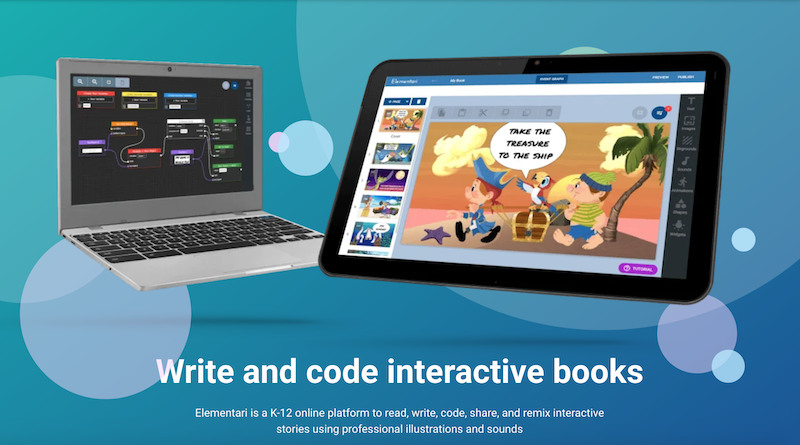
Elementari has a huge component that is based around computational thinking and trying to introduce coding concepts in a way that is not code to students who might not want to learn how to code.

~ Nicole Kang, Cofounder of Elementari

Creators: Nicole Kang & David Li

Country: France

Interview Date: March 24th, 2019

Link to the Project: https://www.elementari.io/

Funding Method: Blood-Sweat-&-Tears, Freemium Model, Workshops & Speaking Engagements


Interview with Elementari’s Nicole Kang


The Project : What Is Elementari?

Elementari is an online platform for building interactive stories, designed based on a culture of remixing. Users are able to add their own imagery and sound, but the platform is ultimately designed to remix the professional illustrations and sounds of artists. These artists are automatically credited when an Elementari user publishes a story using the artist’s work.

While Elementari can be used by adults, and holds a lot of potential for creators such as ourselves, the platform was ultimately designed for Kindergarten to Grade 12 schools, teachers, and youth, as a tool to facilitate reading, writing, coding, game design, and building an understanding of crediting artists and of remix culture. In the interview teaser below (starting at time marker 01:59), Nicole talks about her sensibilities behind Elementari …


The Creators : Who Are Behind Elementari?

Elementari was co-founded by Nicole Kang and David Li.

Nicole Kang is a bit of a world traveller, born in the US and now living in France. She studied Management Science at MIT, but most of her work experience has been in education, particularly around scientific inquiry and STEM. Included in this was working in the Educational Arcade at MIT. Nicole’s interest education took her to Taiwan to pursue a Masters, where she ran into issues in conducting experiments in scientific inquiry, as she doesn’t write in Chinese. This created a shift to ESL and ultimately to developing the concept for Elementari, sparked on by a course in digital ebooks. Nicole recognized the need for Elementari in the course as they were using InDesign which at that time she found unnecessarily complicated, frustrating, and impossible to share. All things that Nicole believes are counterintuitive to what education should. Rather she believes education should be open to everyone, allowing everyone to be able to learn, catalyzing her to leave her Masters to begin to build Elementari. In building Elementari, Nicole primarily focuses on the packaging, the marketing and the backend website development.

  • Nicole Kang

Meanwhile, David Li has focused on building the authoring tool. David’s background before starting Elementari with Nicole was in engineering, management, and linguistics.

I believe education should be open to everyone, allowing everyone to be able to learn.

~ Nicole Kang, Cofounder of Elementari

Road to Funding Sustainably

Early Days, Solving the Initial Challenges

Two of Nicole and David’s early realizations in developing Elementari and a sustainable funding model behind it were:

  • that they needed to have something built to show, in order to attract funding to the project; and
  • that they needed assets in the forms of illustrations and sounds for Elementari users to build their stories with.

After some initial unsuccessful pitching of Elementari in Taiwan and France, Nicole and David realized from comments like, “What’s the point of creating stories? Who reads stories? Who wants to write stories?” and “If you only need $100,000, then since you went to MIT, why don’t you just ask your friends and family to pitch in and pay for it?”, that they were going to need to build and demonstrate what Elementari was capable of, before continuing to invest their time in marketing the platforms to potential funders. Despite never having undertaken a digital development prior to Elementari, David and Nicole were determined that they could solve the first problem by teaching themselves and building Elementari on their own to present to potential investors. Impressively, they have done just that.
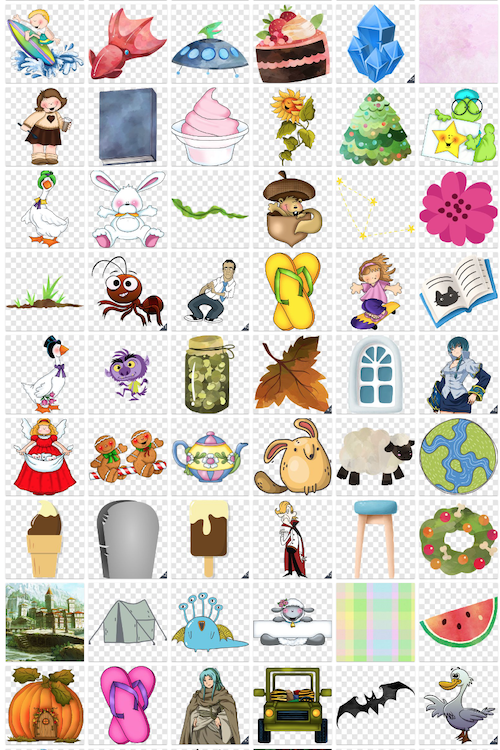
Not being artists, the need for assets needed a different approach to solve. For this, they recognized that many illustrators were sharing their assets on social media for likes, but that was the limit to the engagement they were creating around their illustrations. So they decided to invite artists to share their images on Elementari for users to build stories with. This enabled the artist to build upon their portfolio for marketing purposes, by giving them stats as to how Elementari’s user base are utilizing their images, and which images are the most popular. This has worked for them, attracting in artists like Len Smith, who illustrated Toontown in Who Framed Roger Rabbit, and Richard Walsh, who illustrated the Math Blaster Reading Series. Surprisingly Elementari’s team discovered that it wasn’t the young art students who were interesting in contributing images, but rather the older professional artists. They think this is because the professional artists like the idea of kids being able to use their artwork to create stories, they enjoy this different avenue to promote themselves, and as they see the future potential in profit sharing with the platform.

Funding Structure for Elementari Users

Currently Elementari is free for everyone to use to create stories with a limited library of images and sounds. A paid Premium version of Elementari gives users access to the entire library of images and sounds.

Similarly there is a free teacher tier for educators that allows for one class of up to 35 students, and then Premium versions for more capabilities, unlimited classes, more students, and for schools and school districts. You can see an example of Elementari’s plans for January 2021 below.

It is the Premium Educational Plans that the Elementari team sees as their sustainable funding model for the future.

We don’t want to put a barrier in the way for anyone to create. We want the disadvantaged kids to still be able to make their dino stories into reality. That’s one of our main goals.

~ Nicole Kang, Elementari Co-Founder

All the educational support materials that are being built to teach lessons with Elementari are public, and teachers are encouraged to adapt and remix to suit their individual classroom needs. Those can be found by clicking here.

Other Funding Streams

Other ways that Nicole and David are helping to fund the early days of Elementari, include:

  • writing workshops, and
  • pitching the Premium Model.

As part of pitching the Premium Model, they have been taking on educational partners to run case studies and develop curriculum. During the case study and curriculum development, the partner gets free use of Elementari, and then after the case study and curriculum development, the partner has the option to sign up for Elementari at a reduced rate provided they wish to continue using Elementari.


Future Building

In the future, some of Elementari’s goals include:

  • profit sharing with their artists (aiming for up to 70%),
  • working with the schools to create examples of what a good classroom library would look like to help convince the school gatekeepers that Elementari is a good investment for their school,
  • the option of non-remixable stories for sensitive content and for professional writers,
  • ability for readers to choose their own characters for a story.

Ultimately, creating a bottom up, product creation approach to marketing is what Nicole believes will work for Elementari. Basically working with educators and kids to demonstrate what is possible, in order to get Principles, School Districts, and Parents to buy in. It is with that in mind that Elementari has approached the COVID-19 pandemic, giving teachers and parents access to a free classroom account on a trial basis, offering a free virtual coding club, hosting free webinars for educators, and offering virtual field trips for Hour of Code.

Other strategies that help to market Elementari are:

  • that the stories are embeddable on other sites, and
  • an Elementari Ambassador Program with percentage sharing on sales.

Final Thoughts on Being an EdTech Entrepreneur

Some final reflections and advice from Nicole on being an EdTech Entrepreneur …


Have a question for Nicole? Ask it in the comments below, and we shall see if we can get you an answer.

A enormous thank you to BCIT for sponsoring this case study, to Grant for the Web for funding the broader Sustainable Funding Series,to the AMTEC Trust Award and CNIE for funding my professional development work around this work, and to David Porter for acting as an advisor to me in this work.

Filed Under: #StoryToGo, Case Studies, EdTech, Erica Hargreave, Storytellers, Sustainable Funding Tagged With: Elementari, sustainable funding

Canadian Artist Denis Nokony Invites Those Who Wish to Celebrate the 46th American Inauguration to Use his Artwork ‘Peace Arch’ Online for Free

January 20, 2021 by Erica Hargreave 2 Comments

Peace Arch, an acrylic painting by Denis Nokony, celebrating the unity and friendship between Canada and the United States

In tribute to the 46th American Inauguration of President Joe Biden and Vice President Kamala Harris, our friend and Canadian artist Denis Nokony invites anyone who wishes to celebrate the unity and friendship between Canada and the United States of America to utilize his artwork entitled ‘Peace Arch’ for free online, provided they credit him as the artist, are not making money from sharing the piece, and do not alter the image.

‘Peace Arch’ by Denis Nokony

‘Peace Arch’ – About the Artwork

‘Peace Arch’ is a 38”x 40” acrylic painting on canvas that was first created in 2004, representing our shared border between British Columbia and Washington at Peace Arch Park in White Rock, BC and Blaine, Washington. It’s day has come to be shared on the inauguration of Joe Biden and Kamala Harris.

Denis Nokony – Meet the Artist

Denis looking like the badass artist in his pandemic mask.

As written by Robert Enright of Denis Nokony’s 1981 exhibition at the Mendel Art Gallery entitled, ‘Figure in Landscape: Drawings’, “The drawings present a synthetic relationship between the figure and the landscape, between being and space, and between quotidian observation and dramatic realism. Mr. Nokony is involved in a process that is both a retrieval and a reinterpretation of prairie space through its human dimensions.”

Landscape and sky feature prominently in much of Denis’ artwork, perhaps as a result of his upbringing in the Canadian Prairies, having been born in Oxbow, Saskatchewan. He became interested in drawing and caricature at an early age. Having, however, only ever taken one drawing course from Canadian painter Reta Cowley, as a young university student at the University of Saskatchewan where he studied political science, he considers himself to be a self-taught artist.

Pre-Covid photo from the Burnaby Blues and Roots Festival with this writer, Matt Andersen, and Denis Nokony.

Over the years, Denis has had a number of careers, in which art has played a prominent role from commercial artist and freelance illustrator to art teacher to arts development officer to Assistant Director for Cultural Services for the City of Burnaby today. Throughout all of this, Denis has continued to create and exhibit his art. While his medium of choice has predominantly been drawings and paintings, it has also include a National Film Board short animated film entitled ‘The Giant‘.

To touch base with Denis or inquire about his art, he can be reached at denis[at]storytogo.ca.

Filed Under: #StoryToGo, Erica Hargreave, Our Community, Storytellers Tagged With: Denis Nokony

Representation in Digital Gaming, Media Arts and Tech – Lived Stories

December 19, 2020 by Erica Hargreave Leave a Comment

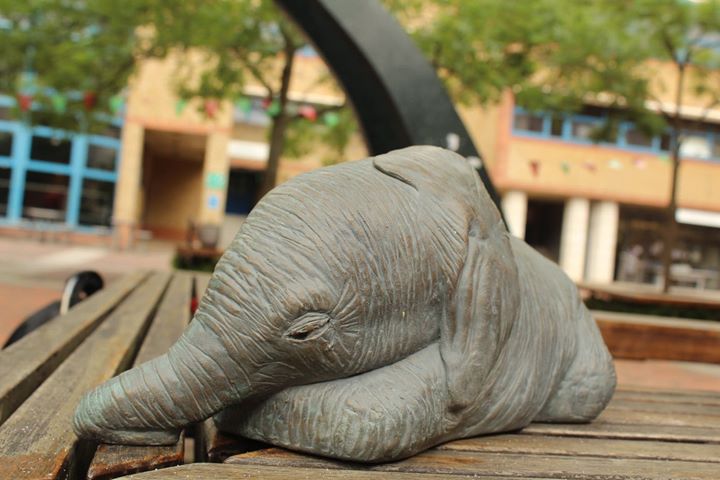
aka the Elephant in the Room that people may dress up and be sickly sweet to, while they stab behind their back and behind closed doors.

Photo care of Ragn27.

Sorry that might sound harsh, but the fact that some people choose to put others down, be aggressive towards them, treat them of lesser value, and / or abuse them because of the colour of their skin, their ethnicity, their gender, their disabilities, their sexuality … etc really makes my blood boil, and leaves me generally feeling sick. Having said that, Representation and Representational Problems is a conversation we need to have to instigate change, and part of doing that is sharing our stories, despite how uncomfortable that might be. Admittedly, that was not something I realized until I became an adult. I grew up in a blissful world where that equality existed, having grown up in a family that was a mix of the arts and science with people from around the world sharing our holiday dinner table and where my parents saw each other as equals (which of course they were). It never occurred to me that that was not the norm (at least in Canada – I had seen racism and sexism in my travels), and that some people would think themselves better than another because of their skin colour, religion, gender, sexuality, or able-body. Or at least it didn’t until I began working in the media arts and technolgy.

As I set off on a walk with my 17-year-old neighbour this past weekend to talk about her aspirations in the media arts, these were all things we talked about as we explored the challenges along with the rewards of the industry she is setting forth into.

Sharing a picture of Ella here, who joined us on our walk, for a bit of grounding in a heavier post.

Importance of Characters Whom Young People Can Relate to

My neighbour is a visible minority in Canada, and so while we talked about the importance of crafting stories that you are passionate about, we also talked about the importance of increasing representation within those stories.

I told her how when I pitched my first kid’s TV series, a Canadian broadcaster told me we couldn’t do a co-production with another country as Canadian kids would not relate with children that looked and sounded different from them. Having grown up on stories from around the world and loving learning about different cultures through stories, I was at a complete loss that this was a Canadian broadcaster’s believe in a country that is made up of people from around the world. My young neighbour then told me that she’d grown up in Canada never having seen Filipino culture (her ethnic heritage) represented within the stories she consumed.

That’s a problem, as while it is great to learn about different people and cultures through your stories, if you never encounter someone like you, you feel at odds with others and a bit alone. As mentioned in Kateryna Barnes’ article on the game Kisima Innitchuna (Never Alone), stories are also an important way of connecting with your cultural roots and sharing that culture with future generations.

While not a visible minority, I do get that sense of feeling alone and at odds with others from a disability perspective. I am dyslexic, and I can’t help but wonder if I’d met a dyslexic kid in my stories growing up, if that might have helped me with my confidence in embracing how my mind works differently at an earlier age, rather than feeling I was not as academically capable as my peers. Instead, when I was younger and I encountered people with a disability in a story, they were usually negatively depicted, teaching me at the time that this was something I should hide, as media treated disability as though it was something to be embarrassed of.

For all these reasons, I am glad to have conversations like this with my young neighbour, and look forward to seeing how she addresses this in her career. I am also glad to see people like Nicole Kang addressing it on Elementari, an animated storytelling and game development platform targeted to kids and schools. If kids can put characters that they relate to in their stories and games, then they can help to start to demonstrate for others the storyworlds they wish to see.


The Dark and Unwelcoming Alley Out in the Open in the Media Arts, Tech & Game Studios

While lack of representation or representation only as evil, weak, and broken characters is destructive to the psyche and identity, what really makes my blood run cold and what I needed to forewarn my young neighbour about is the very real culture of misogyny and sexual harassment. I did not want to terrify her, but I did want her to be aware of the dangers in the media arts (and particularly game design) in order to keep herself safe.

Illustrated by Naomi Ushiyama; Indypendent / Creative Commons

Trigger Warning

I have been very lucky in that I have never been raped, but I have found myself in dangerous situations and I have found myself in psychologically abusive situations by people I thought were my friends. While I didn’t go into all of this with my young neighbour, before you read on, I should warn you that this will not be a pleasant read and may trigger things, so stop here if you need to.

As much as I hate to term it this way, I was ‘eased’ into this culture of misogyny and sexual harassment by the film industry. In that world as a young writer and actor, I learned never to trust that a business meeting was a business meeting and that a man wanting to partner with me wasn’t just them trying to sleep with me. I’m not saying that egotistically, it was just a reality, and not one that helped build my confidence in myself as a young creative. As an example, a talented director chased me for months for a meeting and when I agree and then accept an invitation to a screening party at his house with his friends, I arrived at the screening party to discover no friends and no screening. That was the night a director tried the ‘casting couch line’ on me. He was a documentary director, so I am not sure what I was to be cast as – a victim? Then there was my producer friend, who I discovered on more than one occasion using me as a lure for unstable, stalker men (I am not embellishing here – these men stalked me for months) he wanted to do business with. One of those men, I made the mistake of working for in a remote ferry-in ferry-out community as a writer and a host, before realizing that he was very unhealthily and dangerously obsessed with me. I will be forever grateful to my friend Tristan for insisting on accompanying me when the producer announced he’d only pay me if I came to pick up my pay cheque. I should add that there are some amazing men in the industry, like Tristan, Cam, and Richard who have always looked out for my safety and well-being, and there are some women that contribute to the problem of the misogyny and sexual harassment. With the latter, I am remembering one film festival when a powerful married man in the film industry was rather inappropriately and boisterously hitting on, which I dealt with by falling on my safety net of turning that into a joke. Meanwhile I learned a number of the women in the room thought I was to blame. A tip of my hat at Richard, Cam, Joanne, and Katrina for standing up for me and telling them otherwise, as well as for helping to safely extract me from the situation.

A younger me with my buddy Paul (a wonderful fellow) in our first TV Show.

All of that though was just a warm up act to what I encountered in the tech and peripherally gaming industry in 2007. There I found myself in a world in which the few of us women that were there were treated like sexual play things to use and abuse both for our minds and our bodies. On the surface the parties were fantastic with free food and booze flowing, but then you’d see how the young women were being treated as toys and someone would turn to you and ask you (in all seriousness) for a lap dance. In those early days, the same individual that asked for that lap dance, publicly claimed mine and Megan’s ideas as his own and that Megan and I were ‘working for him’ on an idea of ours that we’d entered into a partnership with his business partner. On one of my calls to their office to try and get some tech answers for that project, after getting nowhere with the lap dance requester, I asked for his business partner’s cell number so I could talk to him, and I was then put on speaker phone to their entire office and told who was I kidding, I had the partner’s number, as I was sleeping with him. I was not sleeping with him, but I am sure there are many in the tech community who still think thats how I got started there. That then lead to an uncomfortable conversation with the business partner, in which he confirmed with those that had been in the office that day that I had indeed been put on speaker phone to the entire office. Despite that, I still had to deal with the lap dance requester on the upcoming project, and when he started aggressively bullying me, the business partner did nothing when I asked him to step in. That was the first time I’ve ever asked for help in such a situation, and as someone who only asks for help when I really need it, I could not believe that no help was given. Another disturbing memory from this time was when a certain large tech company hosted a retreat that began with a drunken and bound to be trouble series of images all hashtagged on the bus ride up, including all the men lined up and peeing at the side of the highway. It was when they reached the camp that things went disturbingly badly. There were only a few women there, and after they reached the camp, one of the men shared one of the woman’s bare breasts on instagram with the trip hashtag. I commented and said that was not cool. The response was something to the effect of “Lighten up, I didn’t share her face.” That didn’t matter, as aside from other reasons, there were so few women there that it didn’t take too much figuring out as to who was in the photo. Thankfully the one female leads at the company stepped in a few minutes later and shut things down, but I still shudder to think what the situation might have been at that retreat for the few women that were there. There was good that came out of all this though, and thanks to few strong women leaders in the industry – I think of Maura Rodgers, Megan Cole, Rebecca Bollwitt, Monica Hamburg, and others, we said enough is enough and began to catalyze change. It wasn’t easy though, and I am sure it still has a long way to go.

Just a few of the strong women who stood up to the misogyny in Vancouver’s social tech industry back in 2007, as photographed by Phillip Jeffrey.
Image care of Alec Perkins, via the Wikimedia.

Just because the misogyny and sexual harassment may be less visible, especially since #MeToo, don’t kid yourselves – the problem is still there. I got a very disturbing reminder of this in the summer of 2018, when I stayed too long at a party of a guy that I trusted and thought was a friend. While that night a married man tried something inappropriate and unasked for with me, it was the friend that disturbed me – attempting to remove my top and that of another woman’s and starting to ask me ‘would I rather’ questions that involved gang rape. The glimmer of hope here was that a young kid, who worked for the two older men stood up for me, and told the aggressor that wasn’t cool.

I extracted myself from the situation in the way I always do, with humour. However, that night has disturbed me ever since, and I’ve found myself avoiding events in that world. Mainly I think, because that was someone I thought was a friend, and the night clued me into just how insidious the aggressor had been for years, doing a number of things to constantly put me down to myself and others. In thinking back, I realize this started with me standing up to him and offering an alternate viewpoint on a panel at a film festival. A disturbing element of realization that I’d been in an insidious and emotionally abusive relationship for years was that he’d been actively putting me down to others through the entirety of my attempting to put my life and career back together following my two accidents that left me learning to live with chronic pain and many new realities. I share this last bit, as the last seven years since the first car accident has opened my eyes up to those that prey on those with disabilities and other vulnerabilities, including this man who I thought was my friend and should have been there to help me back up, rather than further push me down and work to keep me there.


Creating Change

Now, while I didn’t share all of that with my young neighbour, I did share some of it, including the recent story, as I feel if change is going to happen, we need to talk about these things, and for her, I need her to be forewarned and forearmed so that she can stay safe.

Towards the end of our walk we did touch on the fact that she needed to be particularly careful in the game industry. I know for myself, I’d be very wary of entering a mainstream game studio for the reasons shared here and how unhealthy and misogynistic an environment that might be for me. That is part of the problem though, is that if women don’t feel safe in these spaces it makes it difficult to change those ecosystems.

What the face of hope and change look like to me – working with awesome creatives, like Kelly Conlin, who get excited about creating projects with me that share stories of cultural understanding and share the voices of those who should be represented equally.

I think for myself, that is why I finally started building my own teams and finding new ways of creating and producing what is in my imagination, as oppose to waiting for the permission of another to do so. I am not sure whether games will be in that mix for me (although there are a few that have been dancing through my imagination), but certainly there will be more immersive media, in which I hope to continue work with talented and supportive individuals (whether women, men, or those who identify in a different way). I hope that my young neighbour is able to do the same, and who knows, maybe at some point that will involve us creating together.


References

Barnes, K. (2019, July 24). Agniq Suannaktuq and Kisima Innitchuna (Never Alone). First Person Scholar. http://www.firstpersonscholar.com/agniq-suannaktuq-and-kisima-innitchuna-never-alone/

British Dyslexia Association. (2018, February 11). See Dyslexia Differently [Video]. YouTube. https://www.youtube.com/watch?v=11r7CFlK2sc

Jenson, J. & de Castell, S. (2016) Gamer-Hate and the “Problem” of Women: Feminism in Games. In Kafai, Tynes, & Richard (Eds.) Diversifying Barbie & Mortal Kombat: Intersectional Perspectives and Inclusive Designs in Gaming. Pittsburgh PA: ETC Press.

Innocenceii. (2020, June 8). Why YOU Would ???? at Being a Main Character [Video]. YouTube. https://www.youtube.com/watch?v=1wOEnUtxO7Q

Never Alone – Kisima Ingitchuna. (2014, August 14). Never Alone – Iñupiaq Perspectives – Joseph Sagviyuaq Sage [Video]. YouTube. https://www.youtube.com/watch?v=BK1IsVEjZKE

One Down. (2020, October 1). Filipinos in Entertainment | Breaking The Tabo | Episode 1 | One Down [Video]. YouTube. https://www.youtube.com/watch?v=9jusUSUTfm4

StoryToGo. (2020, March 15). Creating Diversity in Story Characters – a Chat with Elementari’s Nicole Kang [Video]. YouTube. https://www.youtube.com/watch?v=MxmLNc2Q934

Filed Under: #StoryToGo, Community Building, Erica Hargreave, Gaming, Storytellers Tagged With: changing the story, representation

Gaming Learning from the Perspective of a Science Educator

December 17, 2020 by Erica Hargreave Leave a Comment

Reflecting on Learning through Games and Constructivism

Image care of Rafael Javier.

Recently, as I read Yasmin Kafai and Quinn Burke’s article Constructionist Gaming: Understanding the Benefits of Making Games for Learning and Kelly Tran’s article “Her story was complex”: A Twine workshop for ten- to twelve-year-old girls, it has had me reflecting on learning through games, constructivism, how I teach, and my own learning styles. With science and science education being central to my development as an individual, storyteller, and teacher, this naturally had me thinking on my years as a science educator, as well as what got me excited about science as a young person, and how that shaped my teaching in other subjects, including media arts. Through these reflections, I recognize that I’ve missed valuable learning experiences to not only create game based learning experiences for my students, but to get them designing the games.

The Predator-Prey Game – a game that taught me a lot both as a kid, and as a teacher when I developed this game for my students. In hindsight, getting my students doing the developing would have been an even richer learning experience. Image care of the Waterloo Nature Club.

The Twine below represents my reflections on Gaming Learning from the Perspective of a Science Educator.

You’ll need to give the Twine below a moment to load, in order for the black box to disappear.

[embed_twine story=”Gaming-Learning-from-the-Perspective-of-a-Science-Educator”]

I had another realization while reflecting and exploring project based learning and constructivism through the creation of this Twine, that perhaps this style of learning and education is what we need in order to allow diverse groups of students with different learning styles to succeed. Rather than prescribing how our students should learn and demonstrate their learning, constructivist project based learning allows student to find their own learning path in a way that works for them and allows them to shine. I always knew this is where I excelled as a student, and knew this is what built my confidence in my own academic abilities, and I have seen the same in the students I’ve taught, especially those who like me are considered to have ‘learning disabilities’. It hit me in these reflections that perhaps the reason for this is that when learning in this way, rather than telling others what they can and can’t do, and are and are not capable of, we are giving them the tools, platform, and freedom to create and discover for themselves, in a way that is meaningful for them – allowing them to approach learning and creating in a way that works for their individual needs. We need to make more such learning opportunities available to our young people, so that they too can shine and build their confidence.

Image courtesy of Gordon Johnson.

References

Kafai, Y. & Burke, Q. (2015). Constructionist Gaming: Understanding the Benefits of Making Games for Learning. Educational psychologist, 50, 4, 313-334.

Tran, K. M. (2016). “Her story was complex”: A Twine workshop for ten- to twelve-year-old girls. E-Learning and Digital Media, 13(5–6), 212–226. https://doi.org/10.1177/2042753016689635

Filed Under: #StoryToGo, EdTech, Erica Hargreave, Gaming, Storytellers Tagged With: game based learning, game design, project based learning

Understanding Games and Play from the Mindset of a Tortie Terror (aka my cat)

December 14, 2020 by Erica Hargreave Leave a Comment

Back in my days as a young Biology undergraduate student, I am remember sitting in a behavioural science class and feeling thoroughly frustrated by the ego and rather omnipotent thinking of the professor, who was lecturing us on his believe that non-homo sapien animals don’t play. Rather everything they do was tied in someway to survival. You just have to have well-loved furry or feathery friend in your household to know that is not the case.

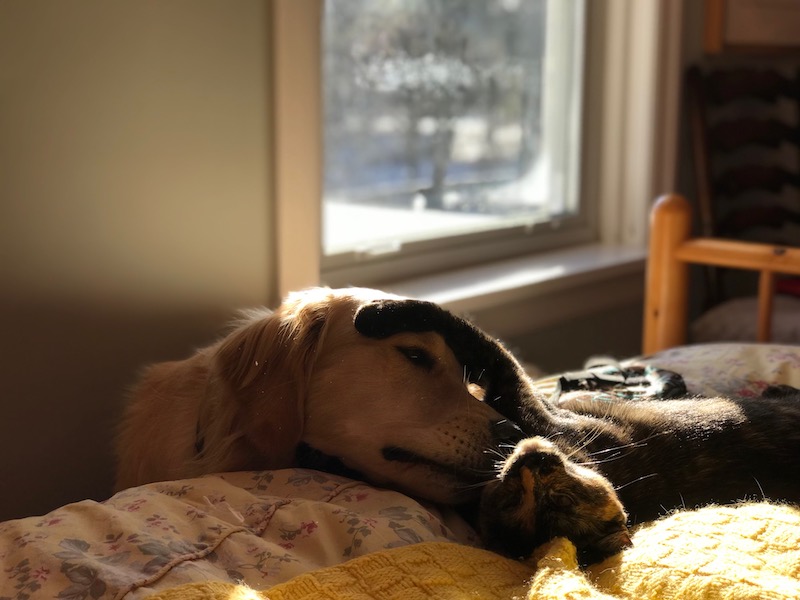
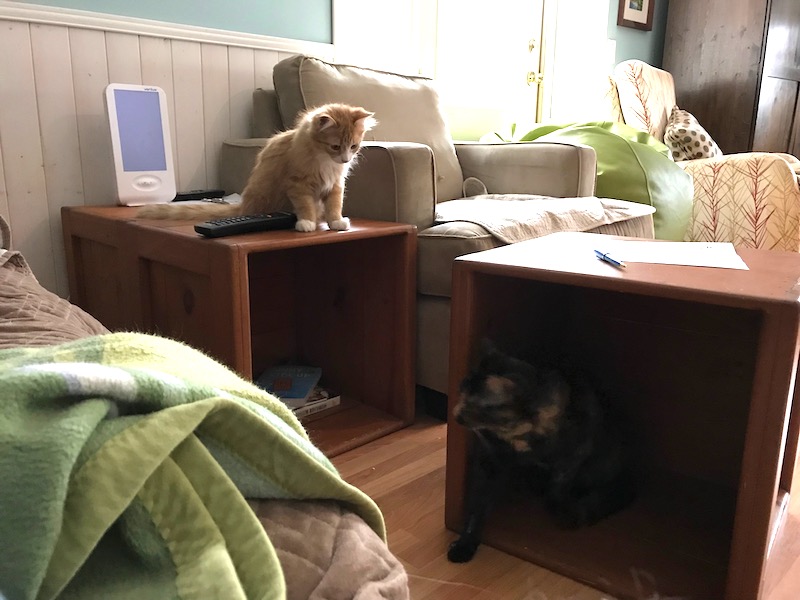
Linus nudging Ella into a game.

Going beyond our furry and feathered family members, in truly observing wild animals with an open mind you will see that not all they do is about survival. While not a play example, this was something I pondered one day, as I watched the heartbreaking scene of some ground squirrels who didn’t want to leave a fellow ground squirrel who had been hit by a car. Each time they returned to the dead ground squirrel’s body, they were putting their own lives at risk. This wasn’t about survival for these ground squirrels, quite the contrary, they were risking their lives in mourning the death of a member of their community.

It made me smile as I began to read Johan Huizinga’s exploration of play in his chapter on Nature and Significance of Play as a Cultural Phenomenon in The Game Design Reader: A Rules of Play Anthology that he noted that play is older than culture. Non-homo sapien animals did not wait for humans to teach them to play. They were already playing. As I continued to read Huizinga’s chapter and that of Roger Caillois on The Definition of Play and the Classification of Games, I watched my young cat Ella (aka the Tortie Terror) who throws herself into play with such total abandon, and what I observed echoed so much of what had caused me to question and resist years ago in that behavioural science class. First though, let me introduce you to Ella.

To advance the pages in the story above, click the flashing arrows, and where you encounter an image with a glowing edge, click on those images.

Games and Play from the Mindset of a Cat

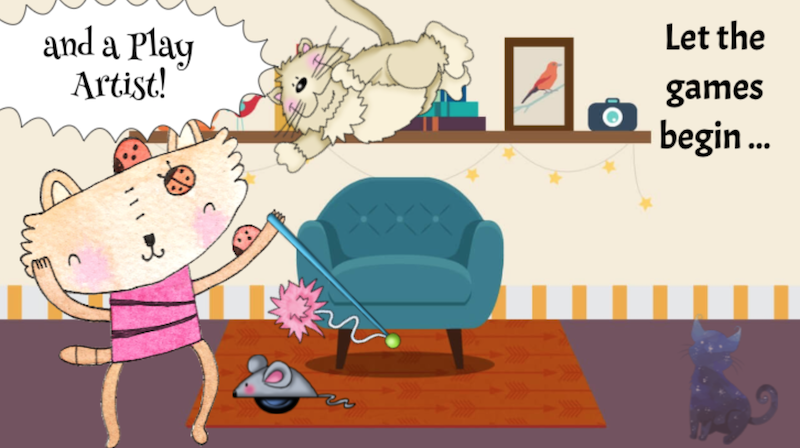
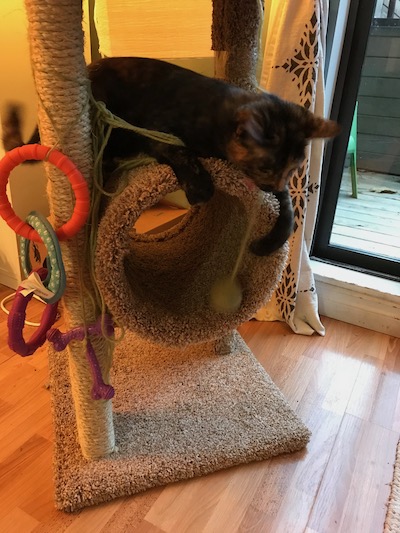
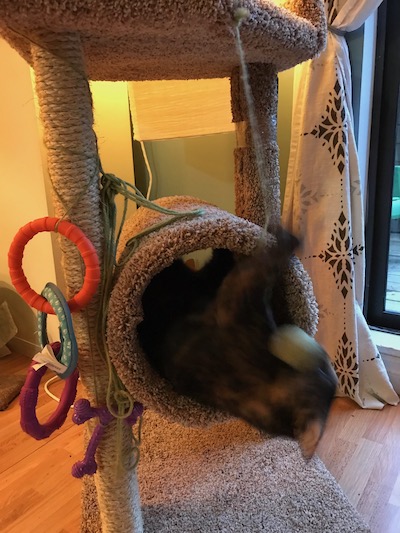
Play and the creation of games are paramount in Ella’s life. She plays the regular games of chasing feather wands, catch with toy mice, and fetch with toy springs, but for Ella, the best games are those that she’s invented and taught to me. These include Run, Jump & Startle, Lure & Surprise, and Hide & Go Seek Tag.

Run, Jump & Startle

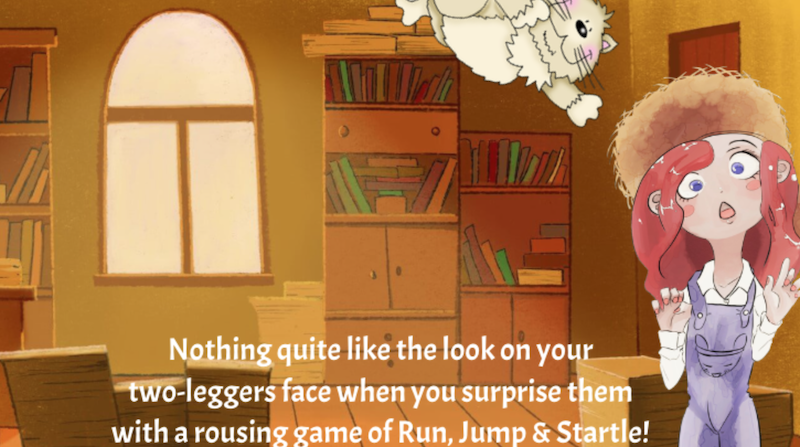
Run, Jump & Startle is usually started by Ella rampaging past me in a crazy flurry with a little “roo roo” in passing me. This is my queue to more subtly creep in her direction or walk by her and pretend not to see her, and then jump in front of her with my arms out. She then similarly jumps in front of me with her arms out, and usually shows off by parkouring off a wall, at which point we both dash off to hide again and attempt to then non-chalantly creep up on the other to be the jumper.

Lure & Surprise

Lure & Surprise is a relatively new game of Ella’s that is usually played at night in the dark. It involves her finding a way to lure anyone in the house towards her, usually by yowling as though something is wrong. As that creature (this game is played with my Mom’s dog, as well as with me) goes to see what’s wrong, she launches herself at them, and then after startling them goes running off to hide somewhere else in the dark.

Hide & Go Seek Tag

Ella trying to entice her cousins into a game of Hide & Go Seek Tag.

Typically Lure & Surprise then evolves into Hide & Go Seek Tag, which is also played in the light. This is like the children’s game of a similar name, where one hides and the other seeks, but in this case everyone is hiding and seeking at the same time with the goal of being the first to sneak up on the other, making it a much faster paced game.

Characteristics of Play

These games that Ella has constructed follow the fundamental characteristics of play as listed by Roger Caillois and echoed by Johan Huizinga’s in his writing.

  • Free – Elle begins the games with freewill, under no obligation, as do her opponents. If anyone should decide they no longer wish to play, they simply stop or walk away.
  • Separate – These games exist in their own time and space, in which the real world is temporarily suspended.
  • Uncertain – There is never any certainty as to who will prevail as reigning champion. Usually each play results in wins on both sides.
  • Unproductive – Nothing is created over the course of play, rather it is simply a release of joyful energy.
  • Governed by Rules – While the rules are unwritten and created by a cat, all the games have clear and definite rules that have been taught to the other players through demonstration by the feline game creator, who is quite bossy about her expectations of the players.
  • Make Believe – It is clear that within the game each player is entering the realm of make believe, in which in my mind we enter a land of spies and ninjas. As for Ella’s mind, I dearly wish I could see inside her imagination to know, but I do know that within the game I have clearly been transformed into a character of her imagination based on the wild looks looks she gives me mid game.

Imagination Central to Play

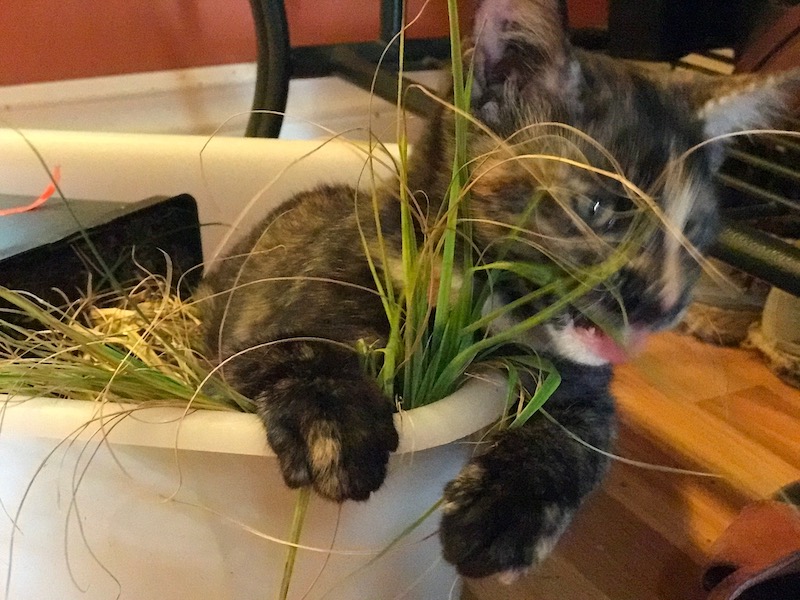
A young Ella fancying herself a jungle beast and demolishing the grasses from the garden store.

It is this element of imagination that both Caillois and Huizinga speak of as being such an important component to play that I find most fascinating and amusing as I watch Ella play. She is by far the most active player of any furry family member that I’ve lived with, and that is clearly denoted by a cat with an enormous imagination. When left to her own play, it is not unusual to see her all of a sudden fluff up her fur and start jumping sideways. Is this because she is angry or scared? No, she is simply playing, and something in the imaginative world that she has concocted in her mind is causing this external reaction in her to the amusement of those of us that have been fortunate enough to witness these play acting moments in her life.

Fostering Wellbeing Through Play

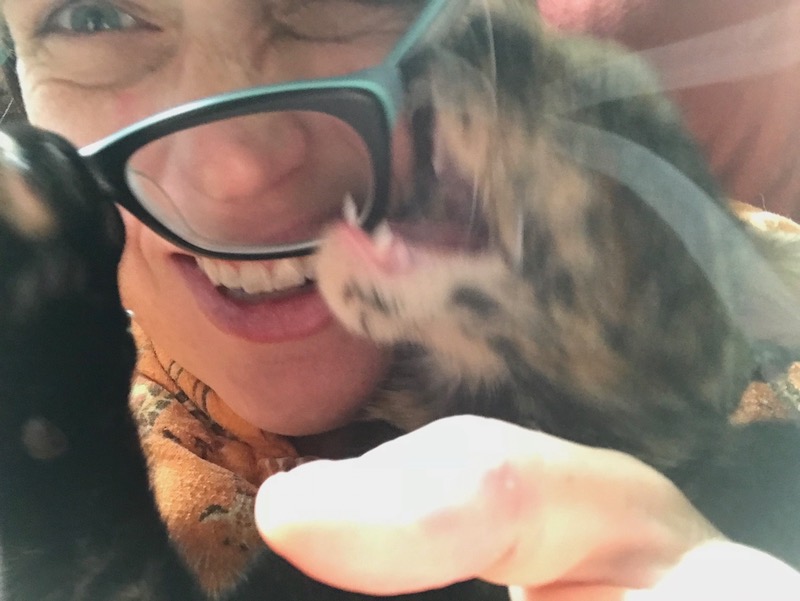
Ella’s kitten game of Steal Mom’s Glasses, which she has yet to outgrow, but rather gotten much sneakier at. Always good for a chuckle between us.

For me, Elle has illustrated the importance that play can have on our wellbeing as creatures. She came into my world in a summer in which I was badly concussed after a car accident. It was her imaginative play on her own, and enticing me into the games that she concocted, that got me laughing and moving again, as well as scheming to beat her at the games she laid out before us. It is quite amazing how the simple act of playing can be so incredibly healing.


References

Caillois, R. The Definition of Play and the Classification of Games. In K. Salen and E. Zimmerman (Eds.) The Game Design Reader: A Rules of Play Anthology (pp. 122-155). Cambridge, Mass.: MIT Press.

Huizinga, J. Nature and Significance of Play as a Cultural Phenomenon.In K. Salen and E. Zimmerman (Eds.) The Game Design Reader: A Rules of Play Anthology (pp. 96-120). Cambridge, Mass.: MIT Press.

Filed Under: #StoryToGo, Erica Hargreave, Gaming, Storytellers Tagged With: game design

OE Global 2020 : A Case for Virtual and Open Conferences to Bring People Together to Share Ideas

November 23, 2020 by Erica Hargreave Leave a Comment

#OEGlobal20 - a virtual and open conference

I had the great pleasure last week to participate in the OE Global 2020 Conference virtually from my home in Richmond, BC, Canada. While I have attended other virtual events and conferences throughout the year, this one was a bit different, and more engaging and exciting for me for a number of reasons:

  • Firstly as I had been invited to speak at OE Global 2019 in Milan, but had not been able to afford to attend, it was wonderful that a virtually hosted conference made that possible.
  • Secondly as I had met a number of the delegates for the first time at another conference in 2019, and I was looking forward to ‘seeing’ them again.
  • Finally, as the conference was designed in such away to accommodate people from around the world, and as Alan Levine had created an online community for delegates to connect before, during, and after the conference.

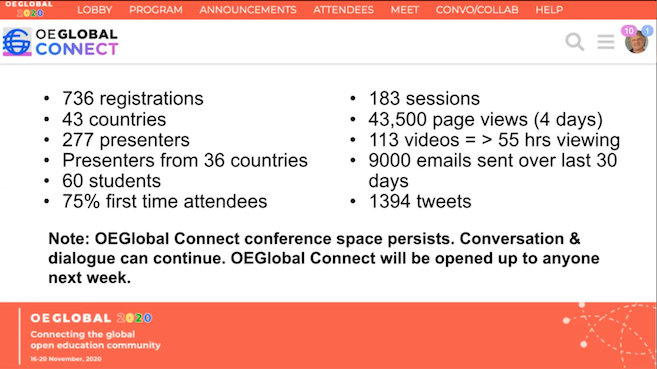
All the hard work and strategy that the team from Taipei Medical University, OE Global, eCampus Ontario, and TU Delft put into organizing the conference paid off. Just look at the stats below.

The conference statistics from the OE Global 2020 Conference.

It seems I was not alone in the question of affordability and accessibility opening up the conference. “75% of the people were first time attendees. Doing this conference in an online fashion enabled a lot more people to participate, who perhaps wouldn’t have been able to if we’ve done it in-person.” ~ Paul Stacey of Open Education Global

One of the exciting things moving forward, post the conference is that OE Global has made all of the recorded talks open and accessible on YouTube, and will be opening up OEG Connect for others to join in the discussion and begin working together on open educational initiatives.

As you begin exploring OE Global 2020, below are the talks and workshop that I gave with others here on StoryToGo, including Lori Jones, Danielle Dubien, Lori Yearwood, and Kevin Ribble:

  • Drawing Eyes and Building Awareness Around OERs

  • StoryToGo : Building Global Connections, Opportunities and Sustainability in the Middle of a Pandemic

  • Are You Asking? Accessibility of Open Educational Resources in Online Learning

These are all projects and initiatives that we’d love to invite others to participate in. Join in the conversation, brainstorming, and planning on OEG Connect:

  • Drawing Eyes and Building Awareness Around OERs
  • StoryToGo : Building Global Connections, Opportunities and Sustainability in the Middle of a Pandemic
  • Are You Asking? Accessibility of Open Educational Resources in Online Learning

Hope to see you in the mix on OEG Connect!

Filed Under: #StoryToGo, Case Studies, Community Building, Erica Hargreave, Events, Storytellers Tagged With: open education, virtual conference

« Previous Page
Next Page »

Primary Sidebar

#StoryToGo is a community designed to reflect storytelling today – shared both through traditional means of oral storytelling, radio, film and TV, and print; in addition to newer forms of media storytelling through the digital arts, including gaming, blogging, online video, and social media.

Explore Past Posts


Tags

accessibility AI for filmmaking AI for videography AR art art therapy art therapy activities augmented reality BCIT clown crowdfunding crowdsourced Elementari elevator pitch Extended Reality FilmFreeway filmmaking game game based learning game design game development health and wellness home education improv inclusive design literacy NFT non-fungible tokens online learning open education phishing scam photography pitching poetry social media storytelling storyworlds sustainable funding universal design video game virtual conference virtual reality Web Monetization XR XR Development

On the Beat with StoryToGo

Follow along on StoryToGo’s digital magazine for our latest case studies, upcoming free courses and webinars, technology tips and tricks, story musings,  and our latest job boards!

  • Case Studies
  • Tech Tips
  • Events
  • Jobs
  • Our Community
  • Courses

Copyright 2012 © 2026 · Ahimsa Media · Log in