• Skip to primary navigation
  • Skip to main content
  • Skip to primary sidebar

StoryToGo

Exploring storytelling in its many forms in this digital age

  • Our Story
    • Our Creatives
    • Join the StoryToGo Community
  • Community Resources
    • Web Monetization Guide
      • Web Monetization Resource Library
        • Web Monetization Tutorials
        • Web Monetization Research Papers
        • Interviews and Case Studies on Web Monetized Projects
      • Web Monetized Content Library
        • Web Monetized Courses
        • Web Monetized Podcasts
        • Web Monetized Social Networking Platforms
    • Podcasting with my Cat
      • Sustainable Funding Series Vlogcast
      • Encounters in EdTech Podcast
      • The Creative Farm Podcast
      • Boma Global Studios Podcast
    • Job Board
    • Storytelling Case Studies
  • Digital Magazine
    • Accessibility
    • Art Therapy
    • Blogging
    • Case Studies
      • Analyst Report
      • Extended Reality
      • Sustainable Funding
    • Community Building
    • EdTech
    • Gaming
    • Immersive and Interactive Media
      • XR
    • Performance Arts
      • Acting
    • Social Media
    • Storytellers
      • Alex Charters
      • Bjorn Yearwood
      • Erica Hargreave
      • Henry Hargreave
      • Jennifer Rose Garcia
      • Lori Yearwood
      • Mary McDonald
    • Tech Tips
    • Web Monetization
  • Professional Development
  • Calendar
  • Contact

Gaming

Game Log 3 : 80 Days – Watching Gameplay

August 30, 2020 by Erica Hargreave 3 Comments

Continuing with my field notes in analyzing the 80 Days video game, as a part of my studies in Digital Games, Learning, and Pedagogy (ETEC 565S), this game log reflects my observations watching another gamer on their playthrough of 80 Days.

Game Log 1 – First Impressions Before Play
Game Log 2 – First Playthrough

Name of Game: 80 Days

This image has an empty alt attribute; its file name is Paragon-Plays-80-Days-Route.png

Date Analyzed:

Friday August 28th, 2020

Session 3: Video Observations

Watch an online video of your game, either via live-streaming (Twitch.tv) or conventional video (YouTube). Get a sense of how an expert plays that game: see how they understand and react to the game and how that differs from YOUR playthrough; see what it is like to watch the game not just as a viewer, but as a mass media spectator. Again, organize your account into three kinds of notes.

The gameplay that I watched was Gavin of Paragon Plays‘ Mutiny Aboard the Waterlily | 80 Days [Interactive Novel Gameplay].

a) Descriptive Notes

Document what the player is doing, paying attention to, ignoring, prioritizing, but also what they are talking about (i.e. what they verbally frame as important during the playthrough). Make notes of what the player is paying attention to, prioritizing, and/or ignoring and if and how that is different from your play.

  • Gavin was well read on Jules Verne’s novel, Around the World in 80 Days, and as such had an idea in playing, the sort of character that Passepartout is, and what sort of daring decisions he might make in parts – taking risks. I have to say, this lead to some fun suspense in the gameplay. As Passepartout says as they approached Bombay in Around the World in 80 Days, “Fortune favours the bold.”
  • I also gained some insights into the character of Phileas Fogg and how he might react to Passepartout’s decisions (based on Jules Verne’s writing of his character) from kebzero‘s gameplay, Let’s Play 80 Days – Around the World We Go! – Episode 01. It is important in maintaining character health and good relations with Phileas Fogg to think what an English gentleman might decide in a public interaction.
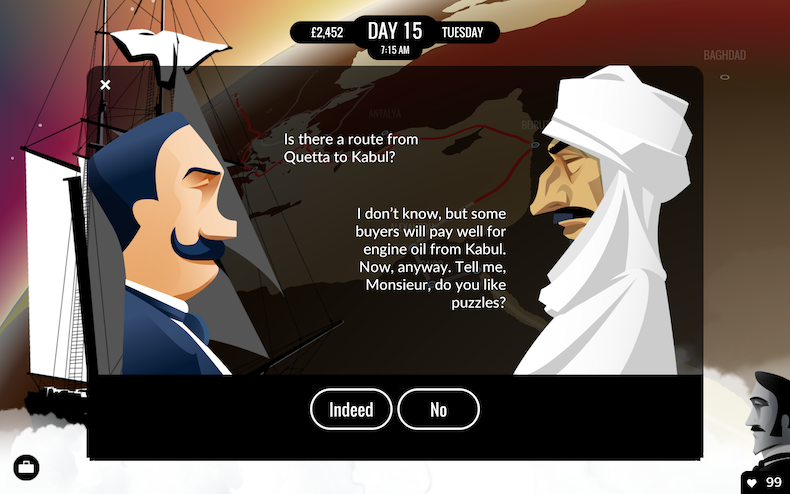
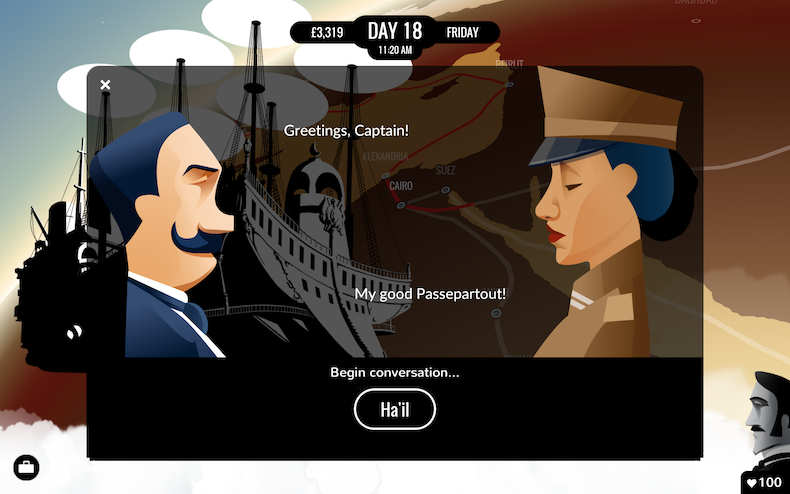
  • Gavin pointed out the importance of having conversations with passengers and crew members during transport, in order to quickly find travel routes and save time in each location.
  • So as not to waste time and to keep to story flowing, Gavin makes decisions quickly – this is definitely an area that I need to take note and tighten up in my gameplay.
  • Definitely important to keep a deck of cards to play whist, as that’s Phileas Fogg’s game of choice.
  • Somethings are not as they seem, like the ship the Waterlily transforming into a submarine. These hidden details are only shared if you engage others in conversation, and ultimately are only revealed based on the decisions that you choose to make and how your character is perceived.
  • Many other players are terming 80 Days ‘fan fiction’ or ‘further fiction’, which has encouraged me to reread Jules Verne’s novel, Around the World in 80 Days, so that I might enjoy some of the easter eggs and insider jokes in the game to the original novel, like meeting characters from the novel and the jokes around crossing the International Date Line.
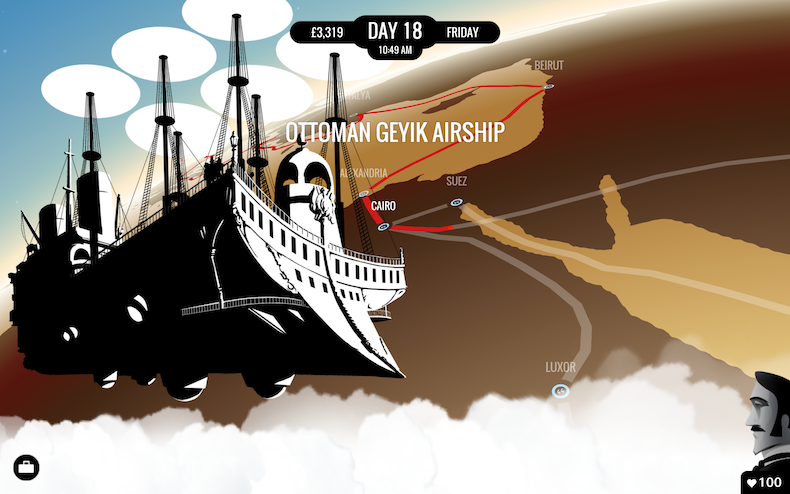
  • Apparently you can even travel to the North Pole and shave several days (even weeks) off your journey.

This image has an empty alt attribute; its file name is North-Pole-landing.png
  • Even if you don’t use certain routes or knowledge in one game, your character retains them for future games.

b) Affective Notes

What affective responses did you observe the streamer having while playing? What evidence did you have of their affective response/s? What did they choose to focus on? How were they different from responses and focus/foci you had? Pay specific attention to instances where you were surprised by something the video streamer said or did. And if possible, reflect on how affective responses impacted the ‘learning’ or ‘engagement’ you think can be recognized and documented from this observed play session.

  • Excitement – over the game, the adventure, and the invitation into a new world of stories started by Jules Verne’s Around the World in 80 Days.
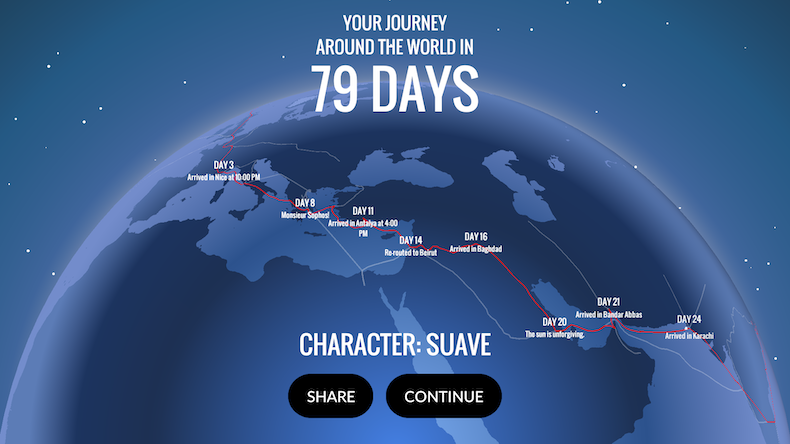
  • Accomplishment – over the route Gavin accomplished in making it around the world in 71 days, on his 3rd attempt at the game – after 2 previously failed attempts of play.
  • Anticipation – over visiting all the cities on the globe that Gavin has not visited yet, and the adventures that might unfold from there with encountering new characters and trade routes.
  • Relishing – in the fun story bites, and some of the choices Gavin made that garnered his character alliances.
  • A Note of Pride – at understanding the insider joke with regards to the dateline.
  • Frustration – at having to stop in Honolulu.
  • Disappointment – over first attempt of mutiny not working.
  • Hope – that there would be another opportunity for mutiny.
  • Amusement – at the graphics for the submarine and reading the voices of different characters.

This image has an empty alt attribute; its file name is Waterlily.png
  • Pride – at speedy travel by the submarine.
  • Pleasure – at words of praise from Phileas Fogg.
  • Excitement – at the idea of following the route of the book.
Gavin’s Focus

Gavin chose to focus on one small story within his journey, that he enjoyed, to share his gameplay from. I thought this was smart, as it kept his audience’s attention and left us wanting more. This had not been his original goal, which had been to share a full game from start to finish, but was a smart choice of circumstance, when his recording cut off.

In terms of play and choices within the game, Gavin leaned towards risky choses, mixed with humour, and camaraderie. This definitely lead to excitement, and has encouraged me to be a little bolder on my next playthrough.

This image has an empty alt attribute; its file name is Paragon-Plays.png

I really loved Gavin’s narration and storytelling. This has inspired a desire in me to film routes of travel and city visits in the game in short chunks in sequence to act as a serialized / chaptered bedtime story that I could share chapter by chapter to our StoryToGo YouTube Channel.

c) Analytic Notes

Review your descriptive notes and consider the problems the player encountered and the strategies/solutions that they enacted. Furthermore, consider how the player navigated/commented on issues/structures of race, gender, class, and violence. What did you notice about the game when you watched, as opposed to when you played? Any quick connections to make here to either Bogost or Taylor? Hold off on making any big conclusions for now.

  • Many of Gavin’s choices in the game had him fraternizing with the crew of the ship he was sailing on, which lead to stories in the game about friction between religions, and allowed for Gavin to use those to instigate change within the game, accompanied by a certain amount of expected violence inherent in the ensuing mutiny.
  • As Gavin chose to treat the female characters in the game with respect and as equals, this won him alliances that ultimately helped him in his gameplay. I noticed the same thing in some of the choices I made. I suspect much of this comes from having a strong female writer on the game, and wonder if the female characters in the game would be different, weaker or not in roles of authority if a man had been the writer of the game? That said, in beginning to reread Jules Verne’s novel, he too treated the women they encountered with a great deal of respect. However, sticking with the time, there were not as many women in their travels or in as strong roles. I am also curious how the game plays out differently, if one were not to treat those female characters with respect?
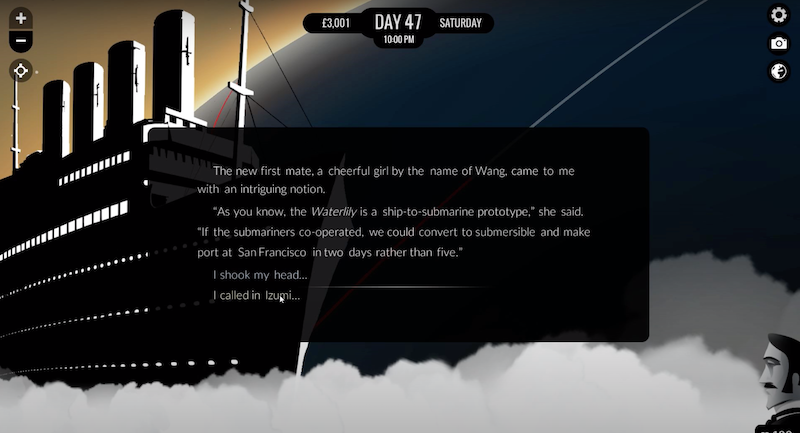
This image has an empty alt attribute; its file name is First-Mate.png
  • The main strategies I gleaned from Gavin are to be daring, make quick decisions, fraternize with the other characters within the game every chance you get, and familiarize yourself with the story of Around the World in 80 Days.

This image has an empty alt attribute; its file name is By-Jules-Verne.png
  • I am also gathering that it behooves one to make decisions within the game that show respect for other religions and female characters, which I have to say makes me smile.

Fieldnote Summary Session 3

At the end of your fieldnotes for session three, craft one or two sentences (no more) that, for you, summarize your observations of a more skilled player playing this game. Include one image that supports your conclusions.

I had a lot of fun watching Gavin of Paragon Plays’ gameplay of 80 Days. He drew me into the story with his wonderful narration and infectious excitement and sense of anticipation, encouraging me to make some bolder choices when I next play, quickly, and with an eye out for gaining understanding of other characters within the game’s circumstance and if I am able to catalyze positive change in that circumstance, whilst approaching my own task at hand.
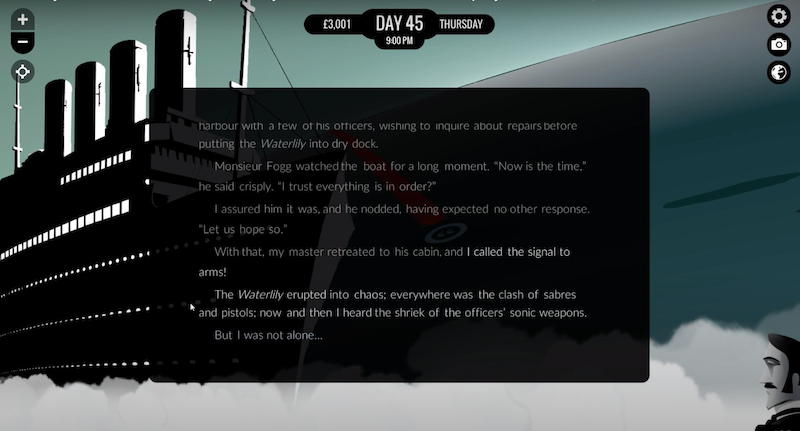

This image has an empty alt attribute; its file name is Mutiny.png

Filed Under: #StoryToGo, Erica Hargreave, Gaming, Storytellers Tagged With: game, video game

Game Log 2 : 80 Days – First Playthrough

August 12, 2020 by Erica Hargreave 2 Comments

Continuing with my field notes in analyzing the 80 Days video game, as a part of my studies in Digital Games, Learning, and Pedagogy (ETEC 565S), this game log reflects my initial experiences in my first playthrough.

Game Log 1 – First Impressions Before Play

Name of Game: 80 Days

Date Analyzed:

Tuesday August 11th, 2020

Session 2: Solo Playthrough

Play the game on your own: familiarize yourself with the controls, mechanics and interface; get an initial understanding of the game’s narrative and its aesthetic. Your goal is to “get a feel” for what it is asking from you, in terms of: inputs, emotion, and attention.

Note: If you use outside help at any point, make a note of that. The effort here is not to do anything “correctly”, but to diligently record whatever you do as you try to get a ‘handle’ on the game.

a) Descriptive Notes

Just write as you play — write anything descriptive, records of objectives, hints, fragments of ideas, anything. You may elect to write as you play (i.e. pausing the game) or right after you have completed a play session. Try to get at least 60 minutes of play time.

  • very different game from what I was expecting, but thoroughly enjoyable – got so wrapped up in the story that over an hour and a half flew by before I realized it
  • this is a story that allows for the reader to choices that effect the stories outcome
  • choose your own adventure story / game
  • I’d been questioning how a choose your own adventure was being categorized a game, as oppose to simply an interactive story, but I am seeing it in the game play here. There is definite strategy and choice at play.
  • hint: a notebook way be useful for jotting down information given to you in conversations with other characters – although these do also show up in references to places that they’ve mentioned on the map
  • hint: pack the transit map – hugely helpful
  • hint: if you are given the option to get off a train before reaching a destination – don’t – this is a not a stretch break – the train will continue without you
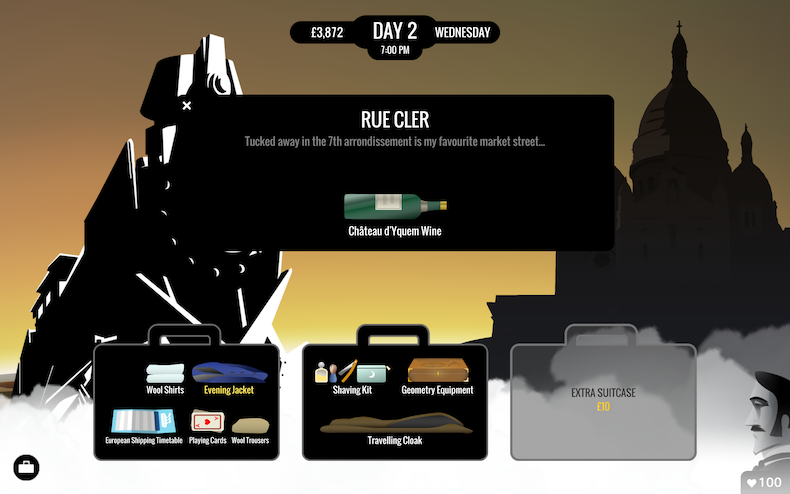
  • hint: you can sell items at the market by dragging them out of your suitcase
  • hint: be careful of how many bags you are carrying – they can cost you a fair bit extra
  • hint: save money on hotels with overnight train travel
  • this is not the real world of 1872 – rather a steampunk storyworld that has been created around the premise of Jules Verne’s Around the World in 80 Days
  • curious if I read Jules Verne’s Around the World in 80 Days if it will add additional layers to the story
  • need to look up what was happening in history in 1872 to see if this is echoed in the elaborate story of war, feuding Guilds, and the imaginative steampunk elements
  • I wish the news articles offered more details than simply the headline
  • being able to snap photographs for postcards is a fun in-game feature
  • the summary of my travels is fun, but I wish that lead to an actual forum where you could interact with other travellers, have a virtual drink in a pub, and share bits and pieces on this new world that we’d all become a part of
  • hint: keep an eye on the clock – especially when buying travel tickets, so you don’t miss departures
  • chuckled at myself, as in this context it turns out I was much better at speedy travel then I thought I’d be

b) Affective Notes

Playing and analyzing games are subjective activities — as you played, you were likely: engaged, irritated, startled, sympathetic, angry, bored, etc. Identify the affective responses you had while playing, and do your best to account for the in-game circumstances that gave rise to them (i.e. where, when, intensity, etc.) Don’t worry about being exhaustive, just mention what you think matters.

  • excitement at the opener – it felt like a movie with the perfect scoring for embarking on an adventure
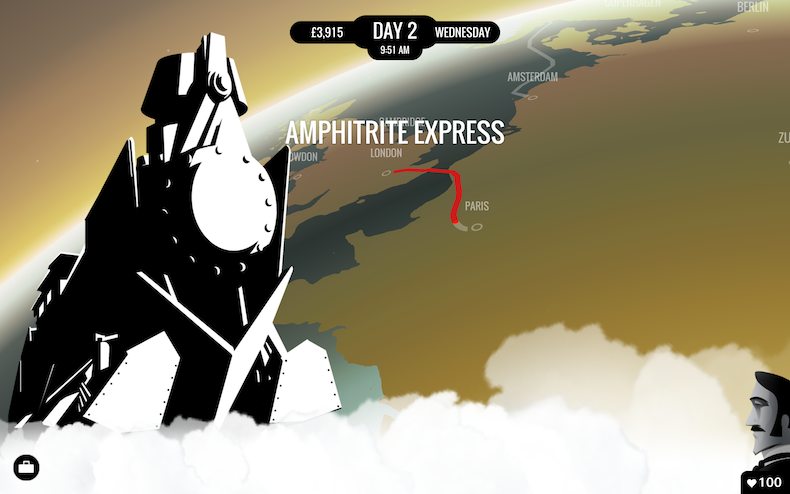
  • thrill at the notion of some of the steampunk inventions in the game – like the Amphitrite Express, a submersible train
  • engaged by my explorations in the different cities
  • irritation that the suitcases don’t fit more items
  • frustration at missing a train or having to pay extra for baggage
  • curiosity in what the conversations with locals will reveal
  • conflicted as to what to feel in my conversations with locals on the politics, as I am yet to be familiar with it and what is going on
  • frustration that the driver to Budapest would not talk further
  • embarrassment and frustration that I chose to sit with the journalist on the train, even after he’d said goodbye – felt like wasted time
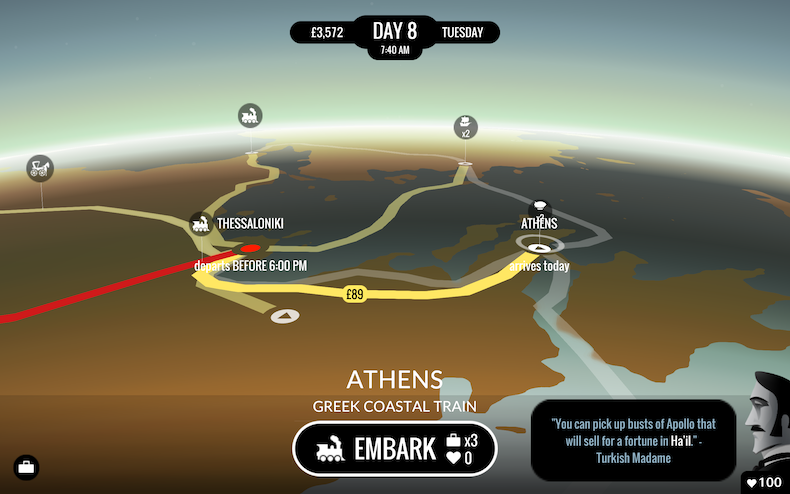
  • irritation that I stepped off the train in Thessaloniki, thinking the option was for a stretch break, only to see the train leave us on the platform
  • more irritation that I still wanted to continue on to Athens but it would now cost us a lot more to make that journey, after stepping off the train in Thessaloniki
  • excitement at earning so much money for the geometry equipment at the market in Budapest
  • curiosity at what I will find if I follow a conversation to Izmir
  • foreboding at the mechanical army in Vienna
  • fear upon boarding a ship to Karachi with a questionable crew
  • sense of accomplishment after making a sale that tripled our money

c) Analytic Notes

After playing, consider your experience more holistically — What problems did it present me with? What options did it give me (to address those problems)? When and how does the game invoke gender, class, race, violence in ways that might be problematic? Reflecting on Bogost, what do you think the video game DOES or enact? What about learning? Does anything stand out as a ‘defining’ or ‘unique’ feature of the game?

Problems Presented:

  • figuring out the fastest routes
  • making sure that we were not robbed or swindled
  • managing our finances
  • earning additional money
  • keeping us healthy
  • luggage space

Options to Address the Problems:

  • doing additional work for money
  • buying and selling goods along the way
  • repacking suitcases
  • buying extra luggage space
  • asking questions and gaining tips from characters in the game
  • stopping to rest where needed

Elements of Game Play around Gender, Class, Race, Violence in Ways that Might be Problematic:

  • there are definite examples of classism in the way you are treated in the game from how you are dressed – but at times the advantage is towards looking as though you fit in and at other times towards giving the impression of a gentleman
  • there are certainly threats of violence at points in the game, but so far we’ve managed to avoid an outright violence
  • there are certainly suggestions in places of flirtation and distrust between male and female characters

I’d say though that none of the above is problematic, rather it is realistic to what you navigate as a traveller, getting the player to think about the circumstances of others and inequities that people face. In fact, had the game been more historically inaccurate, we might have seen much more of this, but we did not, and I was pleasantly surprised to discover many female characters throughout the game in positions of leadership.

What is the Video Game Doing or Enacting?

  • while the games goal is to travel around the world in 80 days, I think ultimately the game is building empathy and understanding of different people’s perspectives and choices based on their circumstances and the pressures placed upon them
  • there is certainly also an appreciation shared within for the steampunk genre of art and imagination, a love of travel and different modes of transport, and an cherishing of literature

Elements of Learning:

  • instil a love of literature, both new and classic stories
  • world geography
  • modes of travel (even if some within 80 Days are ficitious)
  • empathy
  • spark an interest in learning about history and culture, and how those impact an individual

Defining or Unique Features of the Game:

  • the steampunk twist to an old story
  • positive and multi-layered depictions of female characters
  • encouraging empathy and interest in culture, history, and geography through playing your way through an elaborate and fantastical story, overlaps with realism

Fieldnote Summary Session 2

At the end of your fieldnotes for session two, craft one or two sentences (no more) that, for you, summarize your experiences of learning this new game, and what specific elements/skills/etc., based on your experience of solo play, to be the most important in getting a ‘handle’ on the game. Include at least one image that demonstrated this / these crucial game elements / skills / characteristics.

80 Days is a very different game from what I was expecting, but one that I am thoroughly enjoying, as I get wrapped up in the story and attempt to navigate the globe strategically without running out of money. The trick seems to be engaging other characters, to open up new routes of travel and gain tips, as well as using my time wisely upon arrival at a new destination, keeping a close eye on the time, lest you miss your desired departure.

Filed Under: #StoryToGo, Erica Hargreave, Gaming, Storytellers Tagged With: game, video game

Game Log 1 : 80 Days – First Impressions Before Playing

August 10, 2020 by Erica Hargreave 3 Comments

As a part of my studies in Digital Games, Learning, and Pedagogy (ETEC 565S), we are to analyze a game that we have not played before, creating field notes around it. As this is an interesting exercise in dissecting game design, I thought I’d share my game logs here, along with the case study that I write up from my fieldnotes.

For those of you curious, this is the Game Log Assessment from Dr. Jen Jenson, that I will be working through.

Name of Game: 80 Days

Date Analyzed:

Monday August 10th, 2020

Session 1: Before Playing

Each of these question aims to get at a general notion, “what expectations (about this game) am I coming in with?” The goal in this reflection is not to test the accuracy of your predictions; rather, the goal is to identify and reflect upon the assumptions and biases you, as an observer, are bringing into the experience, as catalyzed by the games’ promotional material, introductory screen, any other descriptive or suggestive information.

Answer the Questions

With this in mind, respond to each of the following questions:

What will I like / dislike about it?

  • I am excited for some travel and adventure, even if it is just virtual travel and adventure.
  • Given that this game is set in 1872, and based around Jules Verne’s novel Around the World in Eighty Days, I suspect if the game plans to be historically accurate that I will need to prepare myself for some systemic racism and sexism.
Meg Jayanth at the 2016 Game Developers Conference.
  • I love that this game is written by a woman, Meg Jayanth.
  • I wish the purpose of the game was not to get around the world in 80 days, as I know I am going to want to take my time to explore the various places within the game.
  • I will definitely miss not being able to enjoy the local tastes in the virtual places I visit in the game.

What will I find interesting about it / boring or tedious about it?

  • I am really hoping to learn about the culture of the different places that I virtually visit in the game.
  • At present I have high hopes that there isn’t anything that I will find tedious. Although on a real life trip, that would be the constant packing for me, waiting in airports, and flights.

What will I need to do in it?

  • Attempt to travel around the world in 80 days.

What will I need to learn within it?

  • Trip preparedness.
  • Fastest modes of travel.
  • Strategic routes of travel.
  • Possibly local customs.

What will it be like / similar to (other games I have played)?

  • It will possibly have some similarities with Where in the World is Carmen Sandiego and The 39 Cues, in that a knowledge of culture and geography will help you to advance in the game at a faster rate.

Fieldnote Summary Session 1

At the end of your fieldnotes for session one, craft one or two sentences (no more) that, for you, summarize your expectations prior to playing, and what these expectations are based on. Include one image that catalyzed and/or supported your expectations.

As I get set to embark on this adventure with 80 Days, I am filled with a sense of excitement and anticipation for discovery. The sort of excitement and anticipation that I’d normally have from real world travel, but I am pleased that a video game can offer me in a virtual adventure in our present pandemic. Like in my real world travels, I am hoping to learn about culture, be met with the unexpected, and enjoy a few thrills along the way.

An Inkle Studio game.

Filed Under: #StoryToGo, Erica Hargreave, Gaming, Storytellers Tagged With: game, video game

Exploring Game Design through a Playcentric Approach

August 8, 2020 by Erica Hargreave Leave a Comment

This summer I have been fortunate enough to study Digital Games, Learning, and Pedagogy (ETEC 565S) in a Summer Institute as a part of UBC’s Master of Educational Technology. As a part of this work, I have been reading Tracy Fullerton’s Game Design Workshop: A Playcentric Approach to Creating Innovative Games. A read that I highly recommend to anyone interested in game design.

Throughout Fullerton’s Game Design Workshop there are a number of exercises that get you reflecting on games, what appeals to you in games and what does not, and on the design and structure of various games. It’s an interesting read and one that I can see myself returning to. In working through Chapter’s 1 – 3 on The Role of the Game Designer, The Structure of Games, and Working with Formal Elements, I worked through a number of the exercises, which I’ve shared below.

Give these exercises a try yourself, and share your responses to them in comments below.

Exercise 1.2 : D.O.A .

Take one game that you’ve played that was D.O.A. By D.O.A., I mean “dead on arrival” (i.e., a game that’s no fun to play). Write down what you don’t like about it. What did the designers miss? How could the game be improved?

Recently I have been experimenting with an interactive animated storytelling platform, Elementari, which I have been utilizing to teach storytelling with a little bit of coding in an online kids camp that I created for BCIT. With the addition of variables to Elementari, kids and teachers have begun to build games there. I thought I’d show my camp kids what was possible in an existing game on the platform, but being a bit limited in time I picked a game to show the kids that the platform had sent as an example of games being designed there, thinking it looked fun at first, but without having had the time to go through it myself. This was a DOA gaming moment for both the kids and myself.

The Game

What the Kids and I Didn’t Like About It

  • it has an instruction heavy start with just a talking head
  • there is a chunk of time with empty space, which leaves you questioning if the game is broken or incomplete
  • the talking head’s lips move, but no sound comes out of the mouth
  • the repetitive music becomes annoying after the first page or two
  • the writing is riddled with mistakes
  • some of the background and text colour choices make the text difficult to read
  • some of the buttons in the game do not work until a period of time had passed, frustrating the player

What the Designer Missed

This could actually be a fun little Spy School Game, provided things are kept moving, and the game play is not stalled by copious instructions and lag time issues.

How the Game Could Be Improved

  • keep the initial welcome / mission brief and give the player the option to visit the ‘game play’ page for more involved instructions
  • fix lag time issues in the coding
  • limit ‘Spy Academy’ music to specific pages or mix it up with other music
  • edit the writing
  • add in read aloud voice over to the captioned text
  • make sure that text is easily readable on the background you choose

Exercise 1.5 : Your Childhood

List ten games you played as a child, for example, hide and seek, four square, and tag. Briefly describe what was compelling about each of those games.

The Predator / Prey Game

I loved the freedom of being in the woods during this game, and having the free range to run, hide, and spend time on my own in nature. I also liked the strategy that went into this game of survival.

Crocodile Crossing

This was always a bit of hilarity filled, absurd, team building strategy and camaraderie, that allowed for ingenuity and creativity.

Frogger

It was just fun to try to get across the road without getting splattered.

Team Sports (like Ice Hockey, Soccer … etc)

I liked the physical aspects of these games, and the strategy and camaraderie that comes with working together as a team. I was also a bit of a bruiser, so liked being able to slide tackle and check an opponent within the rules of fair game play.

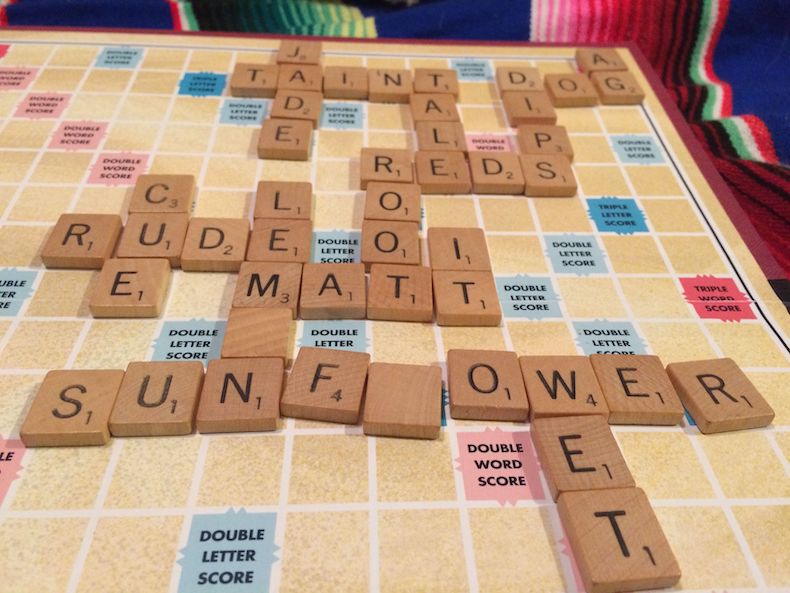
Scrabble

While I enjoy playing with and constructing words, the part of Scrabble that I get the most fun out of is playing strategically to hit double and triple word and letter scores, to block my opponents from those, and create multiple words in a single turn.

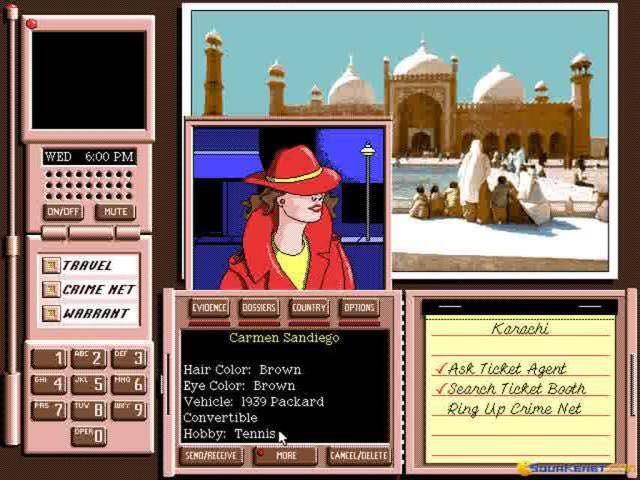
Where in the World is Carmen Sandiego?

I loved the spy and international mystery solving aspect to this game, that virtually took me traveling the globe to discover different parts of the world.

Clue

I’ve always loved a good whodunit, so it is only natural that a game that allowed me to either be the detective or the murderer would appeal. Tied to that the opportunity to either mislead or outwit my family and friends, what more could a gal want?

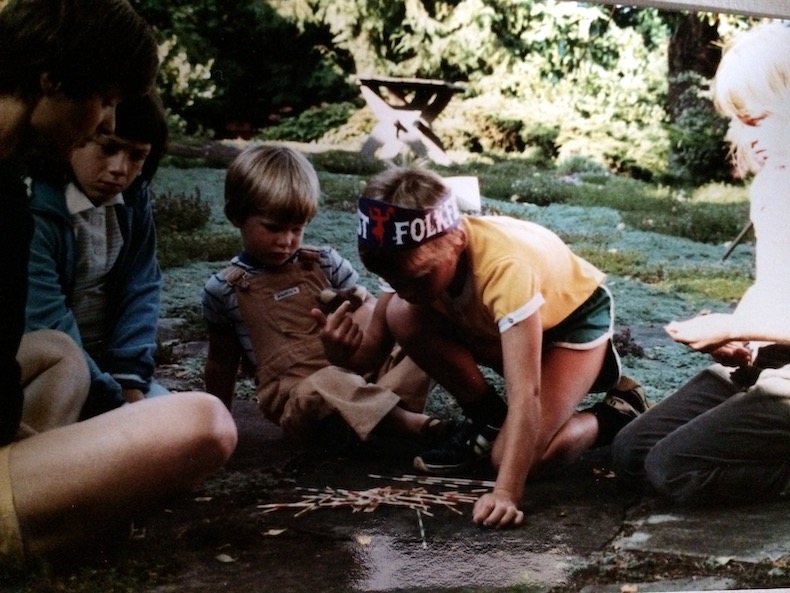
Pick Up Sticks

Love the careful precision of teasing out sticks and trying to set my opponents up for a difficult turn.

Murder in the Dark

I use to love this game at parties. There was the thrill of being in the dark, and the thrill of either dodging and guessing the killer, or subtly ‘killing’ those around you without being caught.

Balderdash

So many fun elements to this game. Concocting nonsensical words with ridiculous definitions, trying to mislead the other players, and guessing at where your competitors are trying to mislead you.

Exercise 2.1 : Think of a Game

  1. Think of a game, any game. Now write down a description of the game. Be detailed. Describe it as if to someone who has never played a game like it before.
  2. Now think of another game—a completely different type of game. The more different this game is from the first one, the better. Describe it.
  3. Compare your descriptions. Which elements were different and which were similar? Dig deep and really think about the underlying mechanics of each game.

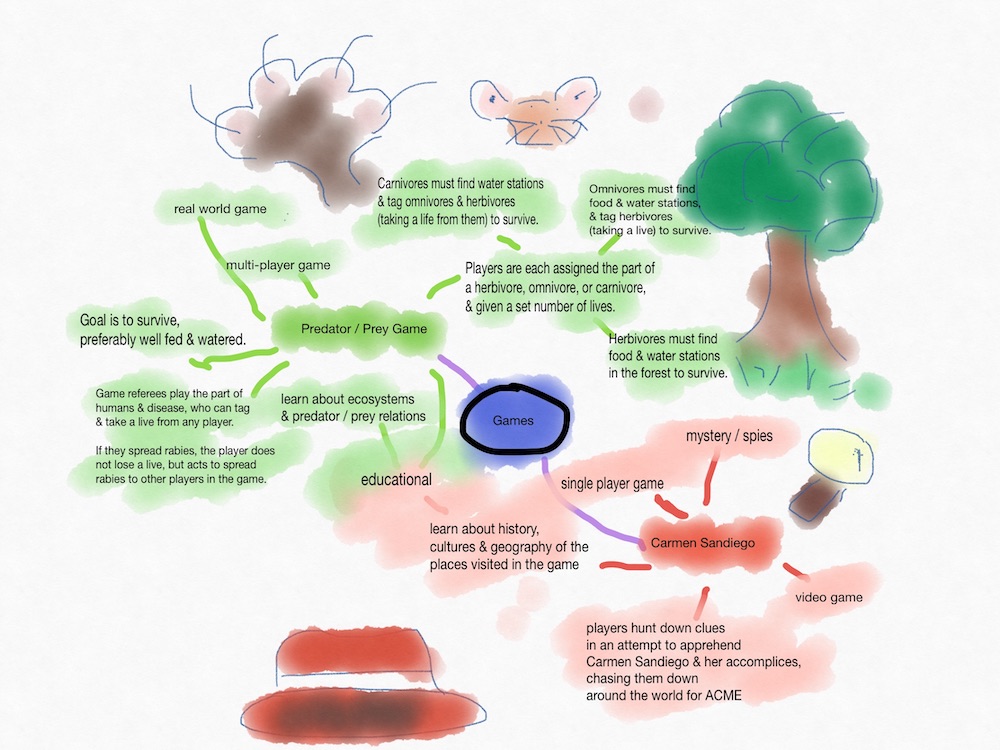
I decided to choose two of my favourite childhood games to dissect in the form of a mind map below.

While clearly I am not an artist, I had fun experimenting with the Concepts iPad, while recollecting the structure and game play of these two games.

Differences Between the Predator / Prey Game and Where in the World is Carmen Sandiego?

There are many differences between the Predator / Prey Game and Where in the World is Carmen Sandiego. The Predator / Prey Game is a real world, multi player game, in which the outcome is unpredictable and dependent on the strategy, cunning, and interactions between the players. There are many paths to success in this game, and many moving parts that could both act as obstacles and allies in reaching success in the game. In contrast, Where in the World is Carmen Sandiego is a single player video game that involves one path to success in correctly solving the pre-designed puzzles.

Similarities Between the Predator / Prey Game and Where in the World is Carmen Sandiego?

The key similarity between both these games are that they are educational. I had fun learning, while I played them. They both also utilized the imagination, role play, and strategic thinking (although more so on the part of the Predator / Prey Game).

Exercise 2.8 : Story

Have any stories within a game ever gripped you, moved you emotionally, or sparked your imagination? If so, why? If not, why not?

Absolutely. Stories are a huge draw for me, and are often the games that I have to guard my time with, so that I don’t lose hours of my day to them. I have vivid memories of this with the first Quest Game (the name escapes me) that I played with my brother and next door neighbour. We’d play so long that we’d all emerge from the basement with headaches and a sort of gaming hangover.

Where in the World is Carmen Sandiego was also one such game for me, that for the past decade has inspired an ARG that’s been running through my head for an international mystery game with a transmedia storytelling character I created – Emme Rogers. Below is the most recent rendition of that ARG that I wrote up for an Immersive and Interactive Storytelling Fellowship that I was shortlisted for in Norway:

Where-in-the-World-ARG

Exercise 3.4 : Objectives

List ten of your favourite games and name the objective for each. Do you see any similarities in these games? Try to define the type or types of games that appeal to you.

Some of my favourite games over the years have included:

  • Ultimate Frisbee – Objective: To score the most points by getting the frisbee past the opponent’s end zone.
  • Scrabble – Objective: To score the most points by using your tiles to spell connecting words on the Scrabble board.
  • The Predator / Prey Game – Objective: To survive by finding food and water, and avoiding disease and predation.
  • Where in the World is Carmen Sandiego – Objective: To apprehend Carmen Sandiego and her allies by solving the clues.
  • Field Hockey / Soccer / Ice Hockey – Objective: To score the most points, by getting the ball or puck in the opponent’s net.
  • Cat Physics – Objective: To pass a ball as quickly as possible from one cat to another, past a number of obstacles.
  • Othello – Objective: To have the most tiles of your colour on the board by the time each player has used up their last tile.
  • Crocodile Crossing – Objective: To get your team across crocodile invested waters the fastest, with limited resources, and without anyone touching the water.
Team Building with Crocodile Crossing
  • High Jumping – Objective: To be the person to clear the highest bar without touching it.
  • Beach Volleyball – Objective: To serve the ball over the net into the opponent’s court, and when the ball is hit into your court to keep the ball from hitting the ground and knock it back into their court within three hits.
  • Balderdash – Objective: To concoct believable words and definitions to mislead your opponents, and to guess which word is real.

In reflecting on the games I enjoy, they include games that involve:

  • outdoor exercise
  • physically challenging activities
  • strategy
  • team work
  • imaginative play
  • problem solving
  • elements of learning
  • time spent outside
Quidditch Training at our Hogwart’s Travelling School of Magic

I also do enjoy games that involve storytelling. However, I tend to avoid those due to their addictive nature for me.


Gaming Reflections of a Couple of Young Friends

I was curious about what the responses to these exercises would be for a few of the young people in my life, so I did a wee video interview with them.


Now, it’s your turn!

I’d love to hear about what sort of games appeal to you in the comments below, and if you were to design your own game, what sort of game that might be?

Filed Under: #StoryToGo, Erica Hargreave, Gaming, Storytellers Tagged With: game design

« Previous Page

Primary Sidebar

#StoryToGo is a community designed to reflect storytelling today – shared both through traditional means of oral storytelling, radio, film and TV, and print; in addition to newer forms of media storytelling through the digital arts, including gaming, blogging, online video, and social media.

Explore Past Posts


Tags

accessibility AI for filmmaking AI for videography AR art art therapy art therapy activities augmented reality BCIT clown crowdfunding crowdsourced Elementari elevator pitch Extended Reality FilmFreeway filmmaking game game based learning game design game development health and wellness home education improv inclusive design literacy NFT non-fungible tokens online learning open education phishing scam photography pitching poetry social media storytelling storyworlds sustainable funding universal design video game virtual conference virtual reality Web Monetization XR XR Development

On the Beat with StoryToGo

Follow along on StoryToGo’s digital magazine for our latest case studies, upcoming free courses and webinars, technology tips and tricks, story musings,  and our latest job boards!

  • Case Studies
  • Tech Tips
  • Events
  • Jobs
  • Our Community
  • Courses

Copyright 2012 © 2026 · Ahimsa Media · Log in